


The volume of fuel flowing through the Strait of Hormuz is on the rise, according to a new report, as President Donald Trump’s war against Iran continues into its eighth month.
According to a Bloomberg News report, “The volume of refined products being loaded within the Persian Gulf is rising, with most of that exiting the Strait of Hormuz.”
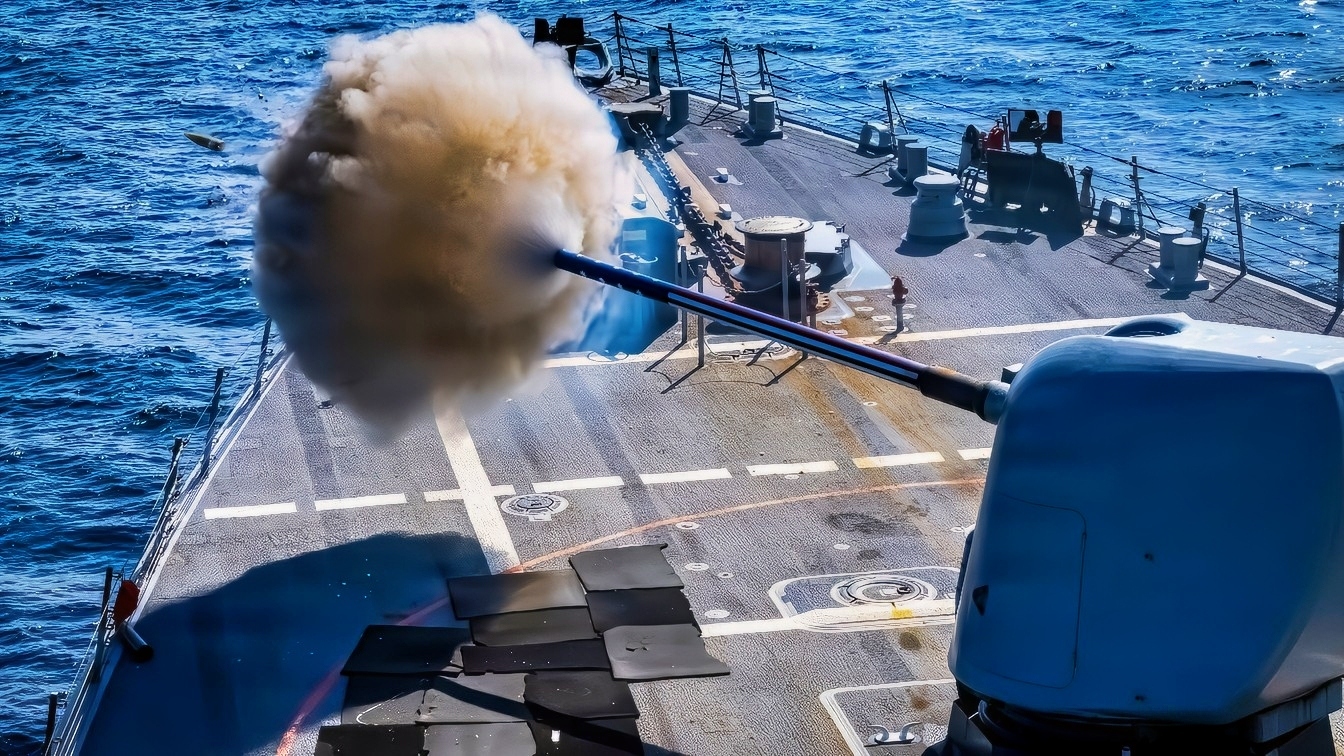
PACIFIC OCEAN (April 27, 2026) U.S. Navy Arleigh Burke-Class guided-missile destroyer USS John Paul Jones (DDG) 53, fires its Mk.45 5-inch deck cannon during a live fire exercise, April 27, 2026. John Paul Jones, part of the Theodore Roosevelt Carrier Strike Group, is underway in the U.S. 3rd Fleet area of operation conducting advanced training to bolster strike group readiness and capability. (U.S. Navy photo by Mass Communications Specialist 2nd Class Ryan Holloway)
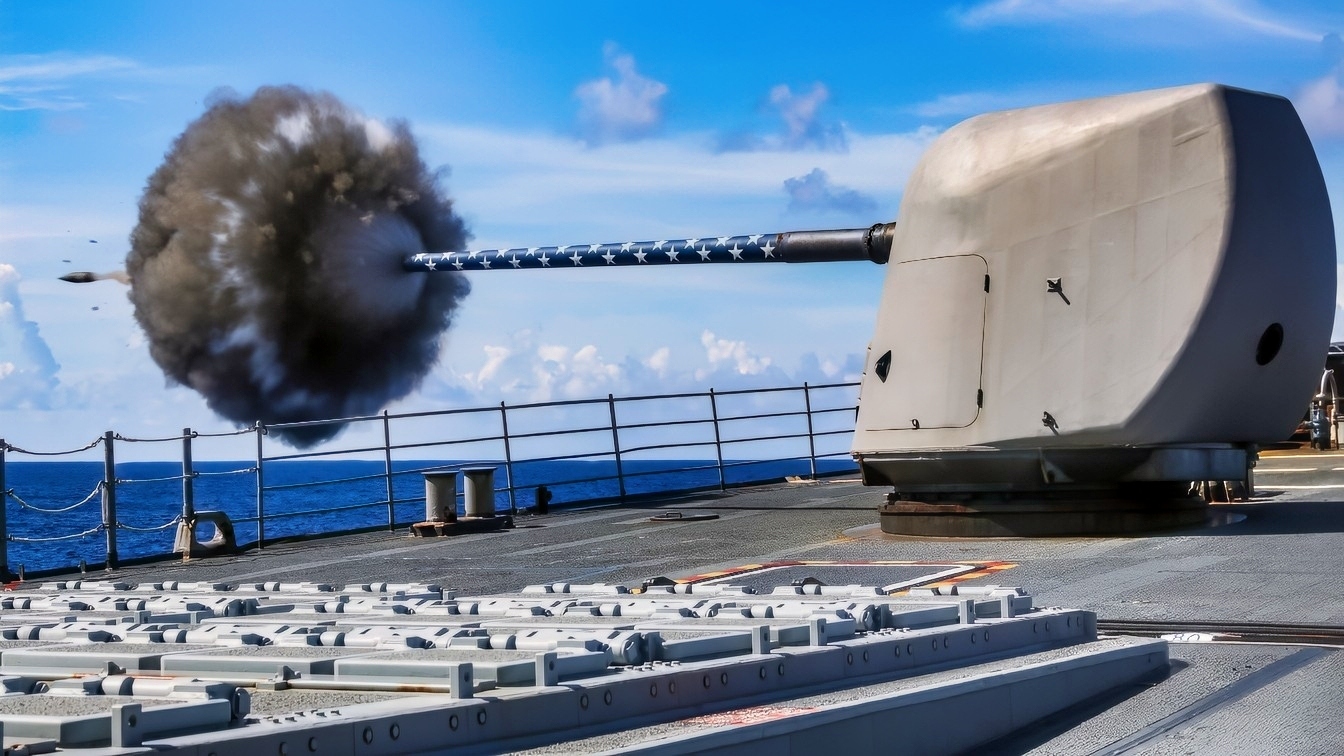
PACIFIC OCEAN (July 29, 2025) The Ticonderoga-class guided-missile cruiser USS Princeton (CG 59) fires its forward Mark 45 5-inch gun during a weapons maintenance shoot, July 29, 2025. The Carl Vinson Carrier Strike Group is underway conducting routine operations in the U.S. 3rd Fleet area of operations. (U.S. Navy photo by Mass Communication Specialist 1st Class Jacob I. Allison)
“The region loaded about 3 million barrels a day of distillates including diesel, petrochemical feedstock naphtha and liquefied petroleum gas in October,” Bloomberg News reported, citing data from the ship-tracking organization Vortexa, adding that while the number was still only half of the levels recorded before the Iran conflict, it was significantly higher than months prior.
Tehran Has Vowed to Reopen the Strait Within 48 Hours Should Trump Agree to Peace Deal
While the Strait of Hormuz has been technically closed to most commercial vessels since the beginning of Trump’s war against Iran, Tehran has vowed to reopen the strait within two days should the president agree to its demands, including lifting the U.S. naval blockade of Iranian ports and releasing frozen Iranian assets.
As of reporting, Qatar is attempting to broker a peace deal between the U.S. and Iran which would see the strait reopened and United Nations (UN) inspections of Iranian nuclear material in exchange for Iran’s aforementioned demands.
While Trump spoke with Qatar Emir Tamim bin Hamad Al Thani about the peace agreement on Friday, the president is unlikely to agree to such a deal given that the U.S. has repeatedly rejected Iran’s demands.
Hundreds of Vessels Have Been Attacked in the Strait, With At Least 24 Seafarers Dead
Around 400 vessels carrying roughly 5,000 seafarers are still stuck in the Strait of Hormuz.
In comparison, more than 120 vessels have been attacked since the beginning of the war, resulting in the deaths of at least 24 seafarers, according to the International Maritime Organization (IMO).
IMO Secretary-General Arsenio Dominguez warned this month during an interview with Bloomberg News that the Strait of Hormuz was still unsafe to transit due to the drone attacks, missile strikes, and potential mines in the water.
While the Trump administration has repeatedly poured cold water on the prospect of an Iran peace deal, with U.S. Secretary of State Marco Rubio stating this month that Iran’s demands were not “acceptable,” Trump insisted this week that the conflict was “effectively over” and that he had no plans to carry out any more major strikes on Iranian territory.
“At this point, taking the military action doesn’t seem to be a very necessary thing — but we’re locked and loaded, ready to go for any reason,” he told reporters. “We’re seeing momentum toward the end of this conflict. I think it’s going to be ending fairly soon.”
A Majority of Americans Want Democratic-Controlled Congress to Put an End to Trump’s War
According to a new Reuters-Ipsos poll, a whopping 71% of Americans want the incoming Democratic-controlled Congress to put an end to Trump’s war against Iran.
That figure included 93% of Democrats and 51% of Republicans
A Pew Research Center poll, meanwhile, found that just 14% of Americans strongly approved of Trump’s handling of the conflict.
Following the Republican Party’s catastrophic defeat in this month’s midterm elections, which resulted in the Democratic Party gaining control of both the House and Senate, Vice President JD Vance acknowledged in a social media post that “the reason we lost is the war” and its economic consequences, including the rise in fuel prices spurred by the closure of the Strait of Hormuz.
Trump also acknowledged that the war had played a major role in the Republican Party’s defeat. However, he told reporters that he would do it all over again to prevent Iran from obtaining a nuclear weapon.
Iran’s government declared victory following the results of the election, boasting that Trump had been handed “a POLITICAL DEFEAT in Washington” as a result of his unpopular war.
Even if Peace With Iran is Brokered, Global Fuel Shortages Will Continue
Even if the Trump administration agrees with Iran to reopen the Strait of Hormuz, global fuel shortages will continue as Russia’s war with Ukraine shows no signs of stopping any time soon.
Despite Trump’s pleas to Ukrainian President Volodymyr Zelensky, Ukraine has repeatedly attacked Russian oil facilities in recent months, worsening the global fuel shortage and placing more pressure on Trump to conclude his war in the Gulf.
About the Author: Charlie Nash
Charlie Nash is a journalist and author whose work has appeared in The Spectator, Mediaite, New Statesman, and the American Conservative, among other major publications. His reporting has been featured by The Washington Post, Fox News, the Daily Beast, MS NOW, NewsNation, Hannity, and more. You can follow Charlie on X at @CharlieNash and on LinkedIn.


