

On Tuesday, Russian and Ukrainian delegates met in Abu Dhabi for negotiations. These talks were the first U.S.-mediated discussions in roughly nine months. According to American negotiators Steve Witkoff and Jared Kushner, the talks were productive, and the two will meet with the heads of state of both nations to capitalize on the progress made in Abu Dhabi.
Meanwhile, India has submitted its own proposal aimed at de-escalating the war in Ukraine.

Tim Murry, a foreign threats compound contractor, drives a T-72 battle tank into position to serve as adversary targets for a joint service exercise, Emerald Flag, at Eglin Air Force Base, Fla., Nov. 30. Emerald Flag is a multi-service exercise aimed to unify information sharing across joint domain platforms. (U.S. Air Force photo/1st Lt Karissa Rodriguez)
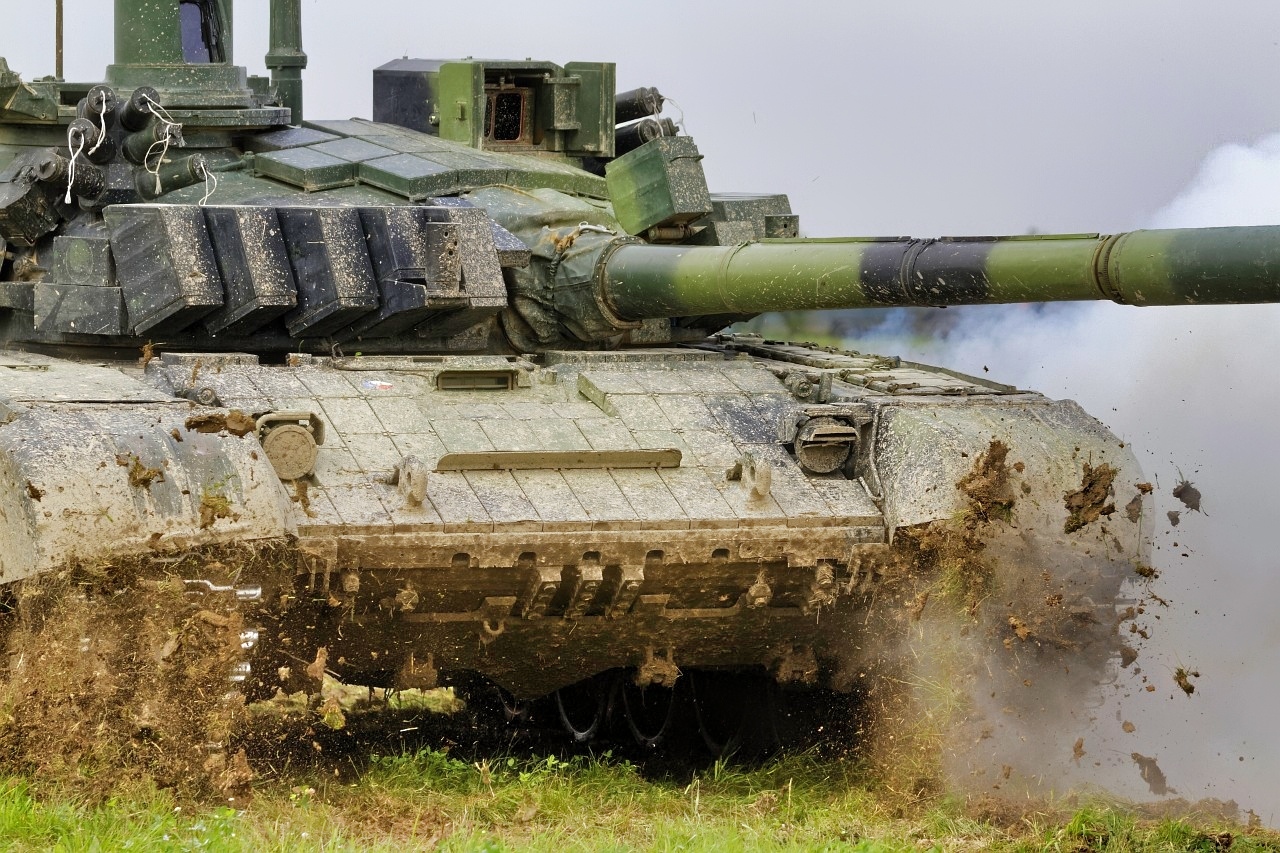
T-72 Tank. Image Credit: Creative Commons.
New Delhi is proposing a three-point plan to secure food exports and halt strikes against energy infrastructure.
Although the proposal does not provide a framework to end the war, it does address growing agricultural and energy concerns.
India’s De-escalation Proposal
According to news reports, India’s proposal calls for an immediate ceasefire on attacks against energy facilities and critical infrastructure, measures to keep grain and energy shipments moving through Black Sea ports, and an end to attacks on merchant vessels and civilian crews along maritime trade routes.
Ahead of the talks in Abu Dhabi, Indian Prime Minister Narendra Modi told President Zelenskyy that India was ready to “mediate in establishing food corridors” in Ukraine.
At the same time, External Affairs Minister S. Jaishankar spoke with his Russian counterpart, Sergei Lavrov. “India remains in touch with both sides, as well as other interested parties, to contribute towards the return of peace to the region,” a spokesperson from the External Affairs Ministry said.
India has remained neutral in the war in Ukraine but maintains close diplomatic and military ties with Russia.
Modi and Vladimir Putin evidently share a close relationship, as the Indian Prime Minister is one of the few heads of state whom Putin legitimately respects.
New Delhi also maintains ties with Kyiv, especially in agriculture.
Both Ukraine and Russia are major grain exporters. Roughly 77-80% of Russia’s total grain exports flow through the Azov-Black Sea region.
In 2026, however, both sides attacked each other’s ships in the Black Sea, with Russia implementing a full-scale blockade against any ship attempting to reach Ukraine’s Black Sea ports.
These developments are particularly concerning because Black Sea grain exports from both sides have effectively ground to a halt.
Many nations in Africa and Asia are reliant on grain from the Black Sea region.
According to some estimates, about 400 million people could face food shortages as a result of the war.
Moscow Isn’t Interested in a Ceasefire
This year, several proposals have been put forward to implement a ceasefire covering energy and critical infrastructure. So far, Moscow has rejected almost all of them.
Despite Ukraine’s constant attacks on Russian oil refineries, the Russians refuse to consider any energy ceasefires or, for that matter, any ceasefires at all.
Earlier this year, Putin dismissed the idea of a long-range ceasefire, saying that such an agreement would only benefit Kyiv.
Likewise, Russia maintains that a ceasefire along the current line of contact would only allow Ukraine to recover its strength.
As a result, the Kremlin argues that any ceasefire or peace talks must address the underlying causes of the war.
While the U.S., India, and other third parties try to mediate a peace deal between Russia and Ukraine, Russia continues to batter Ukraine’s vulnerable energy grid.
Over the past several weeks, Moscow has launched large-scale attacks on a near-daily basis using hundreds of attack drones.
Its ballistic and cruise missile attacks have also continued, striking at a time when Ukraine’s air defenses are stretched thin.
Russian missiles and drones have hit critical energy infrastructure, ranging from power plants to electrical substations and transformers.
Multiple regions in Ukraine have been forced to implement mandatory blackouts throughout the day to keep the energy grid stable.
As winter approaches, many Ukrainians will likely be forced to endure the cold season without heat or electricity.
Negotiations in Abu Dhabi
Both Washington and New Delhi kept a close eye on the talks in Abu Dhabi, hoping for positive developments.
Jared Kushner, who attended the talks on behalf of the U.S., said he believed there were “some good ideas on how to bridge” the differences between the two sides.
According to him, recent talks between Moscow and Kyiv have helped identify and narrow some of the gaps between them, and President Trump was committed to achieving a peaceful end to the war.
Ukraine’s chief delegate, Rustem Umerov, opened the talks by saying that Ukraine was focused on achieving security guarantees and a lasting peace.
Russia’s chief delegate, Vladimir Medinsky, reiterated that Moscow is seeking a peace settlement that serves both sides’ interests.
The final round of talks ended today. “The conversations were very thorough,” Kushner said. “We covered all the relevant issues and were able to have a good exchange of ideas; [in] some areas we see places where we can find compromises, [while in] others, we need to have more discussions.
This was a good first step.” According to Russian and Ukrainian news outlets, both sides have agreed to a large-scale prisoner swap; the exact numbers will reportedly be worked out on Thursday.
The exact outcome of the talks remains to be seen.
Kushner and Witkoff will reportedly meet with Presidents Zelenskyy and Putin to discuss the outcome and lay the groundwork for future talks.
About the Author: Isaac Seitz
Isaac Seitz, a Defense Columnist, graduated from Patrick Henry College’s Strategic Intelligence and National Security program. He has also studied Russian at Middlebury Language Schools and has worked as an intelligence Analyst in the private sector.


