


Ukraine pulled off 41,000 verified strikes on Russian troops in October, the highest total in a single month since the launch of Ukraine’s e-Points program, the Ministry of Defense said, as cited by United24 Media. The previous record was 35,000, in March of this year.
Nearly 24,000 Russian troops were killed in October, the report said.

Switchblade Drone. Image Credit: Industry Handout.
The Ministry of Defense recorded all of the kills on its DELTA battlefield management system and verified them with the Brave1 defense innovation cluster.
Ukrainian forces, in 2026, have struck 320,000 Russian troops.
Another Record
United24 Media also reported that Ukraine’s defense ministry broke a record in October for the most rescues carried out using unmanned ground vehicles, with 598, more than 100 more than the previous month.
Earlier this week, NATO Secretary General Mark Rutte said Russia may have seen 50,000 troops either killed or seriously wounded in the Ukraine conflict in the month of October, which he noted was nearly as many casualties as the United States suffered in the entirety of the Vietnam War.
That figure differs from the Ministry of Defense one, mostly because it counts different things.
Rutte’s comments came at the Atlantic Future Forum held this week aboard the British aircraft carrier HMS Prince of Wales.

Bohdan, a drone pilot from the Unmanned Systems Battalion of Ukraine’s 110th Separate Mechanized Brigade, pilots an FPV drone in Donetsk Oblast during active battle operations. Photo: David Kirichenko
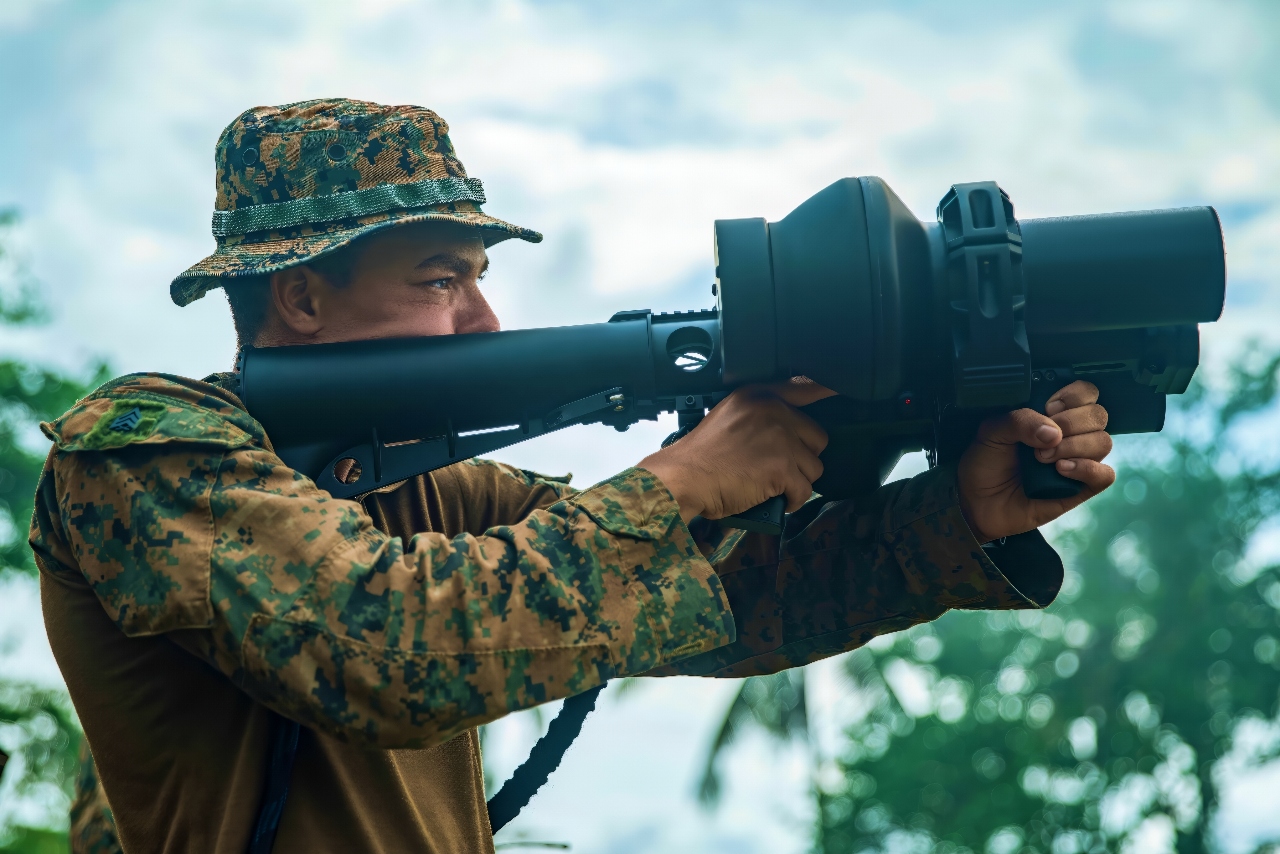
U.S. Marine Corps Sgt. Colin Clark, a mortarman assigned to Bravo Company, Battalion Landing Team 1/5, 15th Marine Expeditionary Unit, and a native of Texas, engages a target with a NightFighter S counter-unmanned aerial vehicle system during a demonstration for Philippine Marines assigned to Intelligence Company, 3rd Marine Brigade, as part of exercise KAMANDAG 8 at Tarumpitao Point, Palawan Province, Philippines, Oct. 17, 2024. KAMANDAG is an annual Philippine Marine Corps and U.S. Marine Corps-led exercise aimed at enhancing the Armed Forces of the Philippines’ defense and humanitarian capabilities by providing valuable training in combined operations with foreign militaries in the advancement of a Free and Open Indo-Pacific. This year marks the eighth iteration of this exercise and includes participants from the French Armed Forces, Royal Thai Marine Corps, and Indonesian Marine Corps; including continued participation from the Australian Defense Force, British Armed Forces, Japan Ground Self-Defense Force, and Republic of Korea Marine Corps. (U.S. Marine Corps photo by Sgt. Amelia Kang)
Per United 24 Media, the Secretary General claimed that Russian President Vladimir Putin was “failing on the battlefield and attempting to break Ukraine’s resistance by targeting civilians.” He also accused Russia of engaging in continued “hybrid warfare” attacks on different European countries in recent months.
The Kyiv Independent reported on Thursday that Russian losses on the battlefield have been surging, which the report attributed to “inflexible orders given to lower-level commanders as Moscow seeks to project an image of battlefield success and territorial gains while negotiations continue.”
“Large losses of manpower and equipment usually indicate that the enemy is willing to sacrifice resources to achieve immediate political or strategic goals,” the 1st Azov Corps said in a statement to the Independent.
Foreign Deaths
Also this week, in terms of Russian casualty counts, Bloomberg News reported that Russia has recorded the deaths of 11,000 foreigners from nearly 100 countries in the war in Ukraine.
Bloomberg cited “confidential data” from Russia’s official statistics agency, Rosstat, which was in turn obtained by a pair of hacker groups, the Belarusian pro-opposition group Cyber Partisans and the Ukrainian group Silent Crow, and presented to Bloomberg and other news outlets.
The groups had announced they had breached the Rosstat systems on November 1.
The hackers got the data from what Bloomberg described as “a cache of more than 11 million death certificates, along with accompanying details such as place of birth, citizenship, and where people died.”
Bloomberg noted that the data was incomplete, mostly because it takes a long time to record combat deaths.
But many of those brought to Russia came from former Soviet nations, including nearly 4,000 from Ukraine, mostly from the occupied or disputed parts of that country.
Foreign Recruiting
While Russia has issued denials, they have been accused of recruiting soldiers abroad, sometimes by deceptive means, which has raised alarms among some foreign governments.
Peru’s foreign minister, Carlos Espá, visited Moscow last week to look into reports that more than 400 Peruvians had been recruited to Russia to fight in the war.
Of the 430 Peruvians, per Bloomberg, 25 have died, and more than 180 are missing. Espá asked the Russian foreign minister for help in repatriating the dead.
In terms of the countries that have produced soldiers, per Bloomberg, they include “a high concentration of deaths from Nepal in 2023 and 2024, Sri Lanka and China in 2024 and 2025, and then Colombia, Kenya and Nigeria from late 2025.”
What About North Korea?
It’s well known that North Korea has sent military units to Russia to fight in the war.
However, no North Korean deaths appear in the data leaked by the hackers. Per Bloomberg, that’s because Russia didn’t issue death certificates for North Koreans, likely because “they were part of foreign units rather than individuals who joined the Russian forces.”
About the Author: Stephen Silver
Stephen Silver is an award-winning journalist, essayist, and film critic, and contributor to the Philadelphia Inquirer, the Jewish Telegraphic Agency, Broad Street Review, and Splice Today. The co-founder of the Philadelphia Film Critics Circle, Stephen lives in suburban Philadelphia with his wife and two sons. For over a decade, Stephen has authored thousands of articles that focus on politics, national security, technology, and the economy. Follow him on X (formerly Twitter) at @StephenSilver, and subscribe to his Substack newsletter.


