


While President Trump weighs his options in Iran, a recent intelligence report indicates that Iran has roughly 1,500 to 2,500 ballistic missiles in its inventory.
The report flies in the face of previous claims Trump has made regarding Iran’s supposedly depleted stockpiles.

President Donald Trump hosts a bilateral meeting with Prince Salman bin Hamad Al Khalifa, Prime Minister of Bahrain, Wednesday, July 16, 2025, in the Oval Office. (Official White House Photo by Daniel Torok)
While the exact number of missiles in Tehran’s arsenal is unknown, the U.S. intelligence community suspects that the Islamic regime still possesses enough missiles to cause significant damage to U.S. and allied installations in the region.
Although Iran’s defense industry took a heavy beating during Operation Epic Fury, the regime’s massive underground facilities responsible for producing its ballistic missiles remained largely intact.
Iran’s Missile Program
According to The Wall Street Journal, the U.S. intelligence community assesses with low confidence that Iran still possesses around 1,500 to 2,500 ballistic missiles in its inventory.
The low-confidence estimate, officials said, stems from the difficulty of tracking the exact number of operational missiles.
Even so, officials are worried that Tehran still possesses a significant number of missiles.
For the past several months, the war in the Middle East has been more or less on pause.

U.S. Air Force Staff Sgt. Jason Lewey from the 8th Aircraft Maintenance Squadron marshals an F-16 Fighting Falcon from the 35th Fighter Squadron at Kunsan Air Base, South Korea, after returning from a training mission during RED FLAG-Alaska 09-2 at Eielson Air Force Base, Alaska, on April 20, 2009. RED FLAG-Alaska provides training for deployed maintenance and support personnel in sustainment of a large-force deployed air operation. (DoD photo by Senior Airman Jonathan Snyder, U.S. Air Force. (Released))
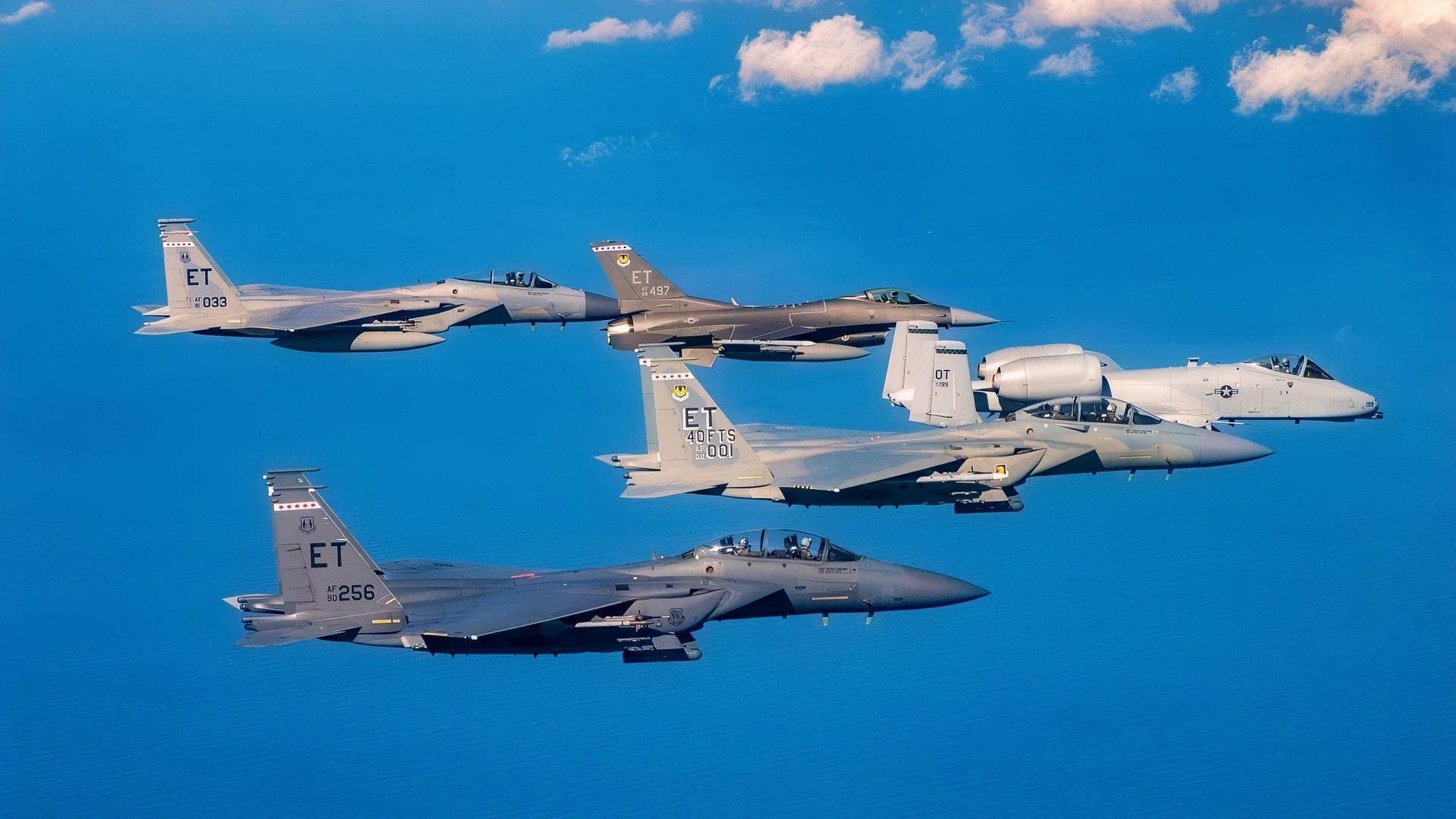
A formation of 4th generation fighter jets from the 40th Flight Test Squadron flies near Eglin Air Force Base, Fla, Jan. 31, 2022. The 40th FLTS executes developmental flight tests for fourth generation fighter aircraft to include the A-10, F-15 and F-16. (U.S. Air Force photo by Tech. Sgt. John Raven)
This quiet phase has allowed the regime to rebuild its stockpiles, which were largely depleted in the war’s early months.
According to some estimates, Iran launched roughly 2,200 ballistic missiles and around 4,900 Shahed drones.
Previously, Bloomberg, citing anonymous intelligence officials, estimated that Iran is currently producing around 50 ballistic missiles per month.
Shortly after the report was released, Iran unveiled its newest underground “missile city,” which it uses to assemble its ballistic missiles and other munitions.
Although officials are confident that most of Iran’s conventional military has been destroyed, its missile facilities remain largely operational, allowing Iran to continue production even after months of war.
These reports seem to contradict claims from President Trump, who said Iran’s missile inventory was at about 10% of its prewar levels. “The only thing they can do is about 10% level — make some missiles and make some drones. Drones at about 15% because much of their factories are gone,” the President said in an interview with CNN. However, according to some estimates, even the lowball figure of 1,500 missiles makes up more than half of Iran’s prewar inventory.
Weighing Trump’s Options
The report on Iran’s missile inventory comes as the U.S. weighs launching more military strikes against Tehran.
For the past several months, the U.S. has refrained from launching any major strikes against the Islamic Republic.
Although it launched a few limited strikes against targets on Qeshm Island, the U.S. has yet to launch any attacks on the scale of Operation Epic Fury earlier this year.
Trump has instead opted to wage an economic war against Tehran by imposing a naval blockade and strangling its oil exports.
Trump has reassured the public that further military action is unnecessary at this point, since Iran’s military has been largely destroyed.
However, he has suggested that the U.S. has not yet entirely defeated the regime in Tehran. “We won,” he said during a Veterans Day address. “Now the question is when we want to end. We must have a total victory, not a 93% victory. It’s going to be total.”
For many of Washington’s Gulf region allies, restarting the war is a frightening prospect.
During the war’s hot phase, oil infrastructure across the Middle East was struck by Iranian ballistic missiles.
If the war restarts, more oil infrastructure could be targeted, including facilities vital for bypassing the Strait of Hormuz, such as Saudi Arabia’s East-West Pipeline.
Tehran has previously threatened to hit the Gulf states again should the war restart. At the same time, Israel has been trying to convince Trump to restart the war.
Following Israel’s own elections in late October, Prime Minister Benjamin Netanyahu is pushing the U.S. to renew its strikes against Iran.
Earlier reports indicated that Israel had tried to persuade Trump to renew military strikes before its October elections.
For now, the U.S. remains confident that new military strikes will not be necessary.
One White House official stated that Operation Epic Fury had rendered Iran militarily helpless and that the economic strangulation had weakened the regime.
Secretary of War Pete Hegseth likewise claimed that Iran’s defense industrial base was essentially gone. “By every measure, we achieved a historic military victory,” he said at a press conference.
However, despite Washington’s optimism, Iran’s missile production continues.
Throughout the war, Iran has been able to improve the effectiveness of its attacks, likely thanks to intelligence and targeting data from Russia.
Ballistic missile attacks on American bases have forced the U.S. to abandon some of its bases and relocate some of its critical assets to Israel, where they are safer. Furthermore, Iran’s missile cities are likely intact and fully operational.
Despite multiple attacks on these facilities, the U.S. and Israel have been able to do little more than damage the entrances to these massive underground facilities.
Protected by thick layers of granite and high-performance concrete, these missile cities are immune to most bunker-buster munitions and are extremely difficult to destroy through conventional means.
As a result, Iran has been able to continue producing missiles and drones despite the high-intensity attacks earlier this year.
About the Author: Isaac Seitz
Isaac Seitz, a Defense Columnist, graduated from Patrick Henry College’s Strategic Intelligence and National Security program. He has also studied Russian at Middlebury Language Schools and has worked as an intelligence Analyst in the private sector.


