

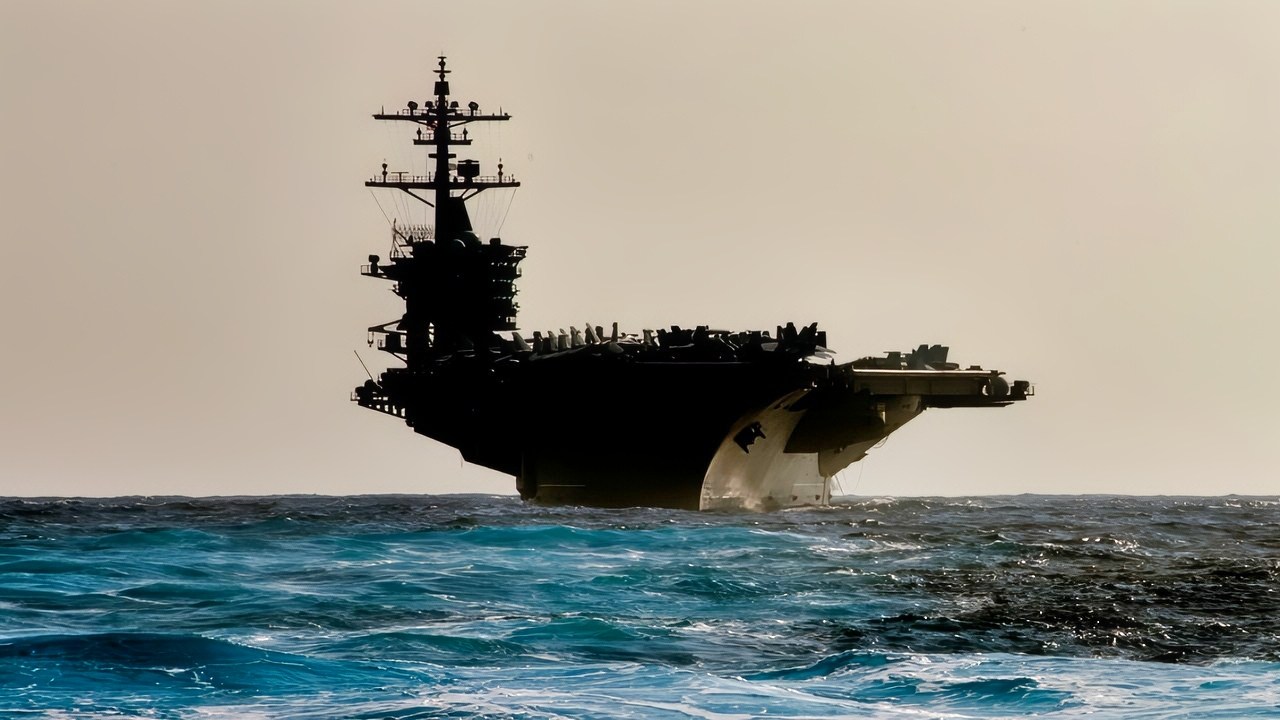
The IRGC said three oil tankers caught fire after hitting naval mines in the Strait of Hormuz as tensions continue to rise and the US blockade is taking a toll on the Iranian economy.
CNBC reported the claim alongside news that the US Treasury Department had widened sanctions on more than two dozen Iranian exchange houses, front companies, and key personnel.

Arleigh Burke-class guided-missile destroyer USS Michael Murphy (DDG 112) sails alongside Nimitz-class aircraft carrier USS Abraham Lincoln (CVN 72) on Dec. 8, 2025. USS Abraham Lincoln (CVN 72), flagship of the Abraham Lincoln Carrier Strike Group, is underway conducting routine operations in the U.S. 7th Fleet area of operations, demonstrating the U.S. Navy’s long-term commitment to a free and open Indo-Pacific. (U.S. Navy photo by Mass Communication Specialist 3rd Class Nathaly Cruz)

USS Ronald Reagan (CVN 76), USS Kitty Hawk (CV 63), and USS Abraham Lincoln (CVN 72) cruise side-by-side in the Philippine Sea June 18, 2006, during exercise Valiant Shield 2006. The joint exercise consists of 28 naval vessels, more than 300 aircraft, and approximately 20,000 service members from the Navy, Army, Air Force, Marine Corps and Coast Guard. (U.S. Navy photo by Chief Photographer’s Mate Spike Call) (Released)
The state-run news agency IRNA, Iran’s Islamic Revolutionary Guard Corps said in a released statement, that three “offending” oil tankers “suffered a severe explosion and fire after hitting naval mines” in the Strait of Hormuz.
“U.S. military cover and escort will not replace compliance with maritime regulations and instructions from the IRGC Navy Traffic Control Center,” the statement said.
U.S. military support “failed to prevent the incidents from occurring,” The Jerusalem Post reported. U.S. Central Command (CENTCOM) rejected Iran’s allegations that commercial vessels were hitting naval mines, saying American forces had cleared all internationally recognized primary shipping routes through the Strait of Hormuz.
According to the US military, these routes remain free of sea mines and are still used by commercial vessels. Independent verification for the latest claim has not been reported, and the IRGC did not identify the vessels involved.
Why Mines Or Missiles Matter
In July, when the Guards said two tankers exploded after hitting mines, CENTCOM’s entire rebuttal on X was “Like most IRGC claims, this is false.”
In September, the IRGC said the Panama-flagged tanker El Gaia struck a mine. CENTCOM countered that Iranian weapons had hit the ship on two separate occasions.
In another case, the command called a supertanker mine claim a flat lie. And on Oct. 28, it said every internationally recognized primary transit route through Hormuz had been cleared of sea mines by U.S. forces and stayed that way.
Why does this matter? It is the messaging.
A missile strike tells a shipowner and the insurance underwriters that Iran can hit his vessel. A mine strike tells him the water itself is not safe to travel, and that a destroyer on escort duty can’t fix it.
That second message aims to erode shipowners’ confidence.
The IRGC drove the point home by warning owners and ships’ masters that U.S. escorts don’t exempt them from Iranian rules on “unauthorized routes.” The real audience is the underwriters, charterers, and crews who decide whether a tanker sails at all.
The August Mine Sweeping Operation Was A Snapshot
On August 25, President Trump said the Navy had removed all mines from the strait’s international waters. Axios reported that two U.S. officials confirmed the Traffic Separation Scheme had been cleared, and that Navy underwater drones had located more than 100 suspected objects over several months.
CENTCOM commander Adm. Brad Cooper credited Navy divers, SEALs, and air power from all four services. SOFREP covered that four-month grind in the dark in detail, and it was genuinely impressive work conducted by the sailors.
However, a cleared lane is a temporary solution as Iran still has dhows, fishing boats, and small craft that can seed the water with mines at night.
The Gulf News pointed out that clearing the mines was only part of the job, since Tehran could simply try to lay more. Whether the IRGC is telling the truth this week or not, the Navy has to sweep as if it might be.
Iran Behind Cyberattacks On Energy Tankers
The U.S. is investigating and believes that Iran is probably involved in dozens of cyberattacks against energy tankers amid concerns that Tehran is widening the war with cyber operations and terror plots against Americans far from the Middle East.
The Wall Street Journal reported that as many as 50 ships carrying oil, liquefied petroleum, chemical products, and other explosive substances are believed to have been targeted.
At the same time, some received warnings and bomb threats, the Journal reported, citing U.S. officials and others familiar with the matter.
The US is also investigating whether Russia could also be involved in the widening threats against the ships, which include ransom messages as part of Iranian efforts to instill fear among shipowners and coerce ships from making the trip through the Gulf.
About the Author: Steve Balestrieri
Steve Balestrieri is a National Security Columnist. He served as a US Army Special Forces NCO and Warrant Officer. In addition to writing on defense, he covers the NFL for PatsFans.com and is a member of the Pro Football Writers of America (PFWA). His work was regularly featured in many military publications.


