

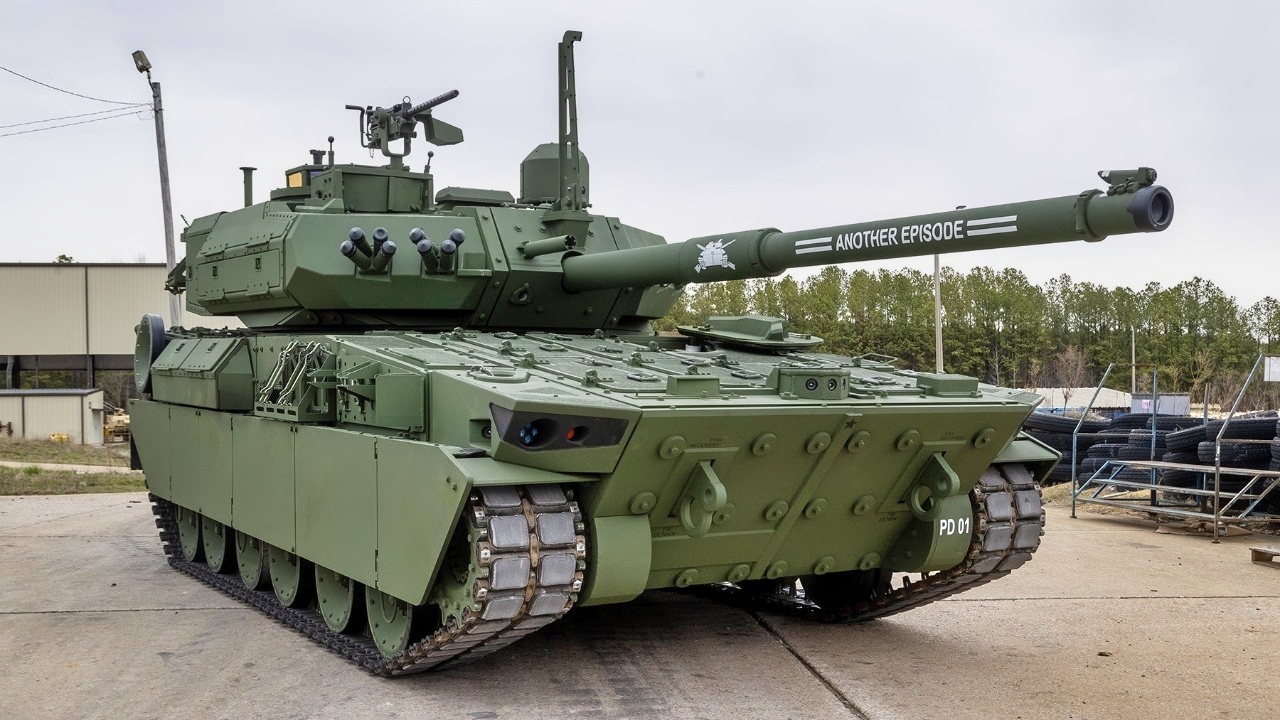
Key Points: The US Army’s M10 Booker armored vehicle program is criticized as a prime example of a flawed requirements process.
-Initially intended as a lightweight, C-130 airdroppable “light tank” to support airborne and light infantry units, successive requirement additions (“creep”) resulted in a 42-ton vehicle too heavy for airdrop and even some base infrastructure, like bridges at Fort Campbell.
-Despite failing its original key criteria, the airdrop requirement was dropped, and the program continued.
-Critics argue the Army now fields a vehicle lacking its intended mission and unique deployability, representing bureaucratic inertia over battlefield need.
-The M10 Booker has now been cancelled.
Big Problems Arise For the Army’s M10 Booker
The US Army began developing an armored vehicle to support light infantry forces in 2013. Mobile Protected Firepower, the competition to create a new light tank for the US Army, was continually handed additional requirements, leading to the selection of a tank that did not meet the conceptual requirements and, therefore, was not needed by the Army.
The result was the M10 Booker, and despite early optimism, the results left the Army with a light armored vehicle that has become a textbook example of a requirements process badly in need of revamping—one more concerned with checking boxes than actually evaluating the Army’s needs.
The realization began last year when the 101st Airborne was slated to receive the first of its Bookers at Fort Campbell, Kentucky. The base staff quickly realized the Booker would crush eight of the eleven bridges on the post.
The Army initially designed the M10 Booker as a relatively lightweight assault gun, airdroppable by a C-130. However, throughout the Army requirements process, the force continued adding requirements, rendering the tank too heavy to roll across the infrastructure at Fort Campbell—the vehicle requirement needed to serve light infantry and Special Forces troops specifically.
Background Information of the M10 Booker
The M10 Booker program was developed in 2013 when leaders of the 82nd Airborne Division told the Army that they would like a new light tank similar to the recently retired M551 Sheridan. One requirement was that the new vehicle could be airdropped from a C-17 or a C-130.
The M10 was designed to equip airborne and air assault troops with limited armor protection. It was to serve as a weapon that could effectively engage enemy strongpoints and armored vehicles. The M10 was supposed to be airdroppable by a C-130. This insertion would enable rapid deployment in battle after airborne infantry troops jumped in or air assault troops who were infiltrated by helicopter.
But by the time the Army finished adding all of the Booker’s extra requirements, it weighed 42 tons—far too heavy to drop from a C-130. Then, in a further snafu, the Air Force said that although they originally planned on loading two M10 Bookers on a C-17, the aircraft could only load one.
Instead of stopping the order and re-evaluating the M10, the Army pushed forward with the project. The Army Requirements Oversight Council reviewed the 2015 requirements submission and said it doesn’t need to be loaded onto a C-130 or airdropped. The Joint Requirements Oversight Council agreed.
“This is not a story of acquisition gone awry,” Alex Miller, the Army’s chief technology officer, said. “This is a story of the requirements process creating so much inertia that the Army couldn’t get out of its own way, and it just kept rolling and rolling and rolling.”
Miller added, “As soon as you remove the requirement for airdropability, you’re no longer actually helping infantry. You are just as maneuverable as a main battle tank at that point, which means you are less maneuverable.”
The M10 Booker Is Gone
Critics of the M10 program believe the whole thing should have been called off in 2013. “I can’t give you a rationale why everything wasn’t backed off,” Miller said. “But the first time that the requirement was sent to the one-stars in September of ’13, and it didn’t look like the [operational needs statement] that came up in July of 2013, the Army should have gone, ‘Stop.'”
Rather than trying to find a new purpose for the M10 and using it as a solution to an unnamed problem, the Army should cut its losses and stop the program with only the initial batch of Bookers built. And, in fact, that is now what the Army is going to do.
About the Author:
Steve Balestrieri is a National Security Columnist. He served as a US Army Special Forces NCO and Warrant Officer. In addition to writing on defense, he covers the NFL for PatsFans.com and is a member of the Pro Football Writers of America (PFWA). His work was regularly featured in many military publications.


Pingback: The Army's M551 Sheridan Light Tank Was Dropped From the Sky - National Security Journal
Pingback: The Army's M10 Booker Light Tank 'Nightmare' Summed Up in 4 Words - National Security Journal