
EU Agrees to Major Drone Deal With Ukraine: The European Union and Ukraine have agreed to establish a major new drone production operation that aims to combine Kyiv’s proven battlefield experience with Europe’s larger manufacturing capacity to make the continent safer in the future. The news is just another example of Ukraine’s wartime successes changing how Europe views defense, with Ukraine also recently announcing a partnership of nine countries to build new, affordable anti-ballistic missile defense systems.
European Commission President Ursula von der Leyen announced the new agreement during a visit to Kyiv on Wednesday, July 15, and described it as the first-ever bloc-wide military partnership to bring together Ukraine’s drone expertise with the manufacturing capabilities of companies across the continent. The news also comes as Russia launches some of its largest drone and missile strikes of the war, using ballistic missiles to target Kyiv.

A U.S. M1A1 Abrams tank needed for training the Armed Forces of Ukraine awaits offloading at Grafenwoehr, Germany, May 14, 2023. The M1A1 training is expected to last several weeks and will include live fire, crew qualification, maneuver, and maintainer training. Armed Forces of Ukraine training is conducted by 7th Army Training Command at Grafenwoehr and Hohenfels training areas in Germany on behalf of U.S. Army Europe and Africa. (U.S. Army photo by Spc. Christian Carrillo)
What Was Announced
Unveiling the agreement during Ukrainian Statehood Day celebrations, Von der Leyen described the new plans as an opportunity to merge the individual strengths of Ukraine and the European Union member states.
“We need to combine our strengths,” Von der Leyen said. “This deal will bring together Ukrainian ingenuity and Europe’s industrial scale.”
She also described how European countries would benefit from Ukraine’s expertise and experience, which she said was unmatched anywhere in the world.
“The knowledge you have gained on how to work drone and anti-drone systems is truly unique,” she continued. “We must tap into this together. Because we know the threats that Europe faces in this area — we have seen incursions and alerts across many member states.”
The comments reflect the fact that the war in Ukraine has been largely responsible for the changing nature of modern warfare. Before the Russian invasion of Ukraine, drones were used, but not in the same ways they are today. When Ukraine first began using drones, most were commercially available unmanned systems that were being jerry-rigged to carry grenades and other munitions. Today, Ukraine has built a drone manufacturing empire, producing long-range drones, first-person-view drones, fixed-wing unmanned aircraft, and more.
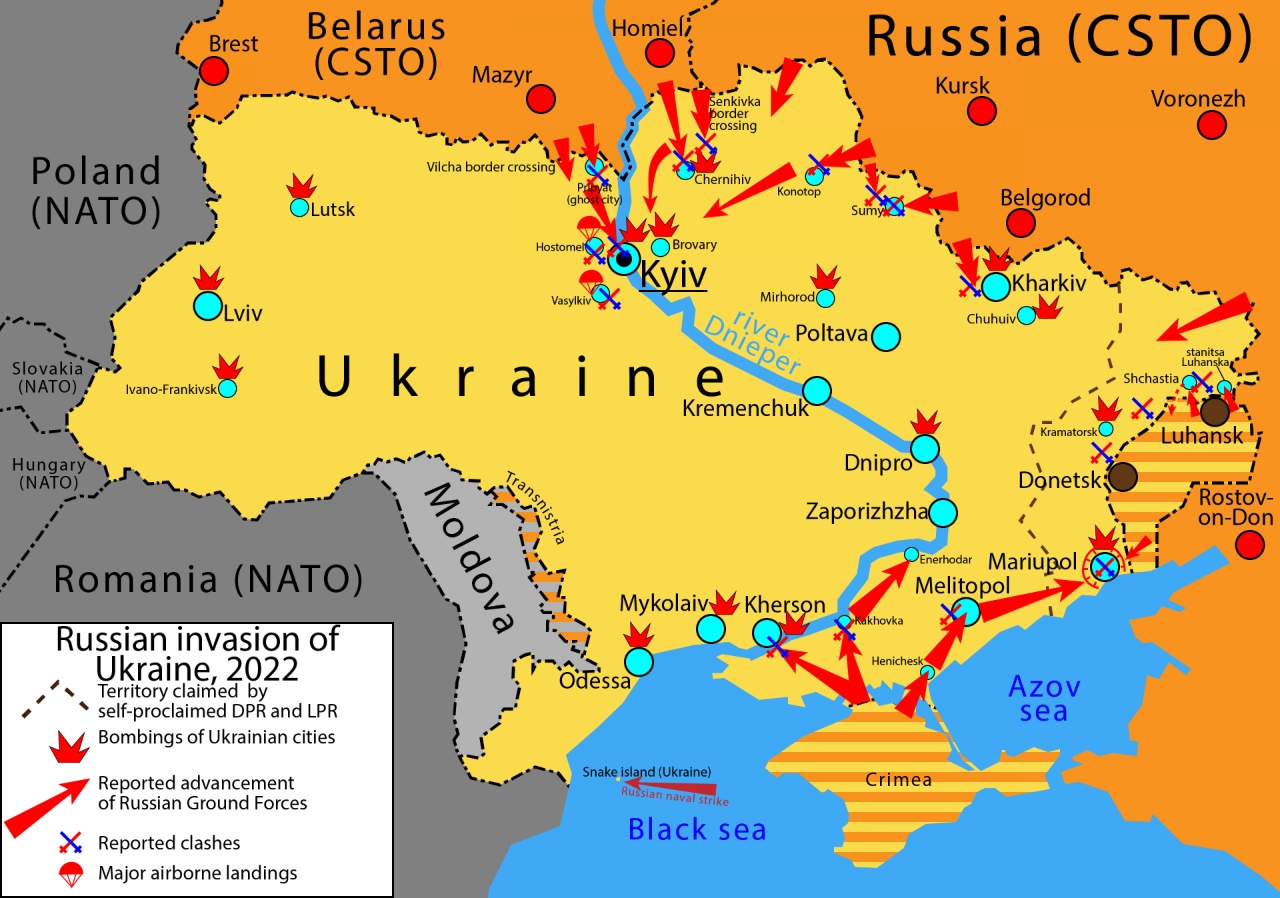
Ukraine War Map. Image Credit: Creative Commons.
The European Commission president added that the European Union would assist by providing vast technological capacity and industrial capability. She also pledged that European companies would provide secure production sites, suggesting that the new drone operations would likely be based in the EU rather than in Ukraine.
Unlike previous drone partnerships, which Kyiv had signed individually with allied governments, the new agreement spans the entire European Union. Zelenskyy also signed three additional bilateral drone agreements during last week’s NATO summit in Ankara, Turkey.
The news brings Ukraine’s total number of drone agreements to nine before the EU-wide announcement was made on Wednesday.
Ukraine’s Drone Industry Is World-Leading
When the Russian invasion of Ukraine began in 2022, Ukraine possessed only a very modest domestic drone industry.
But more than four years later, the country has become one of the world’s leading developers of unmanned military systems.
Between inexpensive FPV systems and high-tech electronic warfare-resistant platforms, Ukraine is proving that it is possible for smaller states to fight back against much stronger military powers – and build new technologies in the process, too.
The scale of Ukraine’s drone production is far beyond any drone operation in the West. On Wednesday, July 15, President Zelenskyy announced that the country’s rapid expansion of its drone industry was exceeding its own expectations and that national capacity had now reached 10 million per year.
“I remember when I first publicly announced the state’s plan to produce 1 million drones a year. There was a lot of skepticism, both in Ukraine and abroad,” he said. “Now we can state: we are producing 10 million drones a year. Ten million – and there will be 20 million.”
Those numbers matter. Missiles are more expensive to manufacture, and while they are typically reserved for striking high-value and large infrastructure targets, drones serve an important purpose even during missile strikes.
With 20 million drones per year, Ukraine can, in theory, produce smaller numbers of missiles – or, at least, depend on a smaller number of missiles per launch. Drones may not only serve as a projectile, but are typically launched in their hundreds alongside missile strikes to overwhelm air defenses.
Ukraine Grows Confident
Not only is Ukraine producing drones in record numbers, but it is also proving extremely competent at using them in combat. On July 6, Ukrainian FP-1 drones made a historic 12-plus-hour flight, covering more than 2,500 km to reach the Gazprom Neft oil refinery in Omsk, Siberia. The strike was so devastating that it took Russia’s largest gasoline producer partially offline. It was the longest-range drone strike of the war, and incredibly, it was achieved using an aircraft that is built around plywood.
The FP-1 drone features foam wings and a plywood skeleton and is powered by a simple two-cylinder piston engine. The drones are cheap and effective, costing just $55,000 per unit.
About the Author: Jack Buckby
Jack Buckby is a British researcher and analyst specializing in defense and national security, based in New York. His work focuses on military capability, procurement, and strategic competition, producing and editing analysis for policy and defense audiences. He brings extensive editorial experience, with a career output spanning over 1,000 articles at 19FortyFive and National Security Journal, and has previously authored books and papers on extremism and deradicalization.


