

On August 31, 2021, adversary intelligence directorates in Moscow, Beijing, and Tehran didn’t just watch the chaotic American withdrawal from Afghanistan; they updated their threat models. The enduring legacy of those final days was not simply the loss of Bagram or the collapse of the Afghan army, but the broadcasting of a bright, unmistakable boundary around American political will. That perception contributed to a broader sense that U.S. resolve had observable limits—a perception adversaries tested in the years that followed, including Russia’s full-scale invasion of Ukraine in February 2022, heightened Iranian regional aggression through proxies, the October 7, 2023, Hamas attack on Israel, and a wider pattern of global destabilization.
The same signal of limited resolve is now visible in the current administration’s approach to the conflict with Iran. Senior civilian leadership—Commander-in-Chief, Vice President, and Secretary of War—appears to have imposed constraints on CENTCOM that sharply limit the consideration of large-scale ground force options. The limited mobilization of American infantry within the Iran theater for any sustained role beyond special operations raids or short-duration security missions makes the boundary unmistakable. The United States has instead heavily emphasized a doctrine of Integrated All-Domain Naval Power, first formally articulated in the 2020 tri-service strategy Advantage at Sea, alongside air superiority and precision standoff weapons.

A U.S. M1A1 Abrams tank needed for training the Armed Forces of Ukraine awaits offloading at Grafenwoehr, Germany, May 14, 2023. The M1A1 training is expected to last several weeks and will include live fire, crew qualification, maneuver, and maintainer training. Armed Forces of Ukraine training is conducted by 7th Army Training Command at Grafenwoehr and Hohenfels training areas in Germany on behalf of U.S. Army Europe and Africa. (U.S. Army photo by Spc. Christian Carrillo)

A M1 Abrams Main Battle Tank in 1st Battalion, 18th Infantry Regiment, 1st Infantry Division fires at a prop target during a live fire exercise on Feb. 17, 2023 in Petrochori Training Area, Greece. American armored units along with Greek armored units spent the past couple days training force-on-force and other combat simulation exercises.
The prevailing operational concept rests on the belief that stealth aircraft, long-range missiles, naval power, and partner or proxy forces can degrade an adversary’s military capacity and economic base without the political costs, casualties, and open-ended commitments of protracted ground occupation. American leaders of both recent administrations have, through words and resource decisions, signaled a clear preference for fighting from the sky, from the sea, and through regional partners rather than committing large formations of American infantry to seize and hold contested terrain. From a domestic political standpoint, the logic is unassailable: protracted ground occupations are financially ruinous and politically lethal. Yet what makes perfect sense in Washington creates acute vulnerability abroad. This is not primarily a doctrinal debate about the relative merits of airpower versus land-power. It is a political choice about how much risk and cost the United States is prepared to accept. That choice is what adversaries read as limited resolve.
No serious adversary welcomes the full weight of American air and naval firepower. Yet sophisticated opponents understand a fundamental limitation: air power and sea power alone cannot achieve definitive political outcomes that require physical control of territory or the decisive dismantling of a determined regime. This is not a shortcoming of American military capability. It is a revealed boundary on American political will. Adversaries have adapted accordingly.
Iran has buried critical nuclear and military infrastructure deep underground or inside mountains, deliberately raising the cost and complexity of pure air campaigns. Russia and China have pursued similar hardening and dispersal. Forces are decentralized; critical capabilities are mobile or concealed. Most importantly, these actors and their proxies lean heavily on asymmetric networks—Hezbollah, the Houthis, and various militias—that have proven extraordinarily difficult to eradicate from the air. The resulting strategy is one of attrition and endurance. Because adversaries calculate that the United States is unlikely to commit the ground forces necessary to finish a fight, they orient themselves around surviving the initial bombardment. They widen the conflict economically and politically, impose costs through cheap drones and missiles, and wait. The arithmetic is deliberately unfavorable: multi-million-dollar interceptors expended against drones that cost a few thousand dollars each. The adversary needs only to hold out until American interest fades, attention shifts to another theater, or the financial and political costs become intolerable.
By repeatedly signaling extreme reluctance to employ large-scale ground forces, the United States draws a bright boundary around its own resolve—a boundary that Iran, Russia, China, and their partners are testing with increasing boldness.
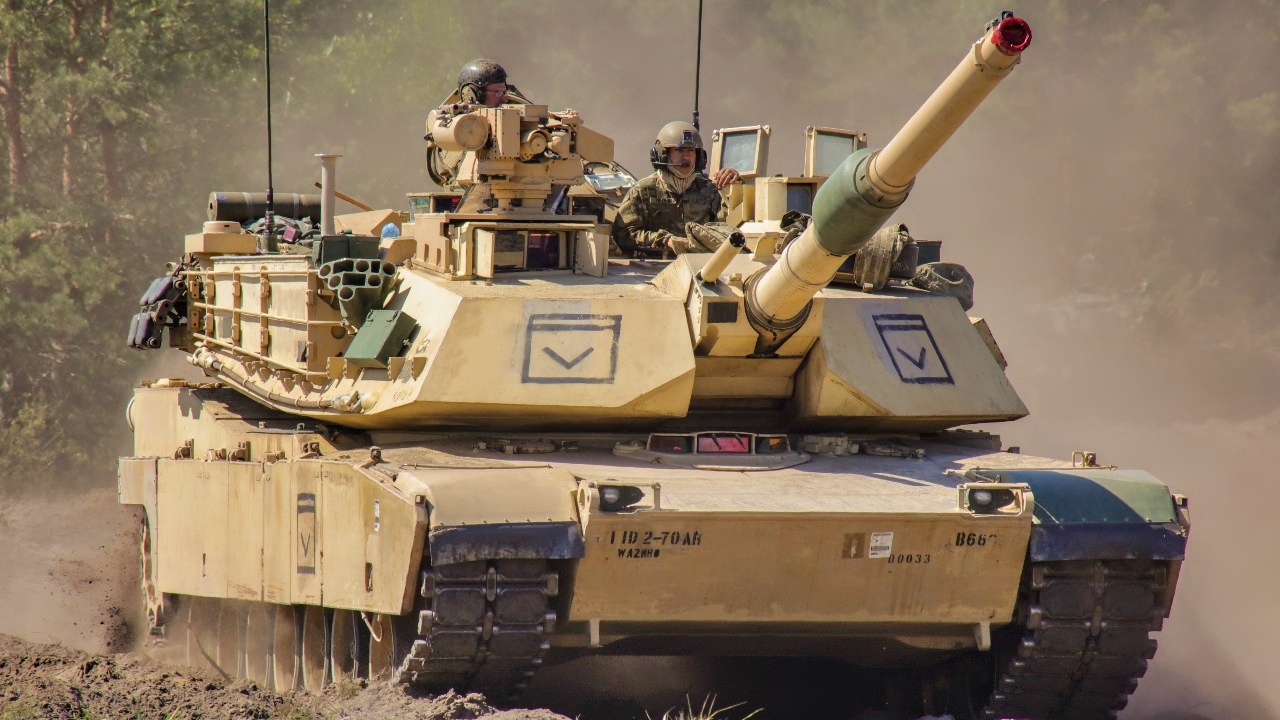
U.S. Soldiers assigned to 2nd Battalion, 70th Armor Regiment, 2nd Armored Brigade Combat Team, 1st Infantry Division supporting the 4th Infantry Division, maneuver an M1A2 Abrams tank while participating in a combined arms rehearsal during Anakonda23 at Nowa Deba, Poland, May 14, 2023. Anakonda23 is Poland’s premier national exercise that strives to train, integrate and maintain tactical readiness and increase interoperability in a joint multinational environment, complimenting the 4th Inf. Div.’s mission in Europe, which is to participate in multinational training and exercises across the continent while collaborating with NATO allies and regional security partners to provide combat-credible forces to V Corps, America’s Forward deployed corps in Europe. (U.S. Army National Guard photo by Sgt. 1st Class Theresa Gualdarama)
The Biden administration’s 2022 National Defense Strategy centered on “integrated deterrence.” It identified China as the pacing challenge and Russia as an acute threat. The document spoke of employing every tool of national power—military, diplomatic, economic, informational—in close coordination with allies and partners across domains and theaters. In theory this was comprehensive. In practice the operational pattern that emerged after the Afghanistan withdrawal heavily favored air and naval power, special operations, and support to partners while treating large conventional ground deployments as something to be avoided.
The Afghanistan exit itself illustrated the point. Even as the security situation deteriorated, residual U.S. ground presence was kept minimal and then eliminated on a fixed political timeline. Subsequent responses to Iranian proxy attacks, Houthi disruption of Red Sea shipping, and Russian aggression in Europe relied primarily on air and missile strikes, naval deployments, intelligence support, sanctions, and arms transfers rather than the insertion of American combat brigades. The message received abroad was consistent: the United States would punish from afar and equip others, but it would not again put large numbers of its own infantry into the close fight for contested territory. That pattern was the first sustained post-Afghanistan demonstration of limited resolve.
The Trump administration’s 2026 National Defense Strategy marks a deliberate shift in prioritization under “America First.” Its four lines of effort are, in order: defend the U.S. homeland; deter China in the Indo-Pacific through strength rather than confrontation; increase burden-sharing with allies and partners; and supercharge the defense industrial base. The strategy de-emphasizes open-ended global commitments and places heavier demands on European allies to handle conventional threats from Russia.
Yet on the specific question of ground force employment against peer or near-peer adversaries and their proxies, the continuity of the signal is more striking than the change. In the context of 2026 operations against Iran, Vice President JD Vance has publicly and repeatedly ruled out large-scale U.S. ground troop deployments for the purpose of regime change. Statements such as “We’re not gonna send 150,000 ground troops” to accomplish political transformation in Iran, and declarations that the era of American forces deciding the future of other nations is over, constitute an unusually explicit articulation of the boundary. Air and naval strikes continue. Special operations and limited raids remain on the table. Partner forces are encouraged. What is deliberately taken off the table is the sustained commitment of American infantry divisions to seize, hold, and administer contested ground. The Integrated All-Domain Naval Power concept remains consonant with this posture: sea control, long-range precision fires, and distributed maritime operations are preferred instruments precisely because they do not require the political capital of large ground campaigns.

An M1A1 Abrams tank from 1st Tank Battalion, 3rd Marines, maneuvers before a live fire assault at Shoalwater Bay Training Area, Queensland, Australia, on May 25, 2001 for Exercise Tandem Thrust 2001. Tandem Thrust is a combined military training exercise involving more than 18,000 U.S., Australian, and Canadian personnel who are training in crisis action planning and execution of contingency response operations.
(DoD photo by Sgt. Bob O’Donahoo, Australian Army. (Released))
The current administration is therefore not inventing a new reluctance. It is making more explicit, and applying to a live high-stakes theater, the same boundary on American resolve that was first broadcast in the Afghanistan withdrawal and then reinforced through the operational patterns of the previous administration.
The strategic logic on the other side is straightforward. If the United States will not commit the forces required to achieve decisive political outcomes on the ground, then survival becomes the central operational objective. Hardened and deeply buried facilities raise the cost and complexity of air campaigns. Decentralized and proxy-based force structures diffuse targets and complicate attribution and targeting. Economic and informational warfare widens the conflict into domains where American domestic politics are more vulnerable. The Houthis’ ability to absorb years of airstrikes, claim strategic victory when campaigns wind down, and resume attacks when pressure eases is a case study in this approach.
China studies the same pattern while expanding its own anti-access/area-denial capabilities and hardening critical infrastructure. Russia has demonstrated that it can absorb enormous attrition in Ukraine so long as the prospect of direct NATO ground intervention remains remote. Iran continues to invest in underground facilities, missile and drone proliferation, and proxy networks precisely because these tools exploit the revealed American preference for standoff warfare and the limited resolve it communicates.
Deterrence ultimately rests on the adversary’s belief that aggression will produce unacceptable costs. When the United States systematically removes one of the most decisive instruments of military power—the ability to close with and destroy an enemy force and occupy the terrain it holds—from its menu of realistic options, it narrows the range of outcomes it can credibly threaten. Precision weapons and naval power can punish and degrade. They have repeatedly proven insufficient, by themselves, to compel regime change, destroy resilient proxy networks, or impose a new political order.
Both the previous and current administrations have, through doctrine, force posture, and explicit statements, communicated a hierarchy of preferred instruments that places American infantry near the bottom for any campaign that risks protracted ground combat. The previous administration wrapped this preference in the language of integrated deterrence and alliance management. The current administration frames it as America First prioritization and rejection of nation-building. The operational signal to Moscow, Beijing, Tehran, and their partners is exactly the same: American resolve has observable limits, and those limits can be tested.
Restoring deterrence does not require a return to open-ended occupations or unlimited deployments of combat forces. As a combat veteran myself, I reject protracted engagements without clear objectives or exit criteria. The Powell Doctrine remains the gold standard: apply overwhelming force, which includes ground forces when required, to achieve a clearly stated objective and then leave. But in the current Iranian theater, the opportunity for strategic ambiguity has passed. Had the United States deployed a substantial ground package early in the crisis, it would have broadcast a fundamentally different message. Instead, by deliberately capping the ground combat deployment at a highly specialized footprint in the range of 6,000 to 8,000 Marines, paratroopers, and special operations forces, the United States didn’t just avoid a wider war—it explicitly quantified the absolute limit of the Commander-in-Chief’s available options. The boundary of American commitment is no longer implied; it is visibly staked on the ground. The result is not peace. It is a world in which the United States retains enormous destructive capacity yet finds it increasingly difficult to translate that capacity into durable political outcomes.
Stephen D. Cook is a retired U.S. Army Special Forces Lieutenant Colonel with 25 years of service. A combat veteran decorated for both heroism and valor, he is the author of the field manuals When We’re Finished and Choose the Heavier Ruck, and the techno-thriller precision-strike trilogy leading with In the Shadows of the Sky. His work explores the intersection of elite military decision-making, intuition, and disruptive leadership. He is based in St. Augustine, Florida.


Tracy Nelson, COL, USA (ret)
July 28, 2026 at 5:56 am
Spot on and great analysis of the paralysis.