


The term “forever war” has a special place in the American psyche.
It denotes a conflict that has no way of winding down or de-escalating and is stuck in a state of perpetuity, wasting American lives and tax dollars.
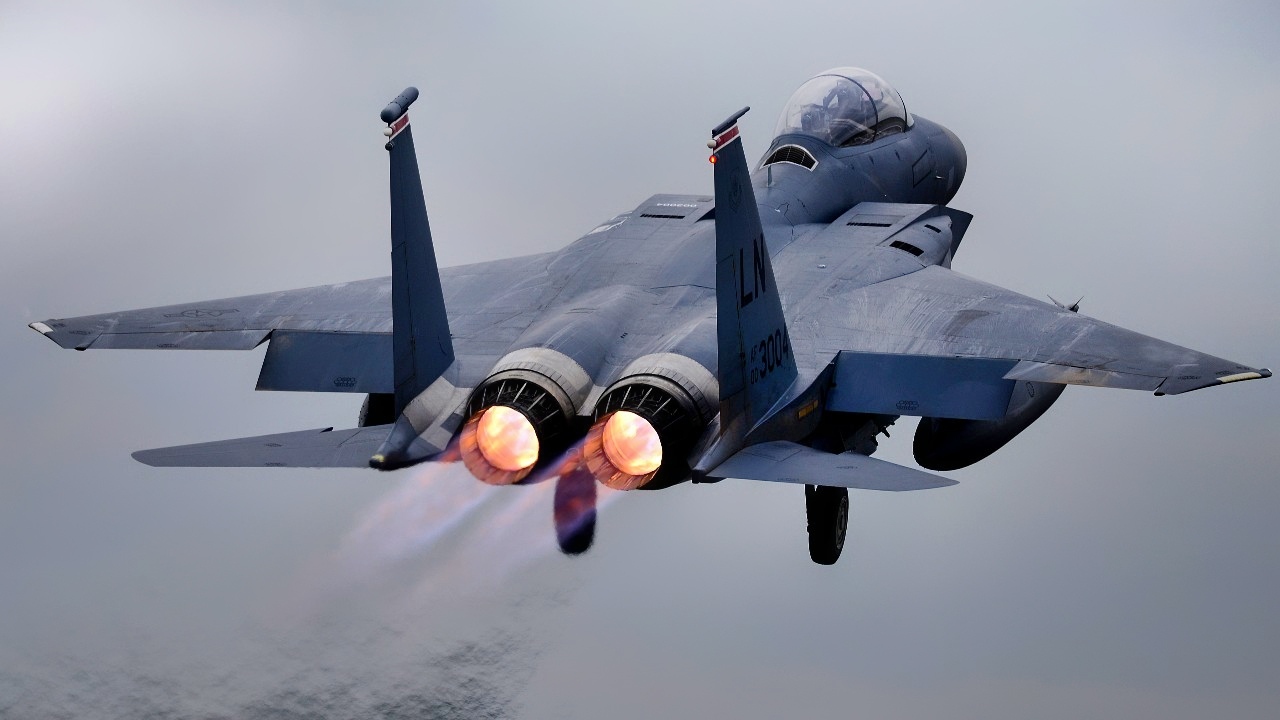
An F-15E Strike Eagle assigned to the 494th Fighter Squadron takes off for a training sortie at Royal Air Force Lakenheath, England, Oct. 26, 2018. The 494th trains regularly to ensure RAF Lakenheath brings unique air combat capabilities to the fight. (U.S. Air Force photo/ Tech. Sgt. Matthew Plew)

A U.S. Air Force B-52H Stratofortress aircraft flies in a seven-ship formation during the Hyundai Air and Sea Show at Miami Beach, Florida, May 24, 2025. The flyover represented the Air Force’s total force, integrating active duty, guard, and reserve pilots flying the B-1B Lancer, B-2 Spirit, F-22 Raptor, A-10 Thunderbolt II, B-52H Stratofortress, F-16C Fighting Falcon, and F-15C Eagle aircraft. (U.S. Air Force photo by Staff Sgt. Bailee A. Darbasie)
For a nation that has never fully recovered from the shock of Vietnam, the mere mention of a forever war sends a chill down the spines of every policymaker in Washington.
Even before his presidency, Trump had been hypercritical of the U.S.’s forever wars and campaigned on a platform of peace and strength.
Now, the President finds himself on the brink of his own forever war as the conflict with Iran heats up with no signs of stopping.
America’s Next Forever War?
Several weeks after the termination of the ceasefire, the war with Iran has been steadily escalating. Both the U.S. and Iran have been trading harsh blows as the two sides battle for control of the Strait of Hormuz.
The conflict is starting to resemble a forever war, according to Kelly Grieco, a senior fellow with the Reimagining US Grand Strategy Program at the Stimson Center, a Washington-based think tank. “You end up in this ‘mow the lawn’ approach, where Iranian capabilities grow up to some level.” She said. “You decide that you’re not willing to tolerate that level of threat, and you come back, and you do another round of missile strikes and bombings. And then we repeat this cycle endlessly.”
Over the past week, U.S. warplanes have intensified their air attacks against Iran. On Tuesday, B-1B bombers took part in their first operations against Iran since the ceasefire was first implemented back in May.
The U.S. has been continually bombarding Iranian positions all over the country, attempting to destroy IRGC offensive capabilities that pose a threat to commercial shipping vessels.
American forces have also been targeting infrastructure such as bridges and power plants.
President Trump recently threatened to unleash even more attacks to coerce Iran into a peace deal. “I am considering a massive attack.
Bigger than ever before. I am close to making a decision. We are all set for it,” Trump said on Tuesday.
Fighting a War on Two Fronts
Despite taking a severe beating from the U.S., Iran does not appear to be budging. IRGC ballistic missiles have been striking U.S. facilities across the region and, according to satellite imagery, they are hitting their targets.
Thus far, the U.S. has taken only four casualties from drone/ballistic missile attacks. However, the real number may be higher to avoid panicking the public.
There is, of course, no evidence that CENTCOM is deliberately withholding any information, but regardless, Iranian munitions have been causing noticeable damage to U.S. military installations in the Middle East.
According to some reports, the U.S. military has been forced to evacuate some of its bases in closer proximity to Iran. Satellite imagery suggests that the U.S. Air Force is repositioning its units out of the Al Udeid Air Base in Qatar, after Iranian missiles struck several compounds at the base.
To make matters worse, the Houthis have opened up a second front in the Red Sea. Earlier this week, the Iranian proxy group announced that it was imposing a blockade over the Bab al-Mandeb Strait, following recent back-and-forth strikes with Saudi Arabia.
The nightmare scenario that many analysts feared came true when UKMTO announced that an oil tanker had been struck by an unknown projectile while operating in the Red Sea.
The Houthis officially announced that they had struck two oil tankers in the Red Sea, one with a cruise missile and another with a drone, although the second tanker was not reported by UKMTO.
At least 10 vessels heading for the Bab el-Mandeb Strait have already altered their courses as the threats from Houthi attacks increase.
Running Out of Options
The dual blockades in the Middle East have spooked the energy market as oil prices rise towards $100 per barrel. While prices are still in a state of constant flux, Brent Crude is currently sitting at $99.95 per barrel after briefly hitting triple digits.
Last week, as the conflict between the U.S. and Iran continued to ramp up, there were already concerns of oil prices rising back to $100 per barrel.
However, now that the Houthis are once again throwing their weight around, the market has been provided that extra push to raise oil prices beyond triple digits.
Economists are now concerned that oil could exceed $120 to $130 per barrel, which could have grim implications for the global economy.
For Trump, the options are running out as the war threatens to escalate out of control. All efforts to secure a diplomatic end to the conflict have failed.
Neither side seems able or willing to make a compromise as the main issues, such as control over Hormuz and Israel’s operations in Lebanon, have remained unaddressed.
Realistically, the only option left is to escalate the conflict further and hope that the U.S. forces a capitulation out of Tehran.
Thus far, however, Iran has proven to be more resilient than first thought. With dwindling supplies of long-range munitions and air defense missiles, escalating the conflict comes with great risks.
About the Author: Isaac Seitz
Isaac Seitz, a Defense Columnist, graduated from Patrick Henry College’s Strategic Intelligence and National Security program. He has also studied Russian at Middlebury Language Schools and has worked as an intelligence Analyst in the private sector.


