


The United States has drastically expanded its military campaign against the Islamic Republic of Iran this week by deploying the iconic B-1B Lancer strategic bomber in combat operations against targets associated with the Iranian Revolutionary Guard Corps (IRGC), Iran’s elite military and political unit.
Per US officials speaking to Axios, the B-1B deployment marked the first operational deployment of the plane since fighting resumed nearly two weeks ago.

B-1B Lancer Getting Closer. Image Credit: Creative Commons.

B-1B Lancer Bomber. Image Credit: Creative Commons.
The large bombers are part of an ongoing attempt by the United States to fundamentally degrade Iran’s military capabilities and to deter future threats, aiming to secure regional stability and protect vital shipping routes like the Strait of Hormuz (SoH).
The Mission and Its Strategic Significance
US Central Command (CENTCOM) did not name the B-1B in its public statement following Tuesday’s operations, but multiple US officials confirmed that the aircraft participated in the strikes.
The bomber is believed to have left the United Kingdom before flying down to the Middle East.
Online flight-tracking enthusiasts watched some of the flight before the United States Air Force employed operational security measures, obscuring the locations of the B-1Bs.
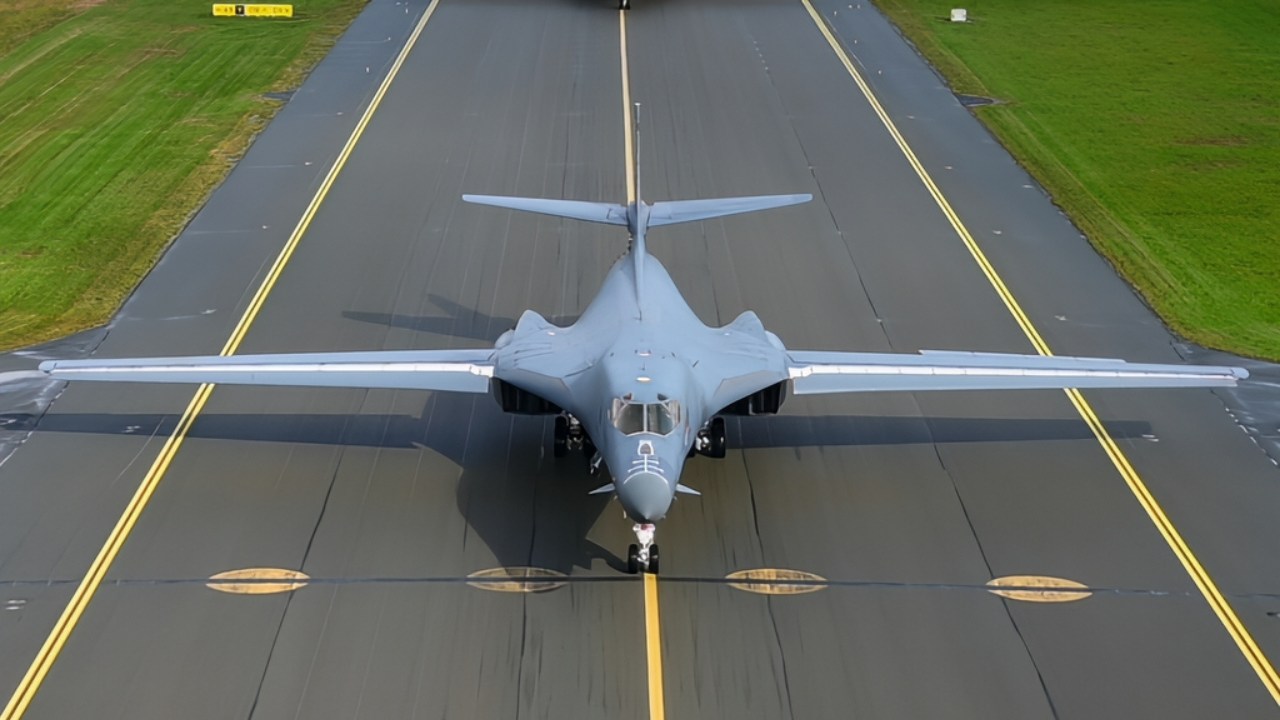
A U.S. Air Force Airman, assigned to the 345th Expeditionary Bomb Squadron, stands a B-1B Lancer during a Bomber Task Force Europe mission at Ørland Air Base, Norway, Aug. 21, 2025. BTF missions expose and familiarize aircrew with air bases and operations in different geographic combatant command areas of operations to enable strategic access and integration with coalition forces to deter global conflict. (U.S. Air Force photo by Staff Sgt. Tambri Cason)
It should be noted here that the B-1Bs had to be flown into the region from the United Kingdom, highlighting Iran’s effective strategy of degrading America’s bases nearer to their territory, which complicates US operations and underscores the persistent challenge.
According to CENTCOM, “Iranian military operations centers, maritime capabilities, aircraft hangars, drone storage facilities, and military logistics infrastructure” were struck by what many observers believe to have been B-1B Lancers. It was part of the Pentagon’s wider strategy to end Iran’s capability to threaten shipping via the SoH.
The B-1B Lancer’s Capabilities
Originally developed during the Cold War, the aircraft was converted entirely to a conventional mission set following arms control agreements.
It no longer carries nuclear weapons.
Today it serves as one of the key elements supporting America’s long-range strike force.
The B-1B combines incredible speed and range with a heavy payload.
Powered by four General Electric F101 afterburning turbofan engines, the B-1B is capable of speeds exceeding 900 miles per hour, or approximately Mach 1.2.
Its variable-sweep wings allow crews to optimize the aircraft for takeoff, long-range cruise, or high-speed penetration missions.
The bomber has an intercontinental range with aerial refueling capability.
It carries four crewmembers. Here’s the really interesting part, though: it can carry 75,000 pounds of conventional ordnance–the largest conventional payload in the US Air Force inventory.
A B-1B Lancer can carry up to 24 Mk-48 2,000-pound bombs, 24 GBU-31 Joint Direct Attack Munitions (JDAMs), and as many as 24 AGM-158 Joint Air-to-Surface Standoff Missiles (JASSMs).
This allows the plane to strike either hardened fixed targets or launch precision cruise missiles from outside heavily defended airspace.
The aircraft features an advanced radar, GPS-assisted navigation, an impressive electronic warfare (EW) suite, and Link-16 networking.
Limited Strategic Results
Earlier in Operation Epic Fury, B-1 aircraft reportedly struck Iran.
Tuesday’s mission demonstrated that the platform continues playing a key role as the United States increases the scale and tempo of its operations against Iranian military infrastructure.
The strikes have proven inconclusive. Iran continues to hold the SoH hostage with little sign of abatement.
President Donald Trump on Wednesday warned that additional Iranian attacks against shipping would prompt American strikes against Iranian civilian infrastructure–including bridges and power plants. Tehran responded by threatening civilian infrastructure in the Gulf Arab states.
Strategic Questions Ahead
Commercial shipping is feeling the squeeze, as Iran maintains its blockade of the SoH and now the Iranian-backed Houthis of Yemen impose their own quasi-blockade on Saudi-flagged ships in the Red Sea region (which includes the Bab el-Mandeb Strait).
The cumulative effect of these moves has been to spike the global price of oil, placing further pressure on the United States and its allies.
At the same time, the Iranians continue riding the proverbial storm the US military has subjected the Islamic Republic to.
With the B-1Bs in the region bombing Iranian targets, and those bombing campaigns yielding little momentum for the Americans at the strategic level, it looks as though Washington is at an impasse.
Does it continue bombing Iran, wasting ordnance, risking pilots and their planes, all while those attacks do little to dissuade the Iranians from engaging in their attacks on global shipping and energy markets?
About the Author: Brandon J. Weichert
Brandon J. Weichert is Senior National Security Editor. He also manages The Weichert Brief on Substack. Weichert also hosts “National Security Talk” on Rumble. He is the author of four bestselling national security books, the most recent of which is A Disaster of Our Own Making: How the West Lost Ukraine (Encounter Books). Follow him via Twitter/X @WeTheBrandon.


