
Commercial shipping traffic through the Strait of Hormuz has collapsed, falling by almost 90% since Washington launched the ongoing nightly barrage of strikes against Iranian military facilities and infrastructure.
With maritime data showing a tangible impact of ongoing attacks on oil tankers and new threats against Saudi Arabian exports, Brent crude also briefly surpassed $100 per barrel on Thursday, July 23.

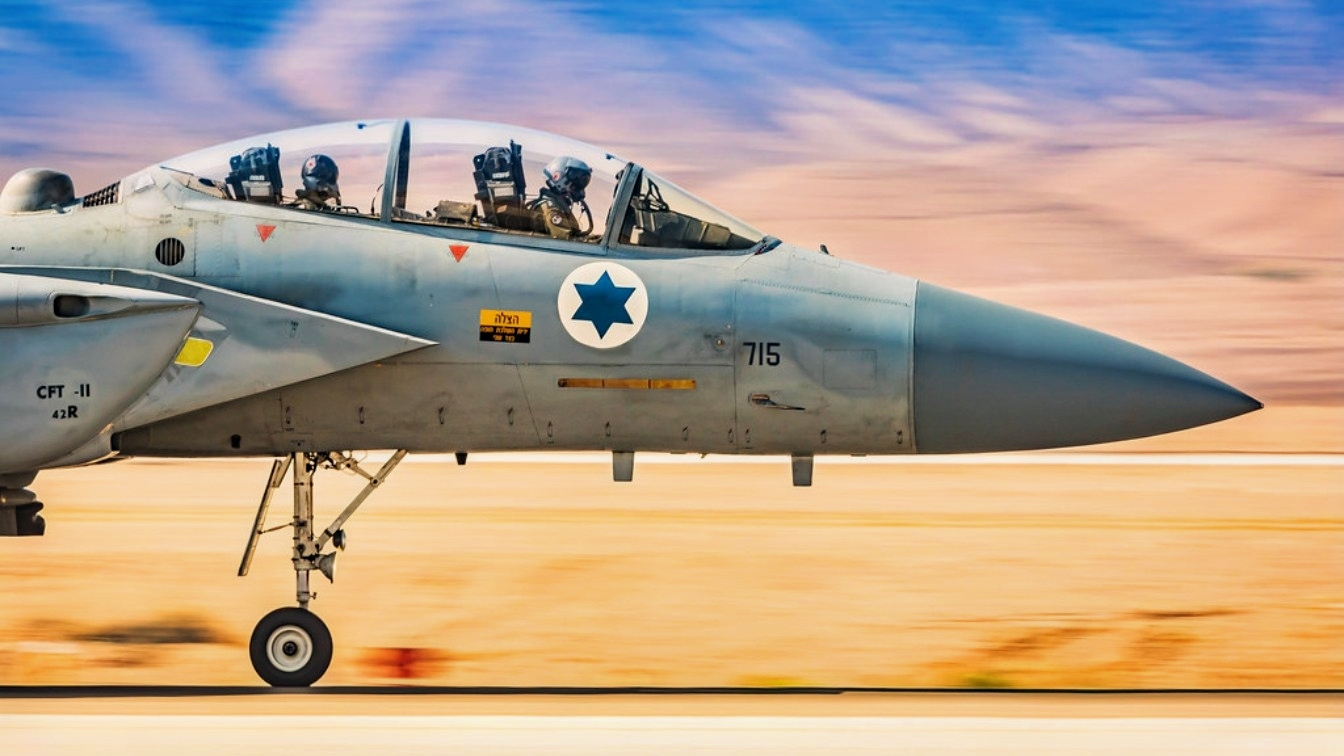
F-15I Fighter from Israel. Image Credit: Creative Commons.

An Israeli F-15I Ra’am assigned to the 69th Squadron launches for a sortie in support of exercise Juniper Falcon May 7, at Uvda Air Base, Israel. Juniper Falcon 17 represents the combination of several bi-lateral component/ Israeli Defense Force exercises that have been executed annually since 2011. These exercises were combined to increase joint training opportunities and capitalize on transportation and cost efficiencies gained by aggregating forces. (U.S. Air Force photo/ Tech. Sgt. Matthew Plew)

Israeli Air Force 69th Squadron – Operation New Order: F-15I jets eliminating Hezbollah and Hassan Nasrallah.
According to maritime intelligence firm Kpler, only 15 vessels transited the Strait of Hormuz on Wednesday, compared with roughly 130 ships per day before the conflict escalated.
The slowdown came as the United States completed its 12th consecutive night of airstrikes against Iran and the Iranian-backed Houthis claimed attacks on two Saudi oil tankers in the Red Sea.
As Brent crude traded above $100 per barrel before easing again, West Texas Intermediate crude climbed to around $91 per barrel. Brent prices have now risen by almost 40 percent since the latest phase of the conflict began.
Hormuz Traffic Is Alarmingly Low
The latest shipping data suggests that commercial operators still don’t believe it is safe to transit the Strait of Hormuz, despite assurances from CENTCOM.
Kpler data shows that just 15 vessels transited the strait on Wednesday – a fraction of the approximately 130 daily transits that were recorded before the war.
Although commercial shipping does technically continue, the volume of traffic is now exceptionally low, with shipowners, charterers, insurers, and even crews now seriously reconsidering the risks of operating in the Gulf at all.
Kpler’s latest analysis also found that the remaining traffic has moved almost entirely to a unilateral shipping route established by Iran earlier this year.
Before the conflict resumed, approximately 60 percent of vessels crossing Hormuz used the Iranian route while 40 percent used an alternative route through Omani waters.
Between July 15 and July 22, however, around 90 percent of all crossings used the Iranian route, and on the most recent day tracked, every recorded vessel transited via the Iranian side of the strait.
The Omani route was, in theory, a good alternative for international shipping, but it has failed to attract significant traffic owing to Iran’s opposition to its use and its repeated strikes on vessels using those lanes.
According to Kpler, marine insurers have not treated the Omani route as materially safer because it was never an established commercial corridor before the conflict, meaning that insurance premiums have stayed high despite the U.S. insisting the route can and should be used.
Saudi’s Alternative Export Route Under Threat
Saudi Arabia has, for much of the conflict, had one significant advantage over other Gulf producers in that it is not entirely dependent on the Strait of Hormuz.
Saudi Aramco, the national oil company of Saudi Arabia, can transport crude from the Eastern Province across the country using the East-West Pipeline to the Red Sea port of Yanbu.
While the pipeline cannot fully replace exporting via the Strait of Hormuz, it could still move significant quantities – around 7 million barrels of crude per day.
Yanbu’s export terminals are capable of loading around 3 million barrels of crude per day onto very large crude carriers (VLCCs), most of which are destined for major Asian buyers like China, South Korea, or Japan.
It wasn’t a full replacement for Hormuz, but it was more than what other countries, like Iraq or Kuwait, could do.
But that alternative route now faces a threat of its own, and its ability to mitigate the damage done by disruption in the Strait of Hormuz is now being impacted too.
On Thursday, the Iranian-backed Houthis claimed that they had attacked two Saudi oil tankers in the Red Sea after announcing a blockade on shipping linked to Saudi ports.
Per Reuters, two Chinese-operated supertankers carrying a combined four million barrels of Saudi crude successfully transited the Bab el-Mandeb Strait after loading at Yanbu and are continuing toward China.
However, several other tankers chartered by Sinopec’s trading arm, Unipec, have slowed significantly or even remained stationary in the Gulf of Aden as operators reassess the security situation.
It’s a problem because the Bab el-Mandeb Strait has effectively become Saudi Arabia’s emergency export route – and any sustained Houthi campaign there against tankers departing Yanbu will threaten one of the few remaining routes available to Gulf producers.
Gulf States Look Beyond Hormuz
According to the Associated Press, at least seven pipeline projects are now under construction, being planned, or under discussion as Gulf producers now seek to reduce their dependence on the Strait of Hormuz.
Saudi Arabia and the United Arab Emirates are already operating alternative export pipelines near capacity, but Thursday’s Houthi attacks also demonstrated the limits of those workarounds, reinforcing concerns that no single replacement route can yet match the security or capacity of Hormuz.
The question now is how long these projects will take, and what damage will be done in the meantime.
About the Author: Jack Buckby
Jack Buckby is a British researcher and analyst specializing in defense and national security, based in New York. His work focuses on military capability, procurement, and strategic competition, producing and editing analysis for policy and defense audiences. He brings extensive editorial experience, with a career output spanning over 1,000 articles at 19FortyFive and National Security Journal, and has previously authored books and papers on extremism and deradicalization.


