

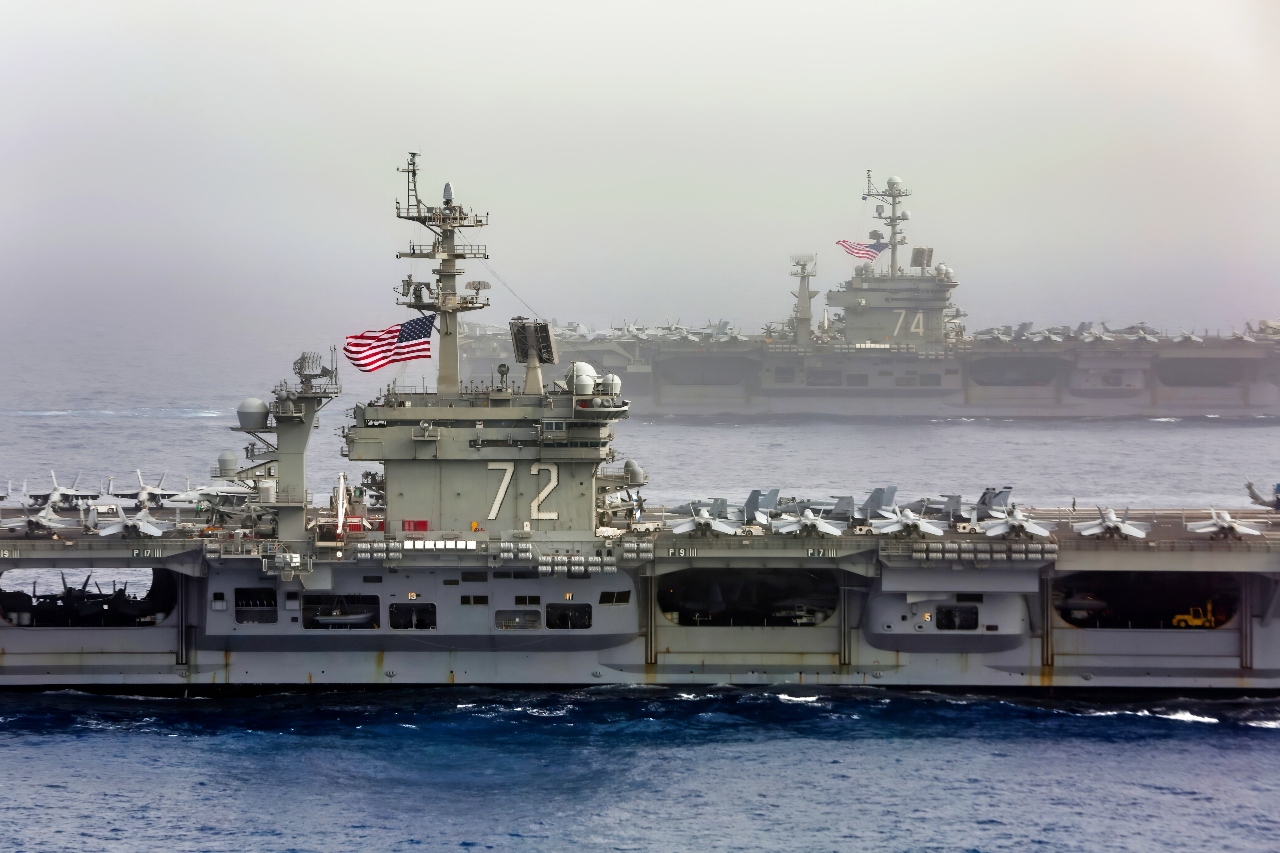
Key Points and Summary – The U.S. Navy aircraft carrier USS John C. Stennis is undergoing a mandatory mid-life overhaul, which has been plagued by significant delays, pushing its return to service to late 2026.
-The problems—workforce shortages, unexpected major repairs, and industrial base challenges—eerily echo the recent troubled overhaul of the USS George Washington.
-Mindful of the tragic sailor suicides that occurred on the Washington, the Navy is now taking active steps to improve crew morale and living conditions for the Stennis sailors.
-The carrier’s extended absence is straining the entire U.S. fleet’s deployment rotation.
Nimitz-Class Aircraft Carrier John C. Stennis Is Behind in Refit
The USS John C. Stennis (CVN-74) is a Nimitz-class aircraft carrier built for the United States Navy.
Beginning its life in 1998, the Stennis has participated in numerous operations throughout its lifetime, primarily in the Middle East. Currently, the carrier is being retrofitted in Norfolk, Virginia, where it is expected to remain until 2026.
Unfortunately, maintenance has not progressed as smoothly as initially expected, evoking memories of a troubled experience aboard the USS George Washington.
Where is the Stennis Right Now?
The reason the Stennis is currently inactive is that it is undergoing a Refueling and Complex Overhaul (RCOH), a mandatory procedure for nuclear-powered aircraft carriers that occurs roughly halfway through their expected 50-year service life.
This overhaul is being conducted at Newport News Shipbuilding in Virginia, operated by Huntington Ingalls Industries. The RCOH involves refueling the ship’s nuclear reactors, upgrading propulsion systems, modernizing combat and communication technologies, and refurbishing thousands of compartments and structural components. It is one of the most extensive and technically demanding maintenance operations in naval engineering.
The overhaul of the Stennis began in May 2021 and was initially scheduled to be completed by August 2025. However, the process has faced significant delays and is now expected to conclude in October 2026. Several factors have contributed to this extended timeline.
One of the primary issues has been workforce and material shortages, many of which stemmed from the disruptions caused by the COVID-19 pandemic. These shortages affected shipyard operations and mirrored similar problems encountered during the overhaul of the USS George Washington, another Nimitz-class carrier that experienced delays.
In addition to supply chain and labor challenges, the Stennis required unplanned repairs after inspections revealed significant damage to one of its eight steam turbine generators. These generators are critical for converting nuclear energy into mechanical and electrical power.
The extent of the damage went beyond normal wear and tear, necessitating extensive and time-consuming repairs. The Navy also cited broader industrial base challenges, including delays in receiving materials and insufficient labor planning, as contributing factors to the delay.
These systemic issues have prompted the Navy to initiate studies aimed at improving future overhaul planning and execution.
The Memory of the Nimitz-Class USS George Washington Carrier Persists
Another important aspect of the overhaul has been the Navy’s renewed focus on crew habitability and morale.
This shift in priorities was influenced by tragic incidents aboard the USS George Washington, where multiple sailor suicides were linked to poor living conditions during its RCOH.
In response, the Navy has taken steps to improve the quality of life for sailors assigned to the Stennis during its overhaul. These measures include providing off-ship housing in apartments rather than barracks and investing in infrastructure to increase the quality of life as much as possible.
The Stennis has faced many of the same troubles that the George Washington experienced during its extended RCOH. Both ships have experienced significant delays due to supply chain issues and labor shortages resulting from COVID-19.
Both carriers have required more maintenance than anticipated initially, with damage discovered in the steam turbines. This indicates one of two things: either the Navy needs to improve inspections before rehauls, or the Nimitz-class is particularly prone to accidents.
When Will the Stennis See Service Again?
The delay in returning the Stennis to service has had a ripple effect across the Navy’s carrier fleet. With only 11 aircraft carriers in total, the Navy typically operates under a “one-third rule,” where one-third of the fleet is deployed, one-third is preparing for deployment, and one-third is undergoing maintenance. The extended absence of the Stennis strained this rotation, especially during the U.S. brief operations against the Houthis in Yemen.
In the Red Sea, carriers like the Harry S. Truman and Carl Vinson were engaged in operations against Houthi militants. At the same time, in the Indo-Pacific, the Navy continues to focus on deterrence against China. The shortage of available carriers limits the Navy’s flexibility and ability to respond to multiple global hotspots simultaneously.
Despite initial setbacks, progress is now moving smoothly. In April 2024, the ship was successfully undocked after nearly three years in dry dock, marking a significant milestone in the RCOH process. It has since transitioned to an outfitting berth, where modernization efforts continue.
As of early 2025, the overhaul has reached more than halfway to completion.
The Navy anticipates that once the RCOH is complete, the Stennis will be the most technologically advanced Nimitz-class carrier in the fleet, capable of supporting global operations for another 25 years.
The USS John C. Stennis is projected to return to active duty in October 2026, more than 14 months later than initially planned.
Upon completion, the carrier will rejoin the fleet with fully refueled nuclear reactors, upgraded propulsion and combat systems, enhanced crew accommodations, and renewed capability to support air operations and strike missions across all mission sets.
Rear Admiral Casey J. Moton, Commander of the Program Executive Office Aircraft Carriers, emphasized that the Stennis will bring the “highest level of capability” across all mission sets upon redelivery.
About the Author: Isaac Seitz
Isaac Seitz, a Defense Columnist, graduated from Patrick Henry College’s Strategic Intelligence and National Security program. He has also studied Russian at Middlebury Language Schools and has worked as an intelligence Analyst in the private sector.
Military Affairs
China’s Stealth Air Force Has 1 Mission


