

As a result of the ongoing U.S. blockade of the Strait of Hormuz, Iran’s main oil terminals are now empty, and have been for weeks, Bloomberg News reported Monday, citing its own data and additional data from Kpler and Vortexa.
According to the Bloomberg report, no tankers have docked at the Kharg Island crude-exports terminal since August.

A Polish F-16 pilot awaits instructions from his crew chief after completion of a Baltic Air Policing sortie at Šiauliai Air Base, Lithuania, Aug. 30, 2017. The Polish air force recently relinquished control of the NATO Baltic Air Policing mission to the U.S. Air Force for the forty-fifth rotation of allied protection of the sovereign skies of the Baltic region since Baltic Air Policing operations began in 2004. (U.S. Air Force photo/ Tech. Sgt. Matthew Plew)
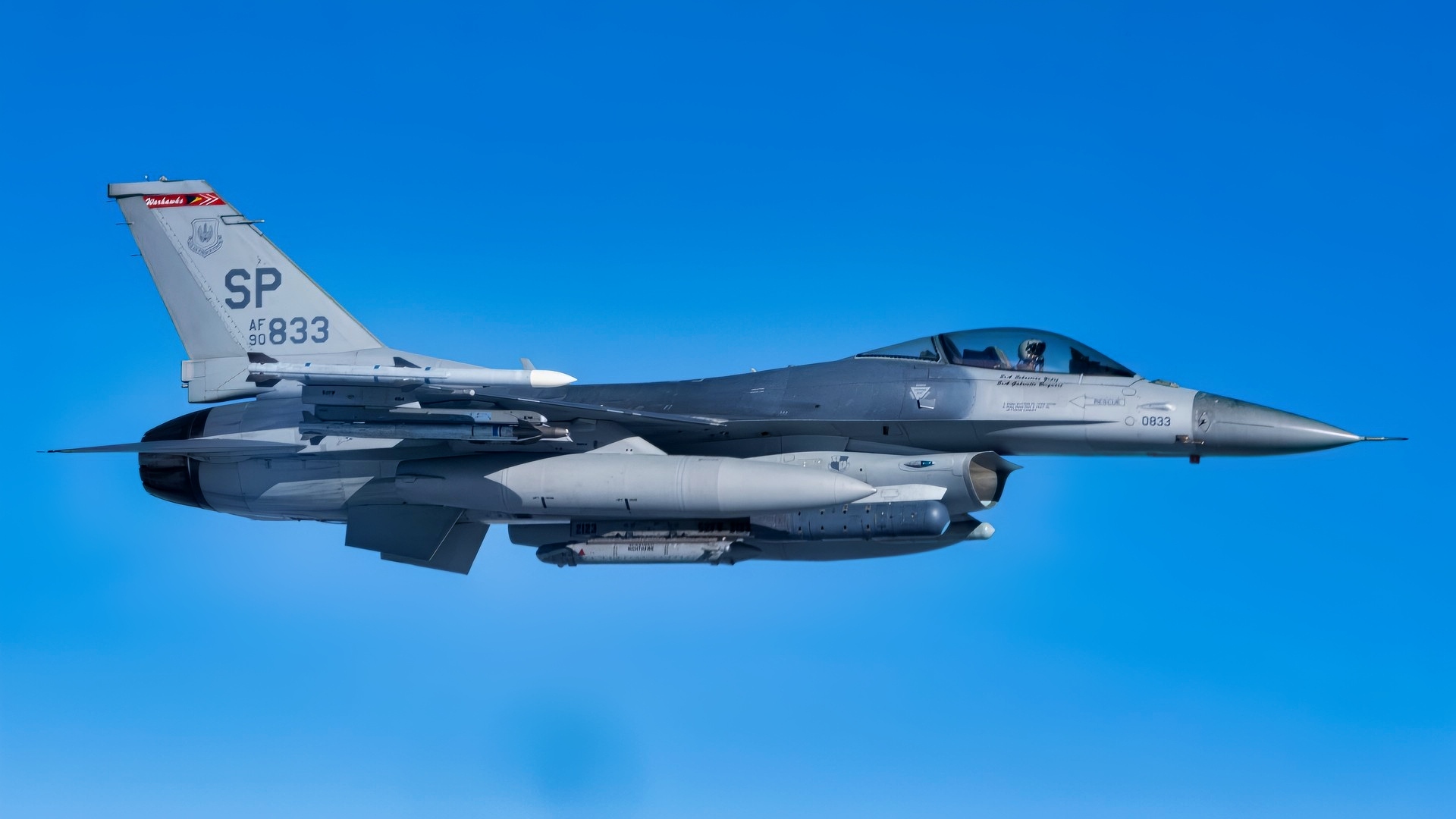
A U.S. Air Force F-16 Fighting Falcon from the 52nd Fighter Wing, Spangdahlem Air Base, Germany, flies during an Agile Combat Employment movement over Poland, Feb. 29, 2024. ACE is a military concept aimed to deny adversaries the advantage of predictability, while concurrently enhancing U.S. Air Forces in Europe’s capacity to respond swiftly to emerging threats. (U.S. Air Force photo by Airman 1st Class Christopher Campbell)
Iran exported nearly a million barrels a day in July, but that figure is now zero. No tankers have been spotted at Jask, another port at the other end of the Persian Gulf.
Bloomberg cited video from the European Union’s Sentinel 1 and 2 orbiters showing no tankers at Kharg Island.
The blockade was lifted temporarily in June after the “Memorandum of Understanding” agreement, but it was reimposed in July.
Most of Iran’s oil exports went to China earlier this year, though China has since turned to other crude sources.
A $25 Billion Hit?
Last Friday, per The Hill, Central Command (Centcom) Commander Adm. Brad Cooper claimed that the U.S. blockade has cost Iran $25 billion in revenue from oil.
“As a point of emphasis, except the humanitarian assistance we’ve allowed in, Iran has no exports and no imports by sea,” Cooper said in a video message last week.
The blockade, Cooper added, has imposed “devastating costs on Iran’s security apparatus and the IRGC specifically.”
The admiral also said that the U.S. had seized $350 million in cryptocurrency held by the Iranian regime. He said the pressure has made it harder for Iran to pay its personnel.
Cooper said Iran’s government is withholding salaries from the IRGC and is also unable to pay “pensions and benefits to workers in industries such as oil and energy, manufacturing, construction [and] security.”
What Iran Can Export
However, a Reuters report last week said Iran has been exporting liquefied petroleum gas (LPG) and jet fuel since July, despite the blockade. Iran has been doing this by slipping those exports into a “growing volume of ship-to-ship transfers by other Gulf producers.”
The Reuters report notes that these exports make up a small fraction of pre-war volumes, but they show that Iran can still get some exports through the blockade.
The report cites data from the advocacy group United Against Nuclear Iran, which showed that eight tankers containing Iranian LPG had departed the Gulf of Oman since the blockade was reimposed in mid-July, as well as a jet fuel tanker that reached Malaysia last month.
The jet fuel tanker and most of the oil tankers were under U.S. sanctions.
Jemima Shelley, senior research analyst with UANI, told Reuters that while a small number of tankers have gotten through, “US forces have redirected the overwhelming majority of tankers laden with Iranian products.’
One U.S. military official told Reuters that the blockade remains “ironclad,” and that in Reuters’ words, “the passage of a vessel does not necessarily mean it had evaded the blockade.”
Meanwhile, a Treasury spokesperson told the news service to take such claims with “a grain of salt.”
Torbjorn Soltvedt, an analyst at the risk intelligence company Verisk Maplecroft, told Reuters that jet fuel could be “a good option” if Iran wants to get product through.
Fires in the Strait
Meanwhile, per Reuters, Iran’s IRGC claimed Monday that an oil tanker caught fire and “exploded” after hitting what they called a naval mine in the Strait of Hormuz.
Al Jazeera reported that Iran’s claim had expanded to two tankers, each containing two million barrels of crude oil. The IRNA news service said the first triggered “fierce fire,” while the other produced “a massive blaze,” after they attempted to go through an unauthorized route in the Strait.
IRGC naval commander Rear Admiral Ali Azmaei had said earlier in the week that any vessel that turned off its navigation systems would be treated as “hostile.”
Brent crude’s price has once again risen to over $109 as of Monday afternoon. The commodity, Trading Economics reported, “remains caught between escalating geopolitical risks and signs of recovering oil flows from the Middle East.”
About the Author: Stephen Silver
Stephen Silver is an award-winning journalist, essayist, and film critic, and contributor to the Philadelphia Inquirer, the Jewish Telegraphic Agency, Broad Street Review, and Splice Today. The co-founder of the Philadelphia Film Critics Circle, Stephen lives in suburban Philadelphia with his wife and two sons. For over a decade, Stephen has written thousands of articles on politics, national security, technology, and the economy. Follow him on X (formerly Twitter) at @StephenSilver, and subscribe to his Substack newsletter.


