

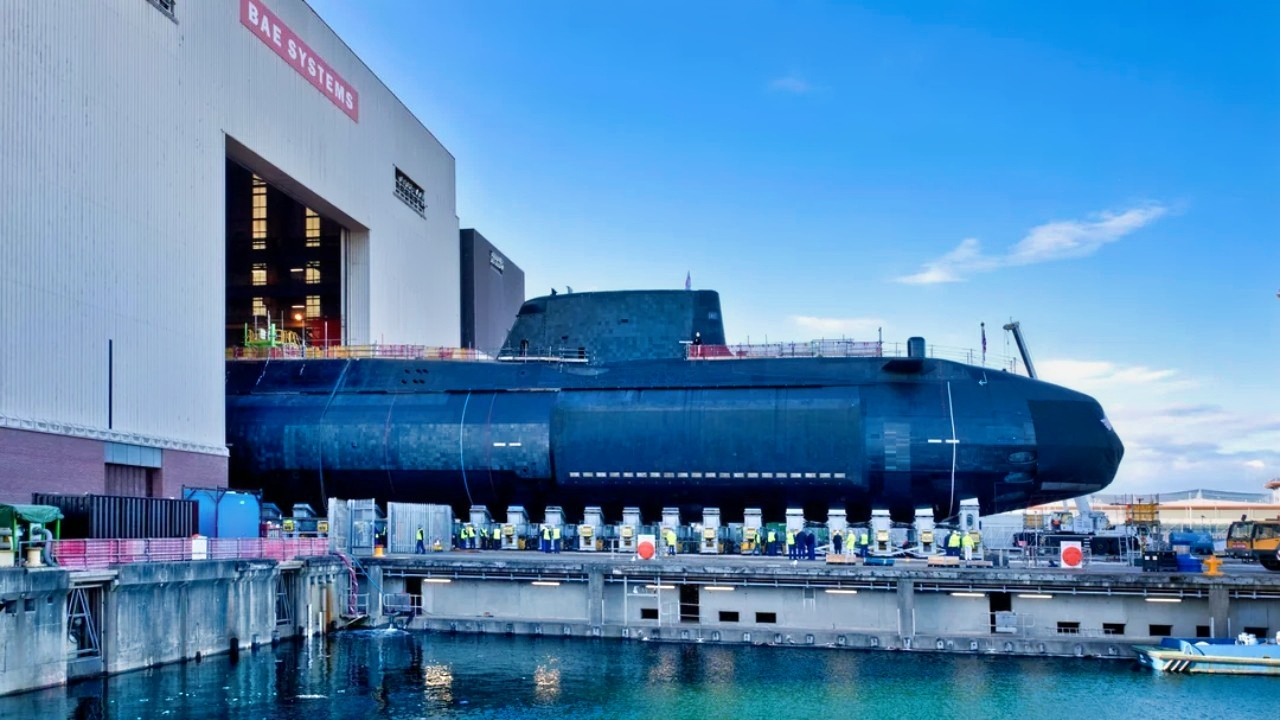
Key Points and Summary – Britain’s Astute-class attack submarines, heirs to the Trafalgar boats, marry quiet nuclear propulsion with heavy punch—and that punch is growing.
-Block V Tomahawks extend precise, retargetable strikes to ~1,000 miles, while upgraded Spearfish torpedoes add faster, quieter fiber-optic guidance and a safer warhead.
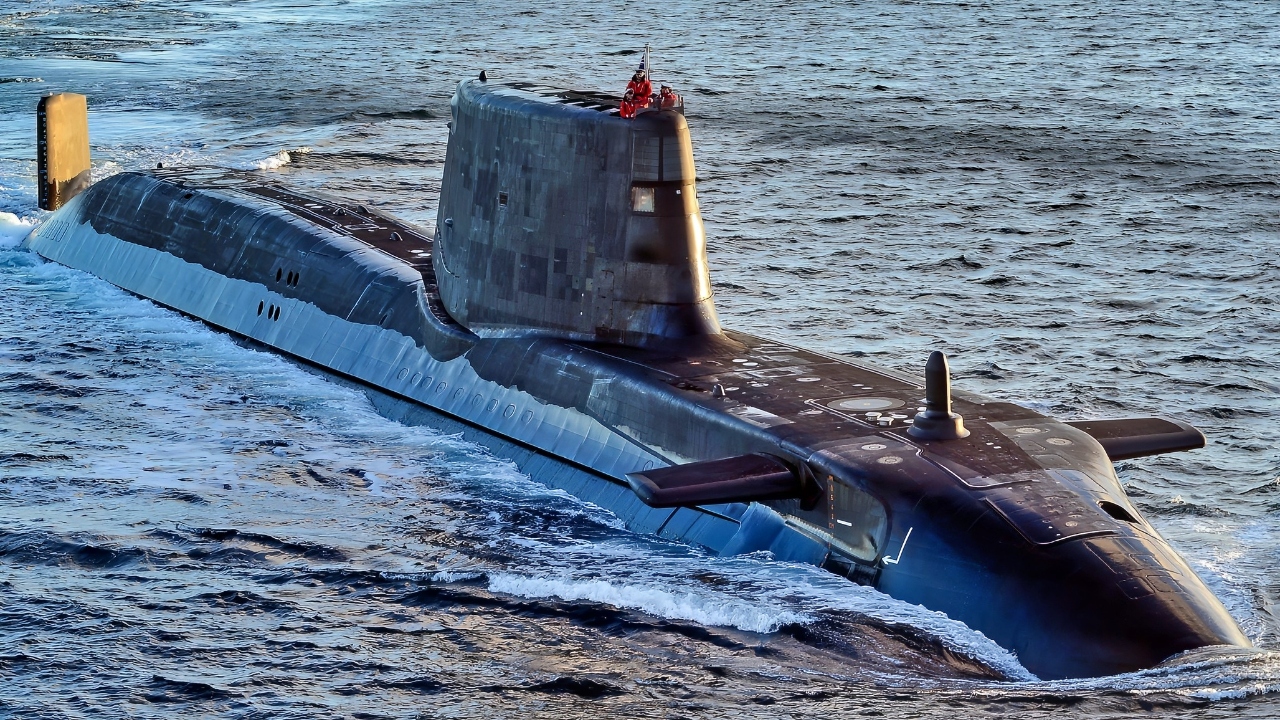
Astute-Class Submarine Royal Navy. Image Credit: Creative Commons.
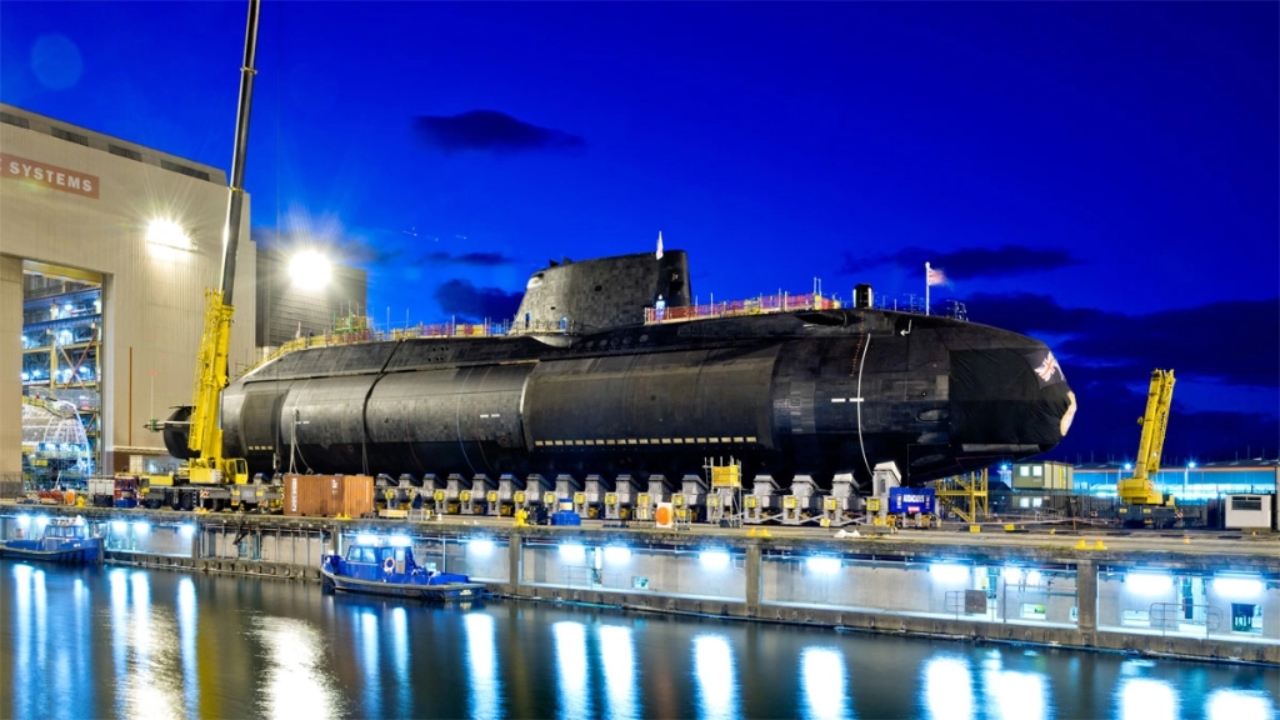
Astute-Class Submarine. Image Credit: Creative Commons/BAE Systems.
-Wrapped in anechoic tiles and powered for near-unlimited range, Astutes were built to shadow Soviet subs; today they deter peers, strike ashore, and anchor UK undersea power.
-With the final hull nearing completion and AUKUS submarines on the horizon, the Astute program bridges Cold War roots to a tighter U.S.–UK–Australia undersea alliance.
Astute-Class: How Britain’s Silent Hunters Got a Big-Range Upgrade
The British Astute-class is the Royal Navy’s latest generation of attack submarines. Replacing the older Trafalgar-class, the seven-sub Astute-class is nearly complete, with a single submarine still at port being built.
Thanks to nuclear propulsion, a robust weapon loadout, and a powerful sonar suite and other sensors, the Astutes count themselves as among the most advanced SSNs in the world. But despite their positive qualities, they are in the midst of several weaponry upgrade programs that are poised to expand the submarine’s combat reach.
This combat reach was the centerpiece of the Astute-class Cold War-era operational objective: find and track the increasingly sophisticated submarines leaving Soviet ports.
Alongside their American counterparts, the Seawolf-class, the Royal Navy’s Astutes would have been tasked with hunting down Soviet submarines if the Cold War ever went hot. Though that operational role evaporated with the end of the Cold War and the collapse of the Soviet Union, the class’s production continued.
The Tomahawks and the Torpedos
The centerpiece of the Astute-class’s precision strike capability is the American-made Tomahawk cruise missile.
With a range greater than 1,600 kilometers, or more than 1,000 miles, the Astutes launch Tomahawks from their 533mm torpedo tubes and can strike warships on the surface or targets on land while remaining submerged below the surface of the ocean.
The Block IV Tomahawks arm the Astute-class and are notable for their flexibility. The weapons can loiter in the air for a few hours, remaining airborne and able to respond to targeting information at a moment’s notice.
A two-way datalink via satellite facilitates the transmission of retargeting coordinate information. But the Block IV is not just a blind cruise missile: leveraging an on-board camera, it can also snap pictures and transmit them in near real time to assess the outcome of previous strikes, helping determine whether follow-up strikes are necessary.

Astute-Class. Image Credit: Creative Commons.
Though the Astute-class’s American counterparts are taking the lead, the Astute-class is also moving toward the latest Tomahawk standard, Block V.
“In a £265 million contract with the US Government, with maintenance and technical support at the UK sites of BAE Systems, Babcock International and Lockheed Martin, the Royal Navy’s Astute-Class submarines will be armed with an enhanced Block V standard missile, capable of striking severe threats at a range of up to 1,000 miles,” a statement from the British Ministry of Defense reads.
“The upgraded missile will be able to travel further than the previous Block IV iteration, maintaining a precision-strike capability that is unmatched in range and accuracy. The upgrade will also make the weapon less vulnerable to external threats, with modernised in-flight communication and target selection.”
Though seemingly poised to expand its missile capabilities, the Astute-class is, after all, a naval vessel, and as such has a robust array of weaponry for engaging surface ships and other submarines at sea, thanks to the Royal Navy’s 533mm Spearfish torpedo that the Astutes carry onboard.
That torpedo’s guidance system is redundant and combines active sonar to find targets as well as wire guidance that spools out of the torpedo and trails behind it, giving the Spearfish the ability to retarget mid-course as well as the ability to reacquire targets should they conduct evasive maneuvers.
And like the Tomahawks, the Spearfish is also being upgraded. A fiberoptic guidance system will replace the older wire guidance system. A redesigned warhead improves safety and handling, and the Spearfish’s fuel system has been completely replaced too, reducing the torpedo’s acoustic profile.
What Next?
Impressive though the Astute-class’s weaponry is, arguably the submarine’s more remarkable capabilities are organic to the submarine itself: the Astute-class’s radar-mitigating features, like anechoic tiles — essentially rubberized tiling covering the submarine’s hull — that absorb and diffuse adversary sonar and help keep the Astute-class “invisible”.
The submarine’s sonar system, developed by Thales, allows the Astutes to detect enemy submarines and surface ships from far away, and thanks to the submarine’s nuclear propulsion, its range is limited only by crew food requirements.
Though the Astute-class roll-out into the Royal Navy is not yet finished — the last of the seven-submarine class is still undergoing sea trials — its successor has already been named: the AUKUS-class.
Named after the tripartite nuclear propulsion agreement between Australia, the United Kingdom, and the United States, the submarines built under that agreement will serve both the Royal Navy and the Royal Australian Navy.
The details of that AUKUS-class have yet to be hammered out, as do the submarine’s production timeline.
Though policy wonks, particularly the Pentagon’s planning head Elbridge Colby, have questioned the wisdom of building nuclear-powered submarines in America for the Australians, given the production disruptions that could create for the United States Navy’s own warships and submarines, the billions of dollars Australia has pledged and paid to American shipbuilders to keep production lines up and on-schedule seem to have mollified the naysayers in Washington.
Though the Astute-class has weathered some controversies, the Astute-class helped the Royal Navy bridge the gap from the Cold War to today.
And once retired, the submarines will have been at least partly responsible for the unprecedented closeness in the British-American underwater relationship.
About the Author: Caleb Larson
Caleb Larson is an American multiformat journalist based in Berlin, Germany. His work covers the intersection of conflict and society, focusing on American foreign policy and European security. He has reported from Germany, Russia, and the United States. Most recently, he covered the war in Ukraine, reporting extensively on the war’s shifting battle lines from Donbas and writing on the war’s civilian and humanitarian toll. Previously, he worked as a Defense Reporter for POLITICO Europe. You can follow his latest work on X.
More Military
The Mach 3 SR-71 Blackbird Spy Plane ‘Broke All the Rules’ Thanks to Titanium
SR-72: The Air Force’s New Hypersonic Bomber?
Russia’s Admiral Kuznetsov Aircraft Carrier Is Now ‘Non-Operational’
New Army M1E3 Tank vs. Russia’s T-14 Armata: Who Wins Summed Up in 2 Words


