

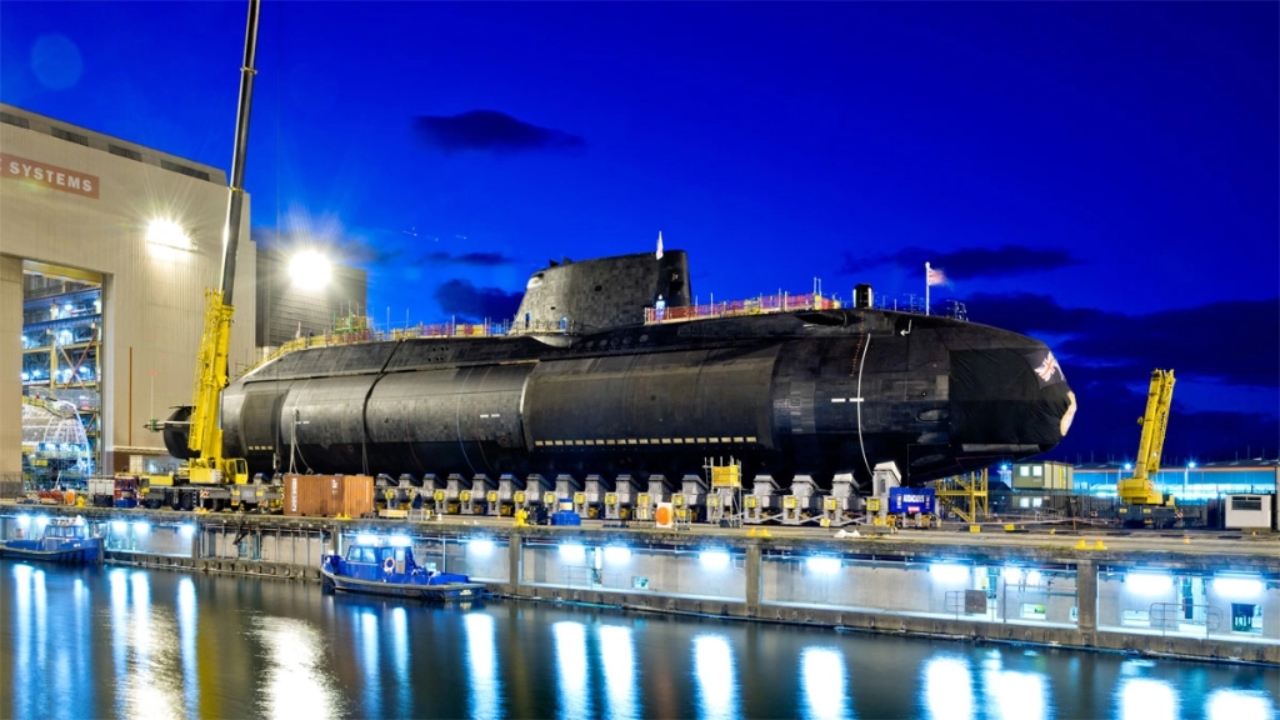
Key Points and Summary on Astute-Class Submarines – The Royal Navy’s Astute-class nuclear-powered attack submarines (SSNs) are among the most advanced in the world, combining cutting-edge stealth, sensors, and firepower.
-These 7,400-ton hunter-killer submarines are equipped with the powerful Sonar 2076 suite, which can reportedly track targets up to 60 miles away, and are covered in 39,000 anechoic tiles, making them “as quiet as a baby dolphin.”
-Their armament includes six torpedo tubes capable of launching up to 38 Spearfish heavyweight torpedoes and Tomahawk land-attack cruise missiles.
-These boats represent the pinnacle of British submarine technology and will be replaced by the SSN-AUKUS class in the late 2030s.
Meet the Asute-Class Submarine: Pride of the Royal Navy
To quote one of history’s most famous sayings, “The sun never sets on the British Empire.” A significant reason this saying rang true for many years was the power projection capabilities of Great Britain’s Royal Navy (RN), hence the refrain from Thomas Arne’s patriotic song: “Rule Britannia! Britannia rule the waves.”
Neither of those utterances carries the same weight they once did, as the British Commonwealth in general and the Royal Navy in particular are shadows of their former selves in terms of sheer size. However, the Royal Navy certainly remains a technologically capable maritime military power, as demonstrated by its submarine fleet.
Case in point: it was a Royal Navy submarine, the Churchill-class boat HMS Conqueror (Pennant No. S48)—under the leadership of then-Comm. Chris Wreford-Brown—that accomplished history’s last confirmed sinking of an enemy surface warship by a submarine, doing so on May 2, 1982, against the Argentine cruiser ARA General Belgrano during the Falkland Islands War.
The proud banner of the British submarine fleet is now being carried on by its Astute-class nuclear-powered attack submarines (SSNs).
We now takes a deeper dive into the story of the Astute-class subs.
Astute-Class Initial History and Specifications
Built by BAE Systems Maritime UK (headquartered in Barrow-in-Furness, Cumbria, England), the Astute-class boats came along as replacements for the Trafalgar-class hunter-killer subs (the last of which, HMS Triumph [S93], completed her final mission in December 2024 and is expected to be decommissioned sometime this year). The lead ship of the class, the eponymous HMS Astute, was laid down on January 31, 2001, launched on June 8, 2007, commissioned on August 27, 2010, and attained full operational status in May 2014.
Since then, four more of the boats have been commissioned between March 2013 and August 2022: HMS Ambush (S120), Artful (S121), Audacious (S122), and Anson (S123). Meanwhile, HMS Agamemnon (S124) and HMS Achilles (S125) are still under construction.
As the official Royal Navy info page proudly proclaims, “The Astute-class submarines are the largest, most advanced and most powerful attack submarines ever operated by the Royal Navy, combining world-leading sensors, design and weaponry in a versatile vessel.”
In terms of tech specs and vital stats, that’s quantified as follows:
Displacement: 7,400 tons surfaced; 7,800 tons submerged
Hull Length: 97 meters (318 feet 3 inches)
Draft: 10 meters (32 feet 10 inches)
Beam Width: 11.3 meters (37 feet 1 inch)
Test Depth (aka Safe Operating Depth): In excess of 300 meters (980 feet)
Crew Complement: 98 commissioned officers and enlisted sailors
Astute-Class Armament:
Six 533 mm (21-inch torpedo tubes) for the Spearfish heavyweight torpedo
Stowage of up to 38 missiles such as the Tomahawk IV Land Attack Cruise Missile (TLAM)
The powerplant is a Rolls-Royce Pressurized Water Reactor 2 (PWR2) that enables the boats to attain a top speed of 30 knots.
These boats are also highly stealthy (“quiet as a baby dolphin” as some observers claim, or to quote that Royal Navy info page again, “the quietest submarines ever constructed”) thanks to their covering consisting of 39,000 anechoic tiles. Though the exact chemical composition of these tiles is classified, it can be ascertained—courtesy of the Naval Institute—that they’re made of “an elastic material containing tiny air pockets and are optimized to reduce the typical sonar frequencies of homing torpedoes.”
As if that weren’t impressive enough, the Astutes are blessed with a passive/active sonar system that enables them to track targets up to 60 miles away.
Operational History in Brief
To cite that official RN info page again, “In the first part of 2012, they proved their ability to prepare and launch Tomahawk missiles, successfully firing 2 missiles from the Gulf of Mexico and accurately hitting the targets on the test range in Northern Florida.” (NOTE: The Tomahawk IVs have a 1,000-mile range.)
Due to their secretive nature, many of the specifics of the submarines’ deployments remain classified. However, it is known that in April 2025, HMS Astute briefly participated in Operation HIGHMAST, an eight-month Carrier Strike Group 25 exercise led by the Queen Elizabeth-class carrier HMS Prince of Wales (R09). Meanwhile, rewinding to June 2022, HMS Audacious made her maiden operational deployment by carrying out NATO security patrols in the Mediterranean.
The Future of the Astute-Class
As impressive as the Astute-class subs are, nothing lasts forever, and indeed, these boats are slated to be eventually replaced by the SSN-AUKUS fleet of SSNs.
However, these latter submarines aren’t expected to enter service until the late 2030s, which means the Astutes still have a solid decade and a half to continue proving their worth.
About the Author: Christian D. Orr, Defense Expert
Christian D. Orr is a Senior Defense Editor. He is a former Air Force Security Forces officer, Federal law enforcement officer, and private military contractor (with assignments worked in Iraq, the United Arab Emirates, Kosovo, Japan, Germany, and the Pentagon). Chris holds a B.A. in International Relations from the University of Southern California (USC) and an M.A. in Intelligence Studies (concentration in Terrorism Studies) from American Military University (AMU).


