


Key Points and Summary – The “Ledeen Doctrine”—the neoconservative idea that the U.S. must periodically crush a small nation to demonstrate power—appears to be guiding a new potential conflict with Venezuela.
The Buildup: The USS Gerald R. Ford and a massive naval task force have arrived in the Caribbean, signaling the most significant buildup since the Cuban Missile Crisis.

The world’s largest aircraft carrier, USS Gerald R. Ford (CVN 78) (front) and the Arleigh Burke-class guided-missile destroyer USS Bainbridge (DDG 96) participate in an integrated phase training event, March 23, 2025. The Gerald R. Ford Carrier Strike Group is underway in the Atlantic Ocean completing integrated naval warfighting training. Composite Training Unit Exercise (COMPTUEX) is the Joint Force’s most complex integrated training event and prepares naval task forces for sustained high-end Joint and combined combat. Integrated naval training provides America’s civilian leaders and commanders highly-capable forces that deter adversaries, underpin American security and economic prosperity, and reassure Allies and partners.(U.S. Navy photo by Mass Communication Specialist 2nd Class Maxwell Orlosky)
The Target: Unlike past interventions, Venezuela is a substantial adversary with state militias, 31 million people, and a regime that retains key loyalty, making a “smooth transition” unlikely.
The Risk: An attack risks triggering a massive refugee crisis, empowering China in the region, and destroying what remains of U.S. soft power in Latin America.
The Iraq War Was a Disaster. Now the Same Ideology Is Targeting Venezuela.
The late Michael Ledeen was once one of the brighter stars in the neoconservative firmament. Though never as prominent as a Kagan or a Kristol, Ledeen was a card-carrying member of the American Enterprise Institute, the Project for the New American Century, and other post-Cold War citadels advocating a crusading, militaristic U.S. foreign policy.
After a short academic career (focused, ironically, on fascism), Ledeen became a full-time intriguer. He had a hand in Iran-Contra, Italy’s Years of Lead, and America’s disastrous invasion of Iraq.
As the Nation’s Jeet Heer wrote earlier this year, Michael Ledeen was “the Forrest Gump of American fascism.”
He also left a pithy directive to his country, as passed on by the writer Jonah Goldberg: “Every ten years or so, the United States needs to pick up some small crappy little country and throw it against the wall, just to show the world we mean business.” In the halcyon early days of the Global War on Terror (GWOT), when the most zealous cheerleaders of the Bush administration chanted “boys go to Baghdad, but real men go to Tehran,” this Ledeen Doctrine had countless adherents in and out of government.
Reality quickly intruded. The Iraq War was the worst U.S. foreign policy mistake since Vietnam, a fiasco that destabilized the Middle East and played a role in America’s own descent into political chaos. Despite constant agitation and intrigues, and new allies like the certifiably insane Lieutenant General Michael Flynn, Ledeen didn’t live to see a U.S. war with Iran: Donald Trump’s brief strike on the Islamic Republic took place a month after Ledeen’s death.
Enter the Ledeen Doctrine
The Ledeen Doctrine, though, is alive and well in the second Trump Administration.
Despite occasional online rants, the president shies away from confrontation with major powers. His trade war with China has been paired with a questioning of existing security commitments in the Pacific, while his enthusiasm for supporting Ukraine in its war with Russia waxes and wanes by the week.
But beating up on a small country? There, the Trump administration is only too eager to fight. Within 60 days of assuming office, they unleashed “Operation Rough Rider,” a punitive operation of sea-launched strikes, on Yemen’s Houthi regime. Boredom and an appreciation of the air campaign’s futility eventually set in, and a ceasefire was agreed to after six weeks of bombing and the expenditure of $1 billion of American ordnance. A doubling of strikes in Somalia and the attack on Iran eventually followed.
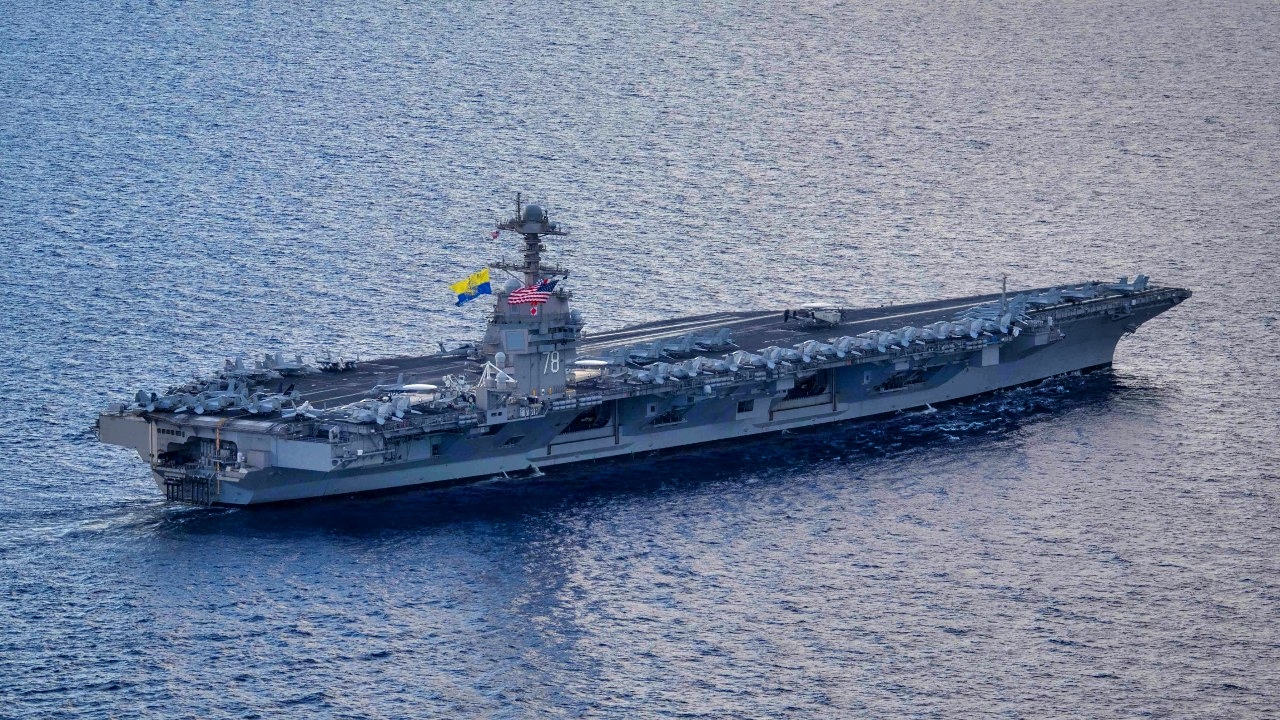
The world’s largest aircraft carrier USS Gerald R. Ford (CVN 78) sails in the Mediterranean Sea, Dec. 31, 2023. The U.S. maintains forward deployed, ready, and postured forces to deter aggression and support security and stability around the world. (U.S. Navy photo by Mass Communication Specialist 2nd Class Jacob Mattingly)
Trump’s moves in Central and South America appear to be far more important, and more ideologically driven, than bombing as usual in the Middle East. The dollar swap bailout of Argentina, the sanctions against Brazil for defending its democracy, and the flagrantly illegal strikes on purported narco-trafficker boats in the Caribbean are all part of a reorientation of U.S. strategy toward “hemispheric defense.”
None of it looks defensive to Latin Americans. The “Donroe Doctrine” may be a return to historical form.
Still, with epigones like Javier Milei and Jair Bolsonaro, Trump cannot even claim to be following Woodrow Wilson’s paternalistic attempt to “teach the South American republics to elect good men.” America’s new round of neighborhood imperialism is notable only for its caprice and strategic stupidity.
The boat strikes have now killed 83 people, all of whom could have been detained and none of whom could have reached American shores on their interrupted journeys. The damage to America’s soft power and relationships is real and growing. But a far bigger operation appears imminent.
The U.S. Navy Moves An Aircraft Carrier
The aircraft carrier USS Gerald R. Ford, America’s largest warship – indeed, the largest warship in the world – arrived in the Caribbean Sea on Sunday. The U.S. force there now stands at a fifth of all deployed U.S. naval vessels in the world, the most significant naval buildup in the Caribbean since the Cuban Missile Crisis. This fleet, and supporting air assets and Marines afloat, is pointed at Venezuela.
Unlike the banana republic targets of earlier Republican presidents, Venezuela is a substantial country: more than twice the size of California and with a population of about 31 million, six million more than Iraq on the eve of the 2003 invasion. Though President Nicolas Maduro has wrecked the economy and crushed dissent, perhaps a third of the country still supports him.
In response to the U.S. buildup in the Caribbean, Maduro has fostered state militias and distributed arms to his supporters. His regime is maintaining its cohesion and the loyalty of key leaders.
As the United States saw in numerous failed states during the Global War on Terror, a collapse of state authority inevitably summons legions of accidental guerrillas, especially in a land awash in arms. Should Maduro’s regime crumble in the face of American attacks, the odds of a smooth transition to democracy are low.

President Donald Trump and Vice President JD Vance depart after an event celebrating the 2025 College Football National Champion Ohio State University Buckeyes, Monday, April 14, 2025, at the South Portico of the White House. (Official White House Photo by Emily J. Higgins)
The stated justification for U.S. strikes on Venezuela is farcical: Venezuela produces little if any of the fentanyl that has killed so many Americans.
What Could Happen Next?
Suppose there is a method to Trump’s madness. In that case, it may be an attempt to knock out Venezuela (and perhaps Cuba next) as obstacles preventing a vertical integration of Latin American regimes and economies in an American-led order.
But throwing this not-so-little country against a wall courts real blowback. America was mainly insulated from the shock waves of its post-9/11 wars: an ocean ensured that refugees, terrorism, and the resulting reaction affected Middle Eastern and European states. But a failed state in Venezuela will destabilize the region and drive refugees to America’s borders, as after past U.S. meddling.
Instead of locking in U.S. hemispheric dominance, regime change in Venezuela is likely to destroy it. Perceptions of the United States, in a tailspin since Trump’s inauguration, will crater. China, already the largest trade partner for the vast majority of South American nations, will stand in stark contrast to an America that has chosen to be an overtly destructive, imperialist power in the region.
Many in Washington seem to hope that if a U.S. attack on Venezuela comes, it will be confined to CIA skullduggery or bombing. But as two experts recently noted in Foreign Affairs, covert action fails far more often than it succeeds, while U.S. airpower alone has never ousted a foreign leader. The temptation to use other means, like special operations raids to kill Maduro and his marshals, will be high. But Venezuela is a far less permissible operating environment than the counter-terrorism wars in which the Joint Special Operations Command raiding machine excelled.
Trump appears to be genuinely conflicted about military intervention in Venezuela. Should he choose to follow the old neoconservative script, the administration and the hemisphere will get front row seats to another tragedy.
About the Author: Dr. Gil Barndollar
Dr. Gil Barndollar is a Senior Research Fellow at the Catholic University of America’s Center for the Study of Statesmanship and a Non-Resident Fellow at Defense Priorities. His research focuses on military manpower and mobilization. From 2009 to 2016, Gil served as an infantry officer in the United States Marine Corps.


