

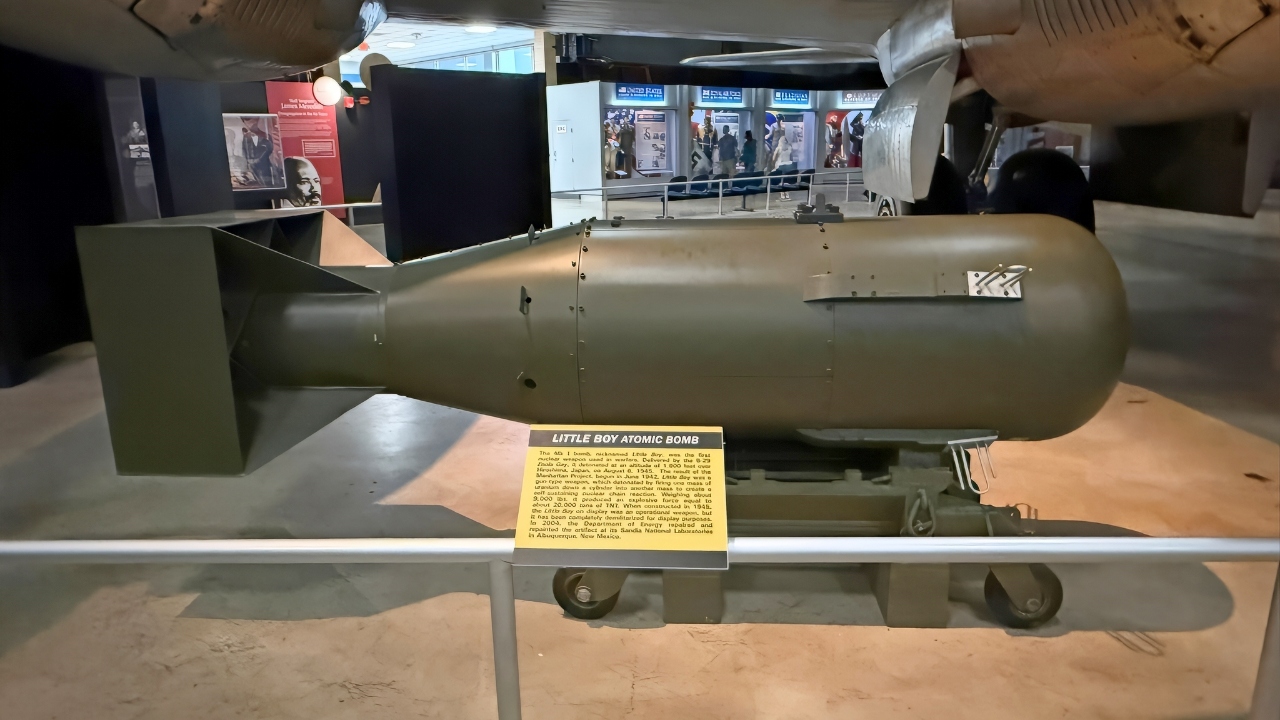
Key Points and Summary – President Trump’s Oct. 29, 2025 call to resume U.S. nuclear testing threatens a 30-year global pause and underscores a wider arms-control breakdown.
-With INF and Open Skies gone and New START imperiled in 2026, distrust is rising as Russia “mirrors” Washington’s refusal to ratify the Comprehensive Test Ban Treaty.
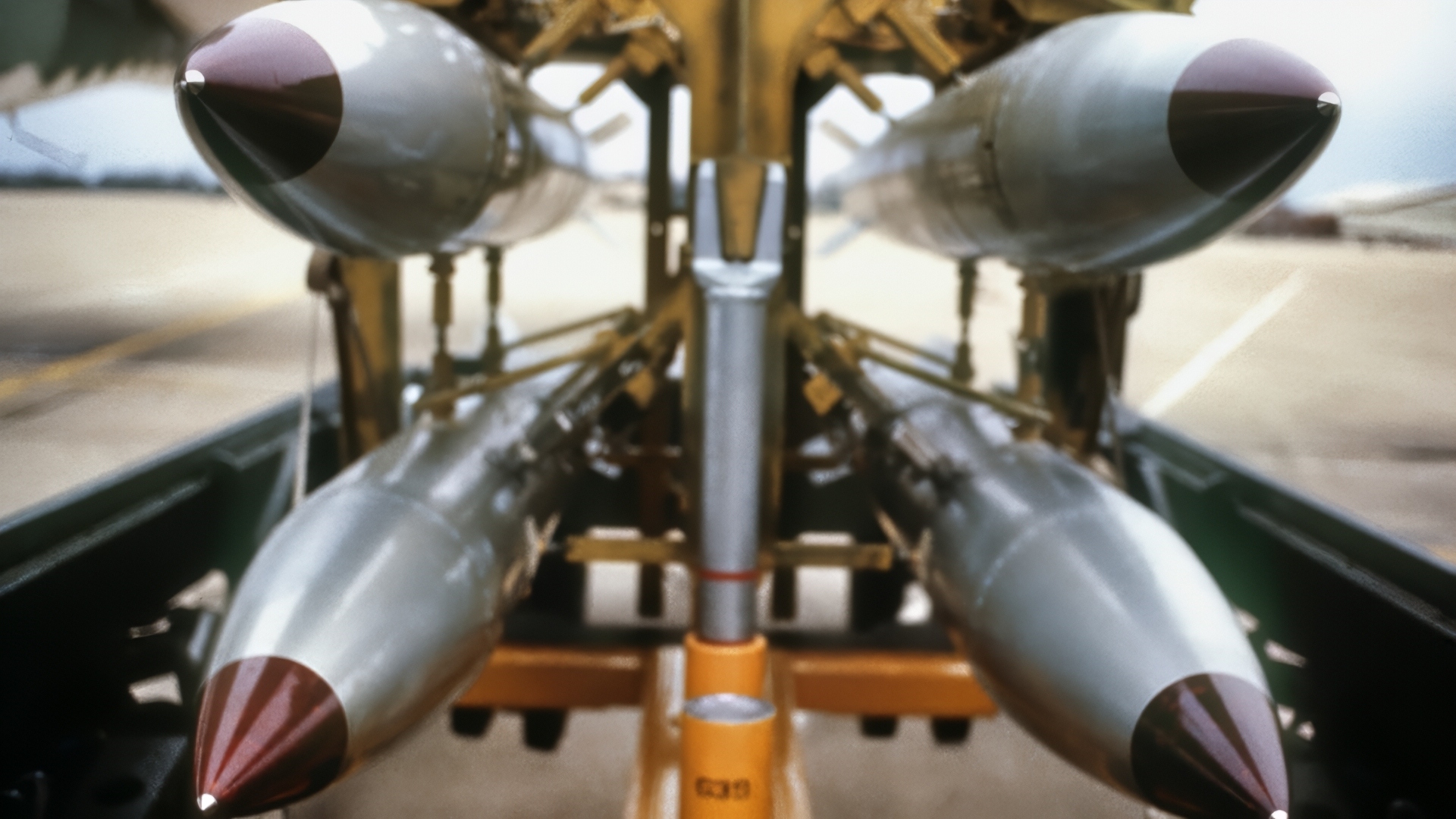
A front view of four nuclear free-fall bombs on a bomb cart. Image Credit: Creative Commons.
-Claims of secret Russian or Chinese tests remain unproven; any U.S. move would likely start with non-explosive “testing” upgrades.
-Rather than ignite a new race, the U.S. should reverse course: submit the CTBT to the Senate, rally allies, and lock in the testing taboo—restoring leadership and reducing nuclear dangers.
Will the U.S. Restart Nuclear Tests? A Smarter Path Forward
President Donald Trump’s announcement on October 29, 2025, that the United States would resume the testing of nuclear weapons was greeted with dismay throughout the international community. If Trump carries out his pledge, it would mark the end of a long period in which all official or de facto members of the global nuclear weapons club had refrained from conducting such tests.
Global End Dates on Testing
The United States held its last test in September 1992, and the People’s Republic of China (PRC) held its last test in July 1996. The Russian Federation has never conducted a nuclear weapons test; Moscow’s last venture into that area took place in October 1990, when the Soviet Union still existed. Great Britain operated on a similar timetable (1991) and France just five years later (January 1996). India and Pakistan, two of the newer entrants into the ranks of nuclear weapons powers, both conducted their latest tests in May 1998.
Globally, the last confirmed episode was the detonation of an underground warhead by North Korea in early September 2017. Despite growing tensions between Washington and Pyongyang on multiple issues, and North Korea’s plethora of moves to advance its ballistic missile program, Kim Jong-un’s regime has not yet ended its moratorium on testing nuclear warheads.
Nuclear Shockwave Experienced Globally
Concern about the possible resumption of nuclear testing by multiple countries is understandable. However, one could see this development coming for years, as the strategic arms control system between the United States and Russia broke down.
Washington’s withdrawal from the Intermediate-Range Nuclear Forces (INF) Treaty in 2019 was a clear indication of trouble. Similarly, the collapse of the Open Skies agreement with Moscow in 2020 was also notable.
The New Start Treaty, set to expire automatically in February 2026, is also in jeopardy, despite Russia’s proposal for a one-year extension of the agreement. That crucial treaty caps the number of ICBMs at 1,550 for each side. The entire nuclear arms control system seems to be hanging by a thread.
Test Ban Treaty Cast Aside
The most directly relevant episode in the breakdown of cooperation on arms control between the United States and Russia that has produced the current surge of worries about nuclear testing was Washington’s longstanding failure to officially embrace the Comprehensive Test Ban Treaty (CTBT). Although the United States signed the treaty in 1996, it has never ratified the document. In November 2023, Russian President Vladimir Putin signed a law revoking Russia’s 2000 ratification of the CTBT.
In pushing through the de-ratification measure, Putin said that he merely sought to “mirror” the US position. Moscow had complained about Washington’s lackadaisical attitude toward that issue for years. Nevertheless, Russia’s repudiation of its previous position underscored the growing estrangement of Moscow and Washington on arms control as well as a host of other issues.
Fortunately, the 1963 Atmospheric Test Ban Treaty, formally known as the Partial Test Ban Treaty (PTBT), remains intact, and no country with a nuclear weapons capability has indicated an intention to defy the document’s prohibition on atmospheric tests.
Trump Launches Nuclear Spark
In his October announcement, President Trump stated that he had directed the Pentagon to begin testing nuclear weapons “on an equal basis” with Russia and China. Trump now openly accuses both Russia and China (as well as Pakistan) of conducting secret nuclear tests. China has explicitly denied his allegations. Russia has done the same.
However, Putin floated the possibility of new tests by his country if the United States goes ahead with such steps.
The evidence for alleged secret tests by Russia and China appears to be sketchy at best. However, unless Trump is willing to disclose information in highly classified US files, there is no way to be certain.
Given the president’s notoriously mercurial nature on a vast array of issues, it’s not entirely certain that Washington will follow through on his order to resume testing. Even if the government does so and takes steps quickly, the significance likely will be more symbolic than substantive—at least in the short term.
Indeed, Trump’s comment about resuming testing “on the same basis” as Russia and China indicates that there is not about to be a surge of underground nuclear explosions in the immediate future. Those countries are not currently conducting such activities, or we would have evidence of suspicious seismic events.
Nuclear Testing’s Broader Scheme
Other actions can qualify as the testing of nuclear weapons, though. Upgrading computer hardware and software in such weapons might constitute activities in that category. Some of these upgrades include efforts to increase targeting accuracy or the survivability of deployed weapons.
It is highly probable that any new rounds of “nuclear weapons tests” would take such forms rather than a series of underground explosions that produce easily detectable seismic activity and would create nasty diplomatic incidents.
Nevertheless, the prospect of a widespread resumption of fresh nuclear weapons tests (however defined) after such a long hiatus would be deeply unsettling and constitute further evidence that the entire global nuclear arms control system might be unraveling. Instead of adopting measures that would inevitably create greater global tensions, the United States should lead efforts to move the dynamic in the opposite direction. Indeed, Washington has a moral obligation to do so.

B-2 Spirit stealth bombers assigned to Whiteman Air Force Base taxi and take-off during exercise Spirit Vigilance on Whiteman Air Force Base on November 7th, 2022. Routine exercises like Spirit Vigilance assure our allies and partners that Whiteman Air Force Base is ready to execute nuclear operations and global strike anytime, anywhere. (U.S. Air Force photo by Airman 1st Class Bryson Britt)
The current turmoil might well have been avoided if the United States had ratified the CTBT in a timely fashion.
The Trump administration needs to muster both its political courage and its foreign policy vision. The president should announce with maximum fanfare that he is now doing something that his predecessors have failed to do. However belatedly, he is sending the treaty to the Senate for ratification.
Senators would be hard-pressed to defy global sentiment and refuse to have the United States finally join the CTBT. If President Trump is serious about receiving the Nobel Peace Prize, this is a great opportunity for him to achieve that goal and deserve it.
About the Author: Ted Galen Carpenter
Ted Galen Carpenter is a senior fellow at the Randolph Bourne Institute and a contributing editor at The National Security Journal and The American Conservative. He is the author of 13 books and more than 1,500 articles on national security, international affairs, and civil liberties. His latest book is Unreliable Watchdog: The News Media and U.S. Foreign Policy (2022).
More Military
‘Skipper, We Have Been Hit’: Tiny Nuclear Sub ‘Sank’ $4.5 Billion U.S. Navy Aircraft Carrier
China’s Military ‘Quantum Leap’ Doesn’t Add Up
Russia’s Air Defenses Are Springing Leaks—and Ukraine Is Exploiting Them
Japan Might Be Ready to Fight for Taiwan. Would America Do the Same?


Krystal cane
November 12, 2025 at 8:02 pm
I’m totally okay with nuclear weapons testing with real nuclear weapons as long as it’s off the coast of Florida
bis-biss
November 12, 2025 at 8:38 pm
As europe pursues a war of annihilation against its anti-nazi enemies in europe, donald trump is intending on pursuing his own war of annihilation against alleged narco-states in the caribbean.
Thus, it’s clear war is taking place everywhere, even in the middle east, where ceasefires have been agreed to.
Ceasefire is only effective and real in name only.
Nuclear weapons are the only thing that can stop the warmongers. Nothing else can.
Jim
November 13, 2025 at 9:49 am
The author does an excellent rundown on the history and present status of nuclear testing.
Many relevant professionals state nuclear testing isn’t necessary to insure these weapons work if used (hopefully never).
But there is an underlying danger as well.
There seems to be an undertow or assumption present among many military analysts about how far conventional war can go between great powers (nuclear powers) without resorting to nuclear weapons.
Publicly, these military analysts claim the risk of nuclear war breaking out amid a conventional war is low. But every now and then, they let slip statements or phrases with suggest should the United States overreach militarily against, say, Russia or China (peer competitors) and the United States finds itself losing a conventional war (in Europe or over Taiwan) then the possibility of tactical nuclear weapons being used is possible.
One, tactical nukes, these days, are as big as the A-bombs dropped on Hiroshima and Nagasaki. Look at the pictures from those blasts, these were devastating over large areas.
To think the other side is going to back off after the United States uses tactical nukes is misguided and arrogant… a sign of hubris… which will lead to disaster.
Another idea which slips out now and then, but is even more heavily guarded, is worse: the United States can win a nuclear war in a first strike military attack.
No we cannot.
MAD stands for Mutual Assured Destruction and a corollary to the acronym is anybody who thinks we can win a first strike attack is mad or insane and instead of being respected and listened to, should immediately be sent to an insane asylum.
This is true. But there are analysts who maintain the idea of ‘winning’ a nuclear war as a sliver in the back of their mind, a secret conceit, if you will… or the idea is expressed as, “Don’t worry if we get in trouble in a conventional war, we can always pull our bacon out of the fire with tactical nukes.”
War is a slippery slope, the longer it goes on or the more intense it gets, the greater the temptation is to resort to more drastic measures. This seemingly happens in all major wars.
Why is the expression, “slippery slope” used?
Because once on the slope you can’t stop yourself from sliding down it… even if you want to stop.
Let’s not get on that slope to begin with.