


Key Points and Summary – China is unveiling a torrent of new capabilities—from the Fujian carrier to lasers, giant UUVs, and advanced drones—while parades and leaks blur hype and reality.
-U.S. experts told The War Zone the challenge is twofold: collecting on secretive programs, especially missiles and directed-energy systems, and fielding counters that demand money and time.
-But something doesn’t add up: one must separate the hyper from the reality.
-Analysts stress distinguishing mockups from breakthroughs and warn against underfunding intelligence as Beijing accelerates.
-Others note many advances were expected and the community isn’t overwhelmed.
Bottom line: China’s military growth is real but uneven; U.S. deterrence hinges on resourcing intelligence and closing the counter-threat gap.
China’s Military Keeps Growing By the Day
Over the last year or so, China has been showcasing numerous new weapons and hinting at even more.
Back in September, China hosted a parade in Beijing to mark the 80th anniversary of the end of World War II, known officially as the “80th Anniversary of Victory in the Chinese People’s War of Resistance Against Japanese Aggression and the World Anti-Fascist War.”
Attended by the likes of Russian President Vladimir Putin and North Korean leader Kim Jong Un, who both made rare visits to China, the parade featured a variety of weapons, including new ones.
The LY-1 laser weapon was featured as part of China’s new array of drones, lasers, and AI-enhanced weapons. The 65-foot-long AJX002 giant submarine drone was also featured, as was the latest version of the Dongfeng-5 intercontinental ballistic missile, the DF-5C.

DF-5C Missile from China. Image Credit: Chinese State Media Screenshot.
“China not only wants to augment, but replace traditional structures,” defense analyst Michael Raska told the BBC after the parade.
Most recently, this week, China finally commissioned the Fujian, its latest and most advanced aircraft carrier.
An Array of New Weapons
The War Zone, in an overview published this week, looked at China’s recent advances in air combat specifically.
“Autonomous combat drones, from relatively small to extremely large, and everything in between, to the emergence of tailless J-XDS and J-36 tactical jets, and ever sub-variations of them, as well as flying a stealth fighter from its new carrier, are among the revelations piling up at an increasing pace,” the War Zone reported.
These new weapons are sometimes introduced at military parades or through social media leaks. But not always, and there are likely some things China is doing in weapons development that the West has incomplete knowledge of.
How big a concern is that? This week, TWZ looked at the big question of whether the U.S. intelligence community maintains “the raw capacity to adequately deal with this now and sustain it for the foreseeable future.”
Neither the CIA nor the Defense Intelligence Agency responded to the outlet’s questions, but they did hear from several intelligence experts on that key question.
The Experts Speak
China’s recent weapons advances do indeed “pose a challenge to U.S. intelligence collection efforts,” Timothy Heath, senior international defense researcher at RAND Corporation, told TWZ. He added that it’s getting more difficult for U.S. intelligence to spot new Chinese weapons, especially due to the “secretive nature of Chinese weapons programs.”
But it also, Heath said, depends on the weapons.
“Some types or programs are easier to monitor and predict than others. Warships, for example, are hard to hide and only built in a few locations. This makes it easier for U.S. intelligence to monitor. Missiles, directed energy, and hi-tech systems are smaller and easier to hide, which makes it harder for U.S. intelligence to collect.”
An even bigger challenge, Heath told TWZ, is finding a way to “counter” these new weapons.
“Chinese technology has improved considerably and many of their weapons and equipment systems lag only that of the United States,” Heath said. “These are sophisticated and deadly systems and could pose a serious challenge to U.S. military forces on the battlefield. Developing counters to weapons such as hypersonic anti-ship missiles, advanced surface-to-air missiles, and stealth aircraft all require enormous sums of money and new technology.”
Also weighing in on TWZ was Brad Bowman, senior director at the Foundation for Defense of Democracies (FDD) Center on Military & Political Power.
Bowman looked at what was unveiled at that parade back in September.
“It is vital that the United States Intelligence Community and the Pentagon understand the capabilities of the systems displayed, distinguishing between systems that are hyped versus those that represent real advancements in capability,” Bowman told TWZ, acknowledging that figuring out the difference could be difficult.
“The importance and difficulty of this task is another reason why we need a large, effective, and well-funded intelligence community to understand our adversaries, their intentions, and their military capabilities – so decision makers can make informed decisions on how to respond,” he added.
He also appeared to take a dig at efforts to find government “efficiency.”
“I am all for efficiency in government, but the effectiveness of our intelligence community is a higher priority than efficiency, particularly in this dangerous geo-strategic moment for Americans,” Bowman told TWZ.
He added that “the split screen between a historic expansion in military capabilities in China and a government shutdown in America could not be more jarring and troubling.”
Also speaking to TWZ about China’s weapons was Zack Cooper, a senior fellow and Asia expert at the American Enterprise Institute.
“I think the United States is certainly concerned about some of the new systems shown by Beijing, but many experts have expected China to continue developing more advanced uncrewed systems and long-range missiles, so I wouldn’t say that those are huge surprises,” Cooper told the outlet.

YJ-20 Missile X Screenshot. Image Credit: X.
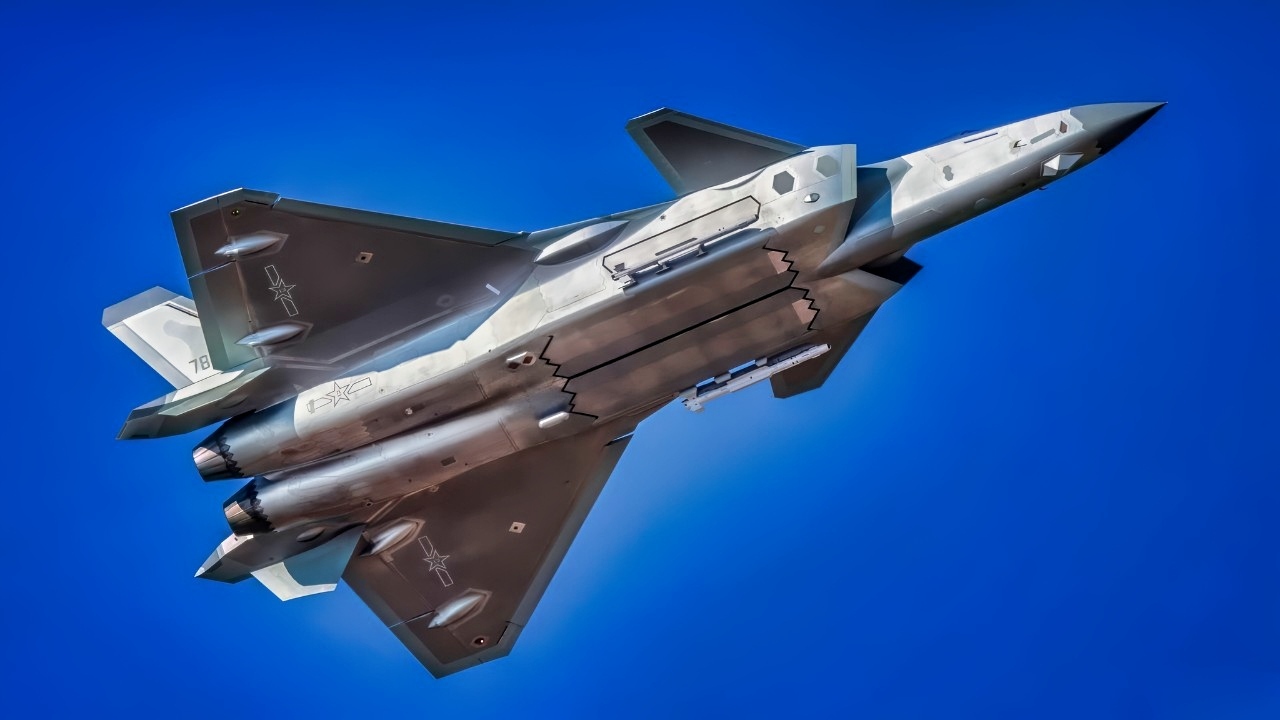
J-20 Takes Flight For China. Image Credit: Creative Commons/PLAAF.
He added that he does not believe that U.S. intelligence agencies are overwhelmed by what has been coming out of China.
And also speaking to TWZ was Christopher Miller, who was briefly acting Secretary of Defense during the waning days of the first Trump presidency.
“I don’t think there was concern about the ability to track and analyze Chinese weapons programs. It was a pretty standard collection requirement. Now, how effective they were ……I don’t know how effective they were. I am out of the business now,” Miller told TWZ. He also called it a “standard pathology” of the Intelligence Committee to always believe they aren’t getting enough resources.
“We should not make the Chinese out to be 10 feet tall”
Robert Peters, the senior research fellow for strategic deterrence in the Allison Center for National Security, was among many experts who spoke to TWZ, who cautioned not to overestimate what the Chinese are up to.
“They are a problem, both the quantity and diversity of systems displayed, but we should not make the Chinese out to be 10 feet tall,” he said. “It is unclear how many of these systems are real vs. how many are mockups. And even if they are all real, it is unclear how effective these systems are.”
What Does Trump Think?
When the president was asked, in September, his impressions of China’s parade, he made it clear he’d been watching.
“I thought it was very, very impressive,” Trump said at a White House event. “But I understood the reason they were doing it. And they were hoping I was watching, and I was watching. My relationship with all of them is very good. We’re going to find out how good it is over the next week or two.”
About the Author: Stephen Silver
Stephen Silver is an award-winning journalist, essayist, and film critic, and contributor to the Philadelphia Inquirer, the Jewish Telegraphic Agency, Broad Street Review, and Splice Today. The co-founder of the Philadelphia Film Critics Circle, Stephen lives in suburban Philadelphia with his wife and two sons. For over a decade, Stephen has authored thousands of articles that focus on politics, national security, technology, and the economy. Follow him on X (formerly Twitter) at @StephenSilver, and subscribe to his Substack newsletter.
More Military
The Russian Military Is In Crisis
The U.S. Military’s Superpower Status Is Slipping Away
The F-35 Looks Like It Might Be In Real Trouble Now
The F-22 Raptor Has 1 Enemy It Can Never Beat (Not Russia or China)


Jim
November 11, 2025 at 5:36 pm
Do you want to find out?
China may be overselling what their weapons systems can do. The United States has over sold weapons systems, or should I say military contractors have oversold their products? Prime example: the Patriot surface to air missile system… no matter what Trump says.
Sure, I’m concerned about the level of technology the Chinese weapons systems have, but what worries me more is the industrial production capacity China has already demonstrated to kick out huge numbers of weapons.
It’s not in the United States National Interest to get into a conventional arms race with China for a conflict we should never get into in the first place.
Watch, observe & measure, and determine the best we can what their true capabilities are and their intent.
And be realistic about what our military capabilities are and how they match up against China, to the best of our ability.
Peace on Earth depends on it.