

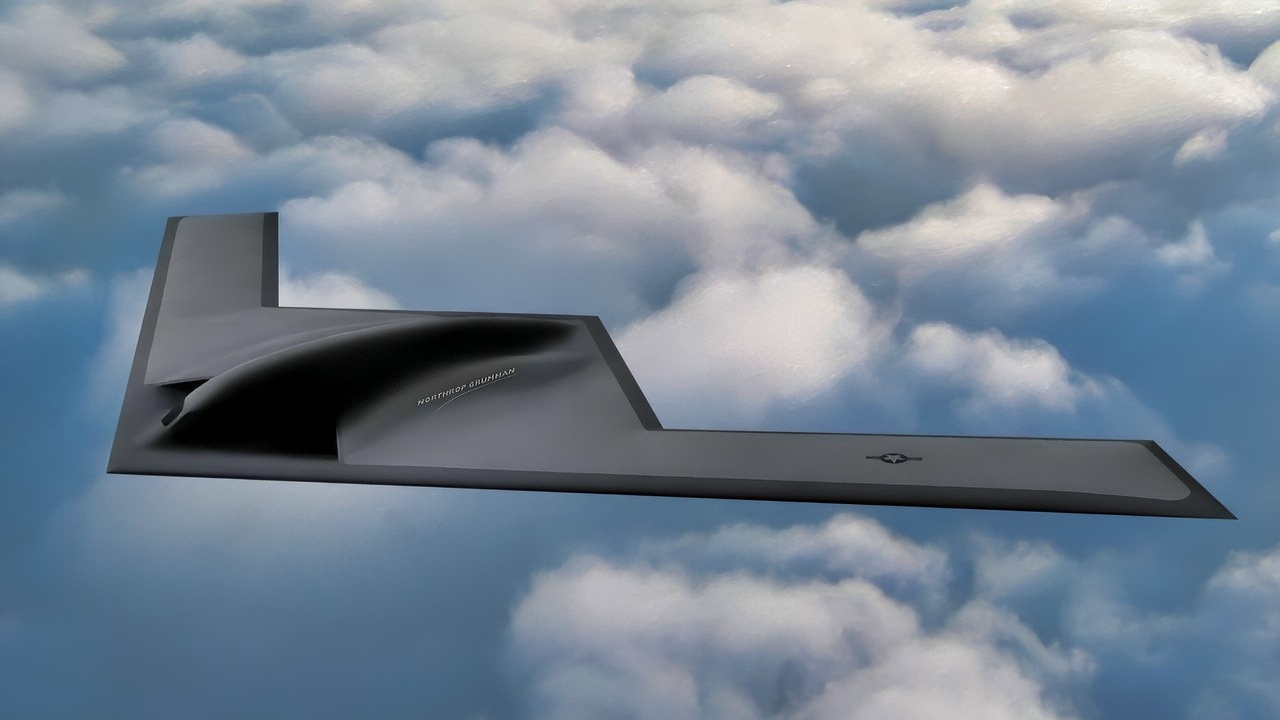
Key Points and Summary – With a second B-21 Raider set to fly soon and a new $4.5 billion funding injection to boost production, America’s next-generation bomber program is rapidly accelerating.
-This analysis highlights a key factor in its success: the “institutional knowledge” gained from its predecessor, the B-2 Spirit.
-Northrop Grumman has taken an evolutionary approach, focusing on refining mature technologies and solving the B-2’s biggest problems, particularly its maintenance-intensive stealth coatings.
-This “lessons learned” strategy is resulting in a more practical, sustainable, and numerous bomber fleet for the challenges of the modern era.
B-21 Raider Production Boost Thanks to Additional Funds, Experience from B-2 Spirit Bomber
Cognizant of the pressing geopolitical challenges in Europe, the Middle East, and potentially in Asia, additional production funding awarded by lawmakers will boost B-21 production. Another key factor is the knowledge Northrop Grumman gleaned decades ago on the B-2 Spirit bomber.
According to the top official at the United States Air Force Global Strike Command, the second B-21 Raider bomber, the United States’ next-generation strategic stealth bomber, is expected to make its maiden flight soon, if it has not already done so.
Speaking to Air & Space Forces Magazine, General Thomas A. Bussiere said that “we should see the second developmental test bird fly shortly,” in an interview late last month.
The B-21 Raider, named after the Doolittle Raid of Second World War fame, is a stealthy, flying-wing aircraft. This design consideration makes the bomber extremely difficult to detect by adversary radar. Once in service, the B-21 will be capable of dropping both nuclear and conventional payloads, like its B-2 predecessor.
Production: Increasing
Aside from the B-21 Raider’s purported stealth capabilities—the US Air Force calls the aircraft the world’s first sixth-generation bomber—one of the more important aspects of the program now is the production capacity, which, General Bussiere says, is set to increase.
A financial boost awarded to the program by lawmakers—$4.5 billion via a reconciliation bill—was specifically allocated to enhance production capacity. But the boost was not unexpected—it “was not a surprise,” General Bussiere told Air & Space Force Magazine. He added that the US Air Force had been “studying this [production increase] now for a little over a year.” The general added that America’s flying force “have great understanding on the capability, capacity, and cost to … increase the ramp rate.”
One factor contributing to the boost in production, General Bussiere said, is the great realization of the value and prominence of long-range strike and the ability to hold at risk anything on the planet at a time and place of our choosing, as well as the knowledge that the American long-range strategic bomber force, while capable, is among the oldest bomber forces in the world.
The B-52 Stratofortress first entered service in the mid-1950s, making the bomber three-quarters of a century old—and it is expected to serve for another 25 years or so. The B-1B Lancer bomber, a variable-geometry strategic bomber from the latter years of the Cold War, will leave service once sufficient B-21 Raiders have been produced.
The B-2 Spirit bomber, while undergoing upgrades to its communications and survivability, including beyond line-of-sight satellite communications and enhancements to the B-2’s low observable materials, entered service just after the end of the Cold War. It has since become long in the tooth, though still a capable platform.
Cold, hard logic is what is driving the B-21 Raider production increase, General Bussiere explained, and added that there is also “a great realization of the value and prominence of long-range strike and the ability to hold at risk anything on the planet at a time and place of our choosing.”
In tandem with this logic, however, is also a deep “urgency to replace our aging bombers and the increased cost and challenges of sustaining a legacy bomber fleet, coupled with a world environment that, quite frankly, everybody looks at and says, ‘we need more long range strike, not less,’ and so that all comes together.”
The Past Informs the Future
Northrop Grumman, the aerospace firm and one of America’s defense heavyweights, is behind both the B-2 Spirit and the B-21 Raider. The experienced and institutional knowledge that went into the earlier B-2 has been applied to the B-21, resulting in smoother production.
The goal with the B-21 Raider was not to attempt steep technological risks, but rather to build a technologically more advanced platform that improves upon and refines the B-2. To that end, the resultant B-21 bomber is an outwardly similar aircraft, but one that is sufficiently more advanced than its predecessor to be called a sixth-generation bomber.
The B-21 is “evolutionary in technology,” General Bussiere said, adding that the US Air Force “learned a lot from how we did initial and then upgraded capabilities on the B-2, and all those lessons were incorporated into the design.”
“There are other unique aspects of the B-21 that were not part of the B-2 production that will make it … a more practical platform to maintain.”
What Happens Next?
One of the main aspirations of the B-21 Raider program, compared to the B-2 Spirit, is the maintenance of the bomber’s low-observable materials. On the B-21, those materials are not only better at absorbing radar and reducing bounce-back, but they are also less maintenance-intensive than the materials of the B-2 Spirit, making it easier to maintain and boosting readiness as a consequence.
Initially, Congress set the number of B-21 Raiders to be acquired at 100. But given the volatile nature of the world since that figure was set in 2018, that number could increase by nearly fifty percent, to 145 aircraft.
There are currently only 19 B-2 Spirit bombers in existence, a production run that was greatly truncated by the end of the Cold War and the lack of a clear application for that platform. Perhaps today’s environment will make the B-21 Raider’s strategic applications less ambiguous.
About the Author: Caleb Larson
Caleb Larson is an American multiformat journalist based in Berlin, Germany. His work covers the intersection of conflict and society, focusing on American foreign policy and European security. He has reported from Germany, Russia, and the United States. Most recently, he covered the war in Ukraine, reporting extensively on the war’s shifting battle lines from Donbas and writing on the war’s civilian and humanitarian toll. Previously, he worked as a Defense Reporter for POLITICO Europe. You can follow his latest work on X.
Military Affairs
China’s Stealth Air Force Has 1 Mission


