

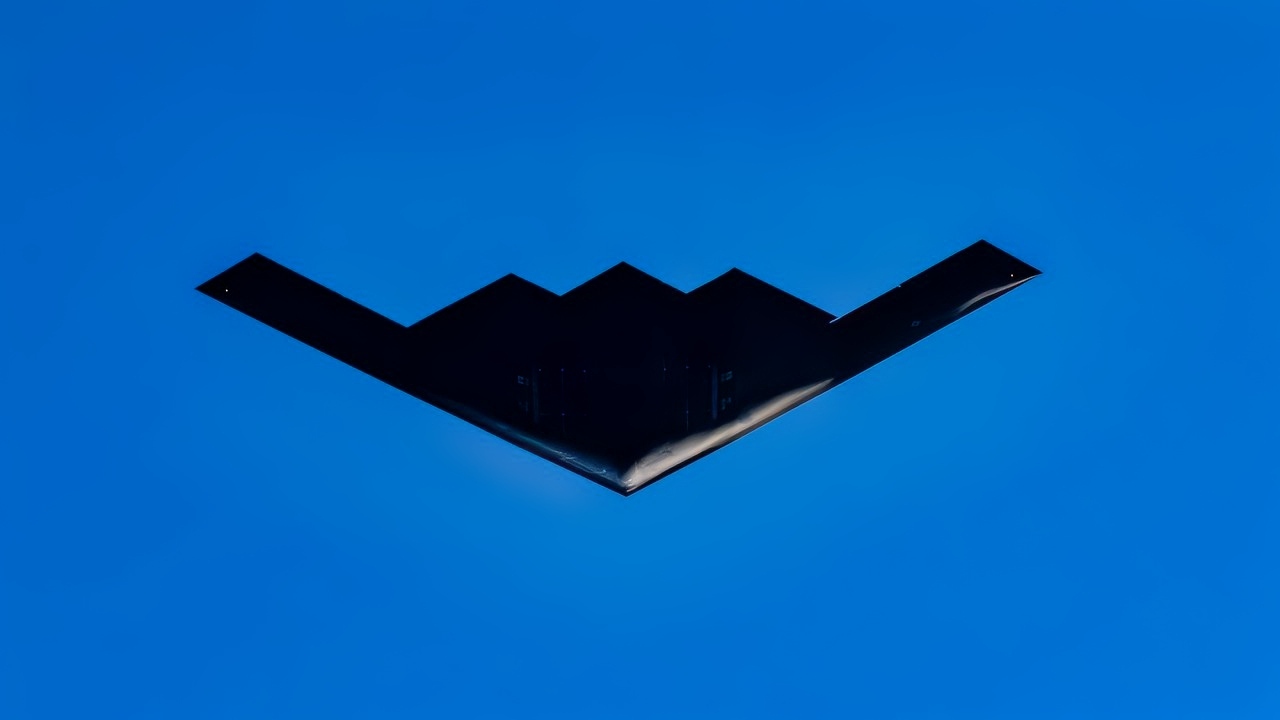
Key Points and Summary – This analysis explores how U.S. airpower would be fundamentally different today if the Air Force had built its originally planned fleet of 132 B-2 stealth bombers instead of just 21.
-This decision transformed the B-2 from a potential “pillar of deterrence” into a “boutique weapon” used only for rare, episodic strikes.
-A full fleet could have shortened wars like Kosovo, strengthened the nuclear triad, and provided a more credible conventional deterrent.
-This historical “what if” serves as a crucial cautionary tale against repeating the mistake by underfunding the new B-21 Raider.
Imagine This: 132 B-2 Spirit Stealth Bombers
They wanted over 100 during the Cold War.
If the United States had built 132 B-2 stealth bombers, as it originally planned, how different would the Air Force look today? The answer: much different.
During the peak of the Cold War, the Air Force wanted to buy over one hundred B-2s. In the end, budget cuts and Soviet collapse conspired to cap the program at twenty-one aircraft. The outcome of that decision has shadowed US airpower ever since. The difference between a low double-digit and a triple-digit stealth bomber fleet is more than a question of numbers; it is a difference between a boutique weapon and a pillar of US deterrence and power projection.
B-2 Performed Important Roles
The original B-2 concept centered on two key missions. First, as a leg of the nuclear triad, the bomber would provide a survivable, flexible, air-breathing deterrent against which the Soviet Union would have to plan. It would be able to penetrate the dense, overlapping air defenses protecting Soviet targets and deliver its payload of nuclear gravity bombs against hardened facilities.
Second, the B-2 would be a conventional deep-strike platform against emerging threats to US vital interests, one that could slip past radar networks, take out air defenses, and undermine command and control nodes before the main body of the force surged in.
With only twenty aircraft—and, due to maintenance and other factors, fewer than that available at any one time—the Air Force has never been able to use the B-2 to execute either mission at scale. The nuclear role was ceded primarily to the ICBM and submarine legs, while the conventional role was split among cruise missiles, fighters, and older bombers.
The B-2 force became a boutique capability: extraordinary when it was used, as against Iran’s nuclear weapons infrastructure, but too scarce to be decisive.
A Notional B-2 Fleet
If the Air Force had gone forward with the original plan, however, the US would have fielded a stealth fleet large enough to have truly transformed both missions. As a nuclear platform, 132 B-2s would have made the air leg of the triad far more robust, complicating Soviet and later Russian nuclear planning.
A fleet of that size could have operated dispersed across multiple bases, creating redundancy and forcing the Kremlin to plan for the near certainty that at least some bombers would always be available to penetrate and deliver in the post–Cold War era, a larger fleet would have given Washington more confidence in its ability to sustain nuclear deterrence without relying so heavily on ICBMs on hair-trigger alert. The strategic stability implications of such a shift would have been profound.
The conventional strike mission would have been even more fundamentally changed. During the 1999 Kosovo campaign, six B-2s flew nonstop from Missouri to Serbia and back, striking heavily defended targets other aircraft could not reach safely. The effect was disproportionate to the number of aircraft used, but the small size of the force ensured that their use was carefully rationed.
Had the Air Force fielded a fleet of a hundred-plus stealth bombers, the campaign might have looked very different: rapid suppression of Serbian air defenses, widespread destruction of critical infrastructure, and a shorter war with fewer risks to pilots in non-stealth aircraft. The same logic applies to the wars in Iraq and Afghanistan, where precision and persistence mattered, but where a small B-2 fleet could not be employed at the intensity required to shift the balance.
A larger force would have also altered the global perception of US airpower. The B-2 need not have been viewed as a rare and almost mythical weapon, reserved only for the most politically sensitive of strikes. Instead, the B-2 could have been seen as the foundation of American long-range precision strike. The perception alone would have had deterrent value, an unmistakable signal to potential adversaries that the criticality of their targets—those deep, hardened, and well defended—could never be entirely beyond the reach of Washington.
Deterrence is based not just on what the US is capable of doing, but on what others believe it can do at scale and with some regularity. A fleet of 132 stealth bombers would have established the credibility of America’s conventional deterrent in ways that twenty-one simply cannot.
Wielding Airpower
The temptation on the part of some, of course, is to think that if the United States had the full, initially planned complement of B-2s, it could have acted as the world’s air hegemon indefinitely, snuffing out emerging threats to the US-dominated Rules-Based International Order before they became true dangers. That is the illusion of primacy that some in Washington still hold onto. But a more sober take is that a triple-digit B-2 fleet would have given the US a far stronger foundation for a strategy of restraint.
Restraint is not weakness; it is prioritization. A large force of stealth bombers would have allowed Washington to hold at risk the truly vital targets—nuclear arsenals, command structures, anti-access capabilities—that could threaten the US homeland and its core allies in Europe and Asia. It would have enabled deterrence by punishment without relying on massive ground commitments or risky forward deployments. In short, it would have given the United States more capacity to deter, and thus fewer reasons to fight.
The point is not to lament a bomber fleet that never was but to note the strength that was lost. America built too few B-2s to make them the backbone of deterrence and too many to treat them as a mere experimental capability. The result was an exquisite capability in perpetually short supply, one that the Air Force pressed into missions where its scarcity blunted its impact.
The B-21 Raider, now coming into service, is designed to correct that error, built in sufficient numbers to provide a true long-range strike fleet. But the lesson is clear: if production is allowed to be capped by budget politics, procurement dysfunction, or strategic myopia at boutique levels, Washington will have committed the B-2 error on an even larger scale.
The difference between twenty and one hundred stealth bombers is the difference between episodic raids and sustained deterrence, between striking at a problem and solving it. The Air Force that could have been—one with a hundred B-2s—would have been a force with fewer illusions of global dominance, but far greater ability to defend the nation’s true interests.
In a world where deterrence is a function of credibility, the greatest tragedy is not the expense of weapons too numerous, but the weakness of weapons too few.
About the Author: Dr. Andrew Latham
Andrew Latham is a non-resident fellow at Defense Priorities and a professor of international relations and political theory at Macalester College in Saint Paul, MN. You can follow him on X: @aakatham. He writes a daily column for National Security Journal.
Fighter Jet Fails
Russia’s Su-57 Felon Stealth Fighter Is a Waste of Rubles


