

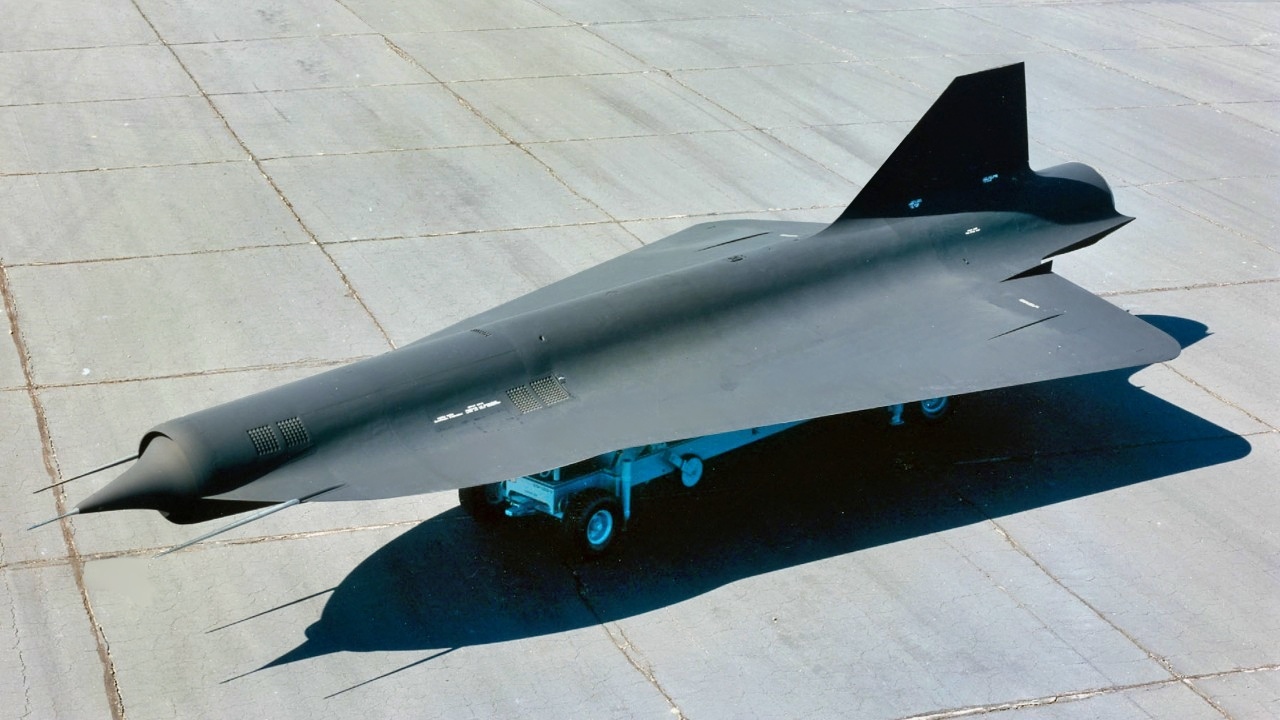
The Lockheed D-21 was a Mach 3.3 reconnaissance drone. Lockheed’s Skunk Works built it in the early 1960s. Its mission: photograph China’s Lop Nor nuclear weapons test facility. The D-21 cruised above 90,000 feet. It borrowed titanium construction and stealth shaping from the SR-71 family — earning the nickname “Baby Blackbird.” Initially launched from an A-12 Blackbird in flight, the program switched to B-52H bombers after a fatal mid-air collision. The Air Force ran 4 operational missions toward China between 1969 and 1971. None fully succeeded. One drone overshot China and crashed inside the Soviet Union. Soviet engineers studied the wreckage. Another crashed in China — where the wreckage may have influenced the modern Chinese WZ-8 reconnaissance drone.
D-21 Was a Mini SR-71 Blackbird Drone
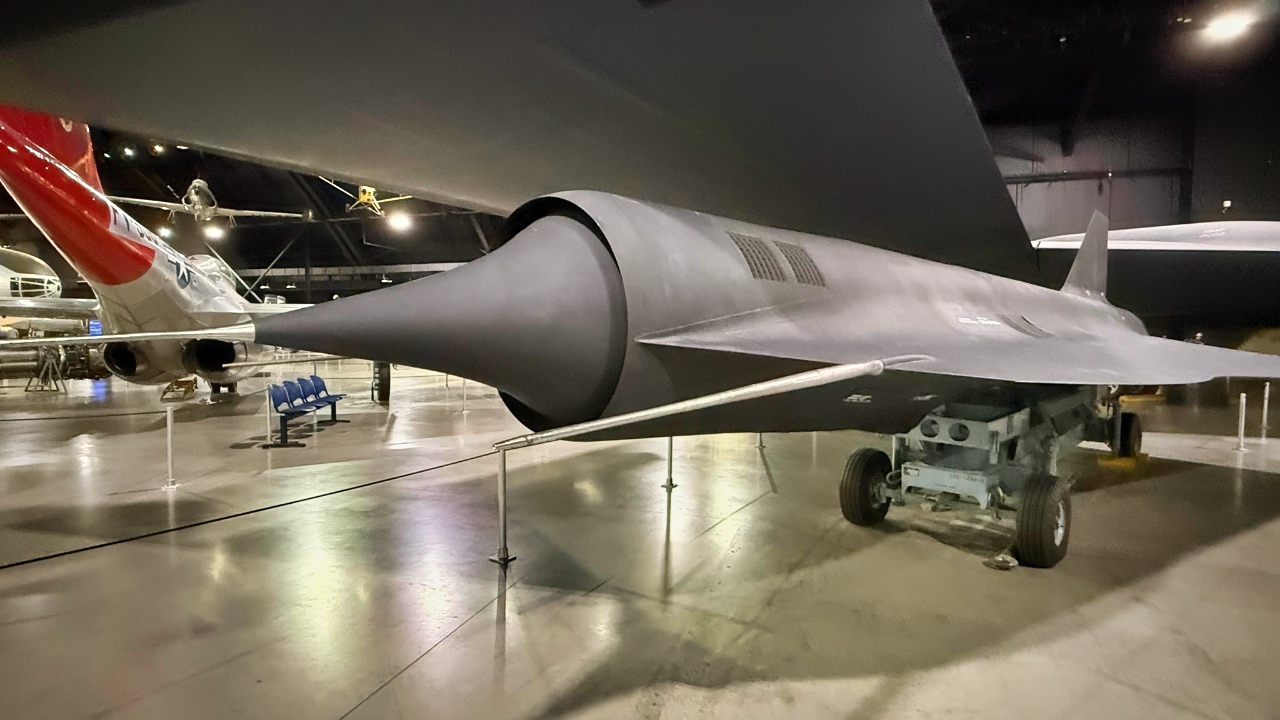
D-21 Drone. Image taken by National Security Journal on 7/19/2025.
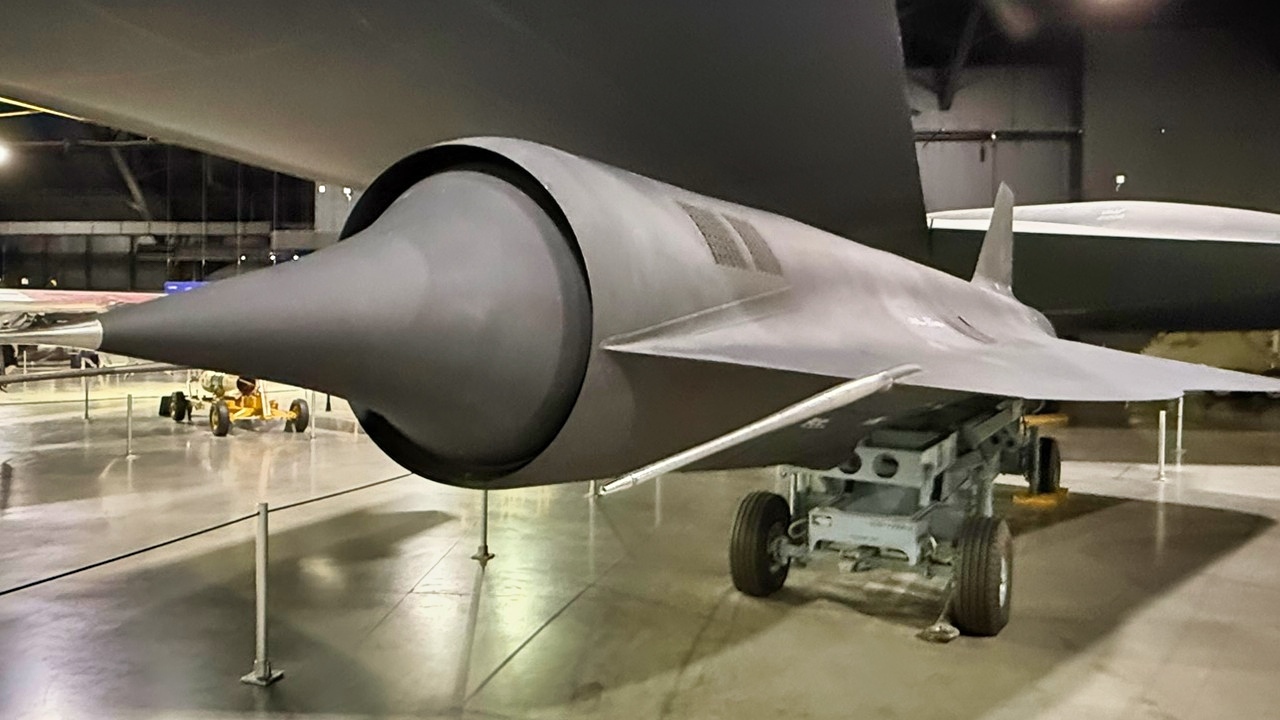
Mach 3 D-21 Drone at the U.S. Air Force Museum. National Security Journal Photo Taken 7/19/2025.
The Lockheed D-21 was one of the wildest intelligence projects to emerge from the Cold War. It was a Mach 3+ reconnaissance drone designed to fly higher and faster than almost anything on Earth, photograph Chinese nuclear sites, dump its film canister for midair recovery, and then self-destruct. Indeed, this was the missing evolutionary link between the U-2 era and modern stealth drones.
Why the CIA & Air Force Wanted the D-21
Developed at Lockheed Martin’s Skunk Works in the early 1960s, the D-21 mitigated the risk of deep-penetration reconnaissance missions for US pilots. D-21 was Lockheed’s attempt to maintain the long-range, covert reconnaissance capabilities of the U-2 spy plane while removing the pilot entirely from the picture. In the wake of the Francis Gary Powers shootdown, this was a key development that made the D-21 desirable.
D-21 could fly above 90,000 feet, at speeds above Mach 3.3. It was small enough to drastically reduce radar visibility and fast enough to outrun interception. The drone was originally called the “Q-12” before becoming the “D-21.”
It borrowed heavily from the A-12/SR-71 family, too. For instance, the D-21 featured a titanium construction, blended fuselage shaping, low-radar-signature concepts, and advanced thermal engineering for sustained hypersonic-like flight.
In fact, it looked so similar to the SR-71 that some dubbed her “Baby Blackbird.”
The Craziest Launch Concept of the Cold War
When the platform was initially ready for launch, Lockheed had created an unbelievably dangerous launch concept. An A-12 Blackbird would launch the D-21, mounted on the back of the aircraft like a disposable appendage on the alien-looking SR-71.
Once the Blackbird carrying the D-21 reached Mach 3, the D-21 separated at extreme altitude, its ramjet ignited, and the drone flew a preprogrammed reconnaissance mission. Upon completion of the mission and its successful departure from enemy territory, the D-21 ejected a film capsule, which the US recovered midair.
Then, the drone self-destructed.
Because the D-21 used a ramjet, it could not take off under its own power. That’s why it needed to be moving at extraordinary speed before the engine could operate.
The launches of the D-21 were, therefore, incredibly risky. In fact, on July 30, 1966, disaster struck when the D-21 collided with its Blackbird mothership upon separation. Neither plane made it. Pilot Bill Park survived, but Launch Control Officer Ray Torrick drowned after ejecting into the Pacific Ocean.
Project Senior Bowl: The B-52H Takes Over Launch Duties
After that, the Blackbird was never again used as a launch vehicle. The military decided to utilize the B-52 Stratofortress to launch the D-21B drone. By riding under a B-52H bomber, the D-21B would fire a giant rocket booster, then ignite its ramjet after booster separation. That operational phase became known as “Project Senior Bowl.”
The modified B-52Hs carried two D-21Bs under their wings. Once released, the rocket booster accelerated the drone to ramjet ignition speed before falling away. That solution was safer and easier to operate than the M-21 concept, though it sacrificed some elegance.
America’s Secret Mission to Spy on China’s Nuclear Program
The D-21’s primary target was Communist China’s Lop Nor nuclear weapons test facility. US intelligence desperately wanted detailed imagery of Chinese nuclear development during the height of the Cold War. Between 1969 and 1971, four operational D-21 missions flew toward China from Guam.
None fully succeeded.
Indeed, their failures are legendary. One drone flew off course and crashed within the Soviet Union. Another completed the mission but lost the camera package at sea. Another failed mission returned successfully, but recovery could not occur. Then another just disappeared. The drone itself often survived the mission. The real problem the Americans faced was recovering the film canister.
By 1971, satellites in space had assumed the reconnaissance and surveillance roles, and the need for the D-21 had evaporated. In 1971, the United States canceled the D-21 program.
Did China and the USSR Reverse-Engineer the D-21?
The D-21’s saga doesn’t end there, though. One of the strangest twists in the D-21 story is that the crashed drones ended up inside enemy territory. A D-21 that malfunctioned crashed in the USSR after overshooting China. Soviet engineers reportedly studied the wreckage extensively.
Another wreckage site in China became the source of decades of speculation that Chinese engineers reverse-engineered portions of the aircraft’s design. Modern Chinese high-speed reconnaissance drones, such as the WZ-8, bear an unmistakable resemblance to the D-21 concept.
Whether the resemblance reflects direct reverse-engineering or convergent engineering logic remains debated, but the aerodynamic profiles are hard to ignore.
The D-21 Was Decades Ahead of Its Time
Despite its mixed record, the Baby Blackbird was operating in conceptual territory that still challenges modern aerospace engineering. It possessed autonomous navigation, hypersonic-like reconnaissance, stealth-shaping concepts that significantly influenced future stealth designs, unmanned deep-penetration ISR, extreme thermal management, and recoverable reconnaissance payloads. Even today, many drones cannot sustain Mach 3 flight, operate above 90,000 feet, or survive prolonged aerodynamic heating as the D-21 could.
The drone was really a glimpse of the 21st century’s style of warfare in the late 1960s and early 70s. That the US couldn’t maximize the potential of this unmanned craft back then is understandable. Nevertheless, it informed so much of what would eventually come.
One must wonder which technology today is viewed as not especially helpful, as the US viewed the D-21 at the time of its operation, only to find it critical to modern warfare decades later.
About the Author: Brandon J. Weichert
Brandon J. Weichert is the Senior National Security Editor at 19FortyFive.com. Recently, Weichert became the editor of the “NatSec Guy” section at Emerald. TV. He was previously the senior national security editor at The National Interest. Weichert hosts The National Security Hour on iHeartRadio, where he discusses national security policy every Wednesday at 8 p.m. Eastern. He hosts a companion show on Rumble entitled “National Security Talk.” Weichert consults regularly with various government institutions and private organizations on geopolitical issues. His writings have appeared in numerous publications, among them Popular Mechanics, National Review, MSN, and The American Spectator. And his books include Winning Space: How America Remains a Superpower, Biohacked: China’s Race to Control Life, and The Shadow War: Iran’s Quest for Supremacy. Weichert’s newest book, A Disaster of Our Own Making: How the West Lost Ukraine, is available for purchase at any bookstore. Follow him via Twitter/X @WeTheBrandon.


