

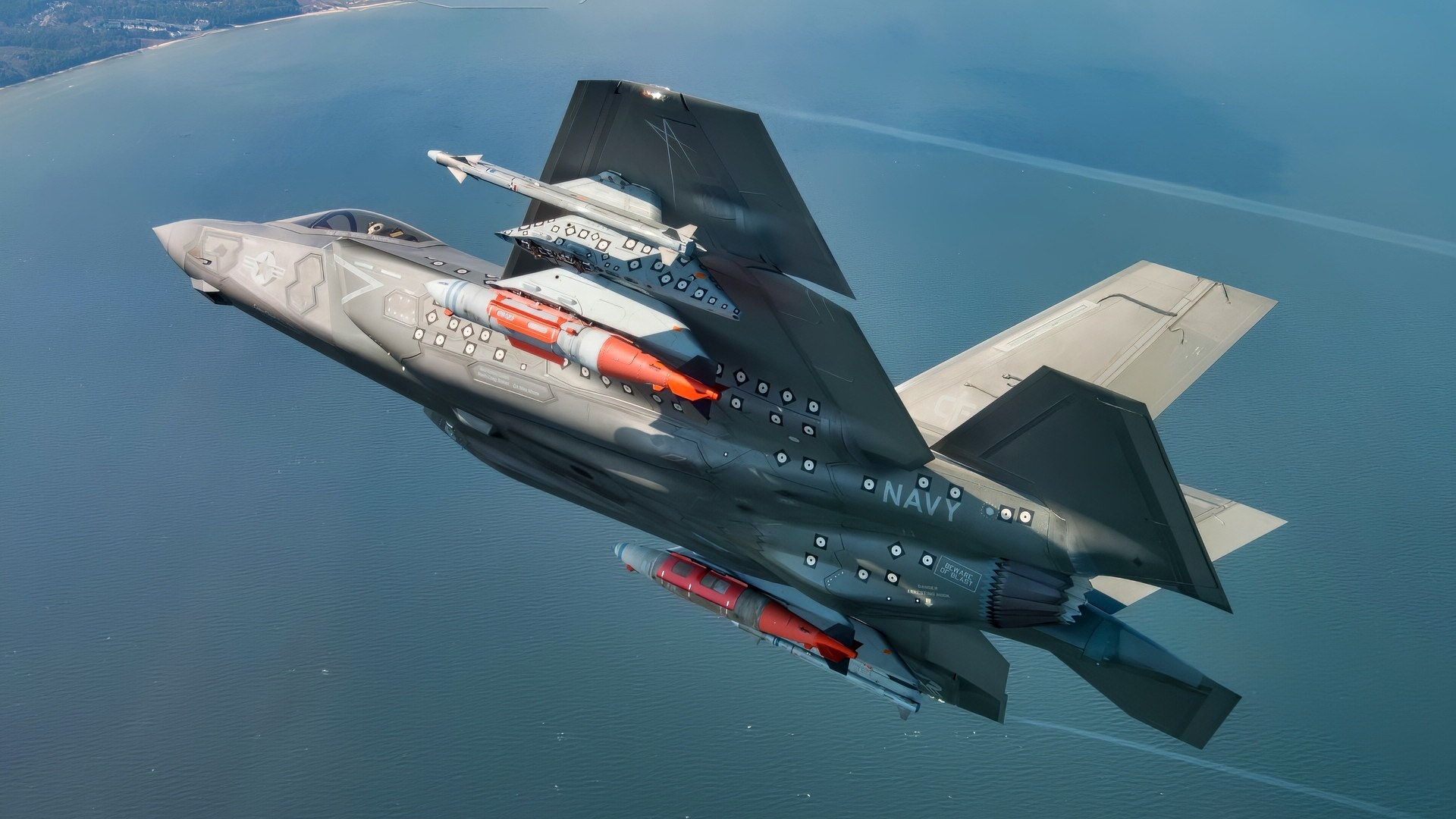
Key Points and Summary – The U.S. Air Force has awarded Kongsberg Defence & Aerospace a $240.9 million firm-fixed-price contract for a second production lot of Joint Strike Missiles for the F-35.
-Built in Norway with associated containers and support gear, the order runs through late 2028 and aims to give the Lightning II a stealth-compatible, internal-bay standoff weapon for ships and land targets.
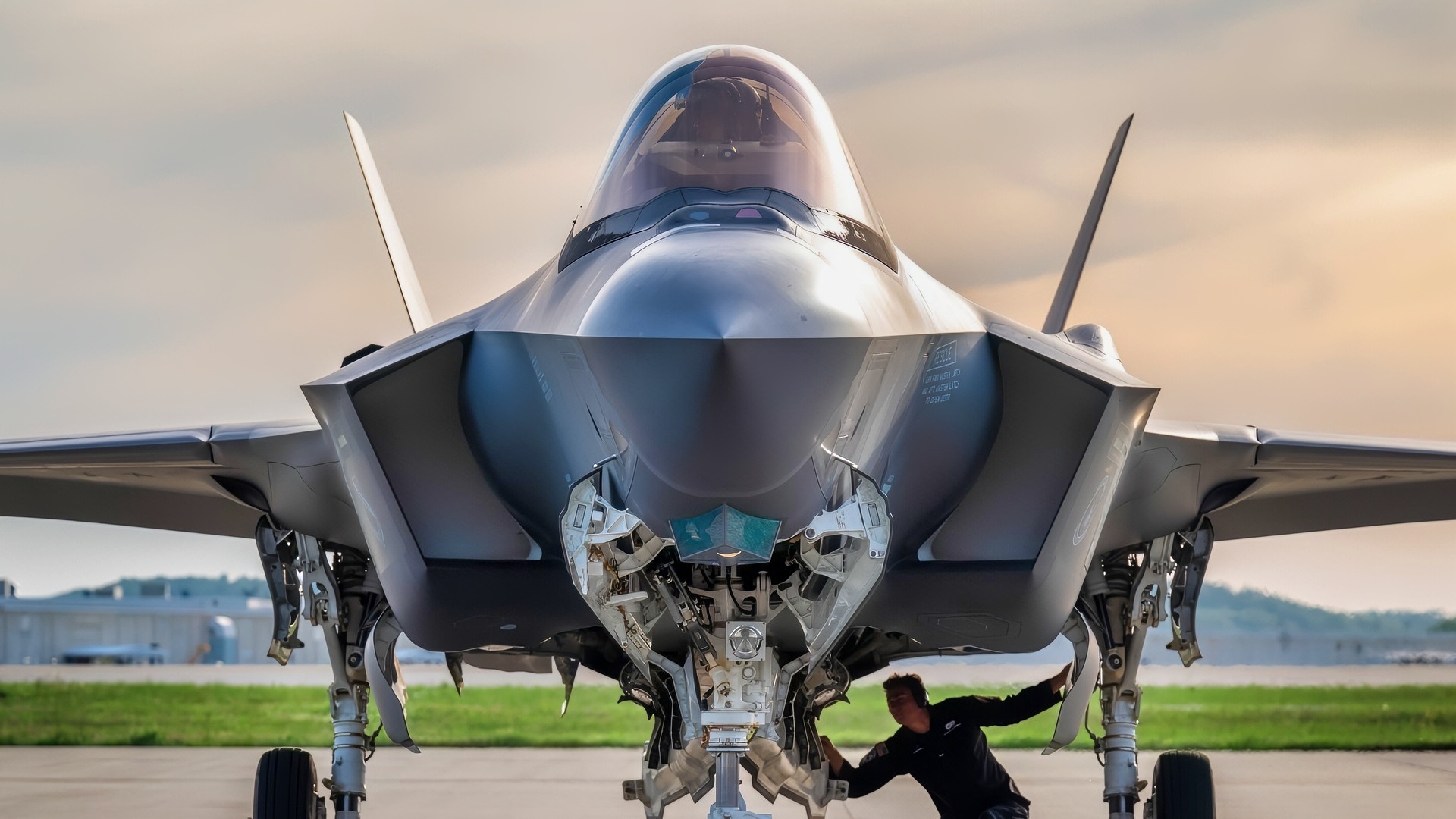
An aircraft from the U.S. Air Force F-35 Lightning II Demonstration Team arrives at the Kentucky Air National Guard Base in Louisville, Ky., April 19, 2023, in advance of the Thunder Over Louisville air show. The annual event, to be held along the banks of the Ohio River on April 22, will feature more than 20 military and civilian aircraft. (U.S. Air National Guard photo by Dale Greer)
-A derivative of Kongsberg’s Naval Strike Missile, JSM uses GPS/INS navigation, terrain-following profiles, an imaging infrared seeker, and a two-way datalink for in-flight updates.
-It broadens the F-35’s growing long-range strike toolkit and helps address range limits without hanging weapons on pylons.
The F-35’s Firepower Just Got a $240 Million Boost
There’s no middle ground on the F-35. People either love the fifth-generation fighter or they hate it. The Lightning II’s lovers consider it to be the greatest thing since sliced bread—the perfect companion piece to Lockheed Martin’s other stealth fighter, the F-22 Raptor, and the ultimate symbol of U.S. airpower, at least until the sixth-generation F-47 comes online.
Meanwhile, the haters consider the warbird to be an overrated, overpriced, unreliable boondoggle.

Capt. Andrew “Dojo” Olson, F-35 Demonstration Team pilot and commander performs a high-speed pass during the Melbourne Air and Space Show March 29, 2019 in Melbourne, Fla. The air show featured the North American Debut of the all-new F-35 Demonstration. (U.S. Air Force Photo by Senior Airman Alexander Cook)

A U.S. Marine Corps plane captain assigned to the Marine Fighter Attach Squadron 225 (VMFA-225) signals to a pilot in a F35B Lightning II as it taxis on the flightline after landing in the U.S. Southern Command Area of Responsibility, Sept. 13, 2025. U.S. military forces are deployed to the Caribbean in support of the U.S. Southern Command mission, Department of War-directed operations, and the president’s priorities. (U.S. Air Force photo by Senior Airman Katelynn Jackson)
The F-35’s supporters and detractors alike are going to have a field day with the news that the fighter was just approved for a $240 million firepower upgrade. Let’s dig deeper into the details.
The Basics/Bottom Line Up Front (BLUF)
The latest update comes to us from Henry Bhatta, writing for Aviospace.
To wit: “On 12th December 2025, The U.S. Air Force (USAF) has awarded a $240.9 million firm-fixed-price contract to Kongsberg Defence & Aerospace, of Kongsberg, Norway, for the production of Joint Strike Missiles (JSM) intended for integration on Lockheed Martin F-35 Lightning II fighter jets. Work on the contract will be performed at Kongsberg’s facilities in Norway. The award is the second lot production contract for JSMs following an earlier Lot 1 order, underlining the USAF’s continued investment in stand-off weapons for fifth-generation platforms.”
If the Kongsberg name sounds familiar, it should, as that defense firm also manufactures the Naval Strike Missile (NSM), a ship- and coastal defense system-launched missile employed by services such as the U.S. Navy (which officially dubs it the RGM-184A), the Royal Norwegian Navy, and the Polish Navy.
Indeed, the JSM is a derivative of the NSM; as the saying goes, “The apple doesn’t fall far from the tree.
JSM Tech Specs and Vital Stats
According to Army Recognition, the Joint Strike Missile has the following technical specifications:
-Overall Weight: 416 kg (917 lb.)
-Warhead Weight: 120-kg (# lb.) blast fragmentation warhead
-Length: 4 meters (156 inches)
-Max Airspeed: Mach 0.9 (767 mph, 1,234 km/h)
-Powerplant: Williams International F-415 small turbofan engine (which also powers the Navy’s BGM-109 Tactical Tomahawk cruise missile)
-Effective Range: 555 km (344 statute miles, 299 nautical miles) for a so-called “hi-hi-lo” profile, more than 350 km (217 statute miles, 188 nautical miles) for “other profiles,” and about 185 km (114 statute miles, 99 nautical miles) for a “lo-lo-lo profile.”
Army Recognition adds that the JSM “combines inertial navigation and GPS guidance with terrain-referenced navigation and terrain-following flight profiles.
Terminal guidance relies on an imaging infrared seeker, and the missile is also equipped with a two-way datalink and passive radio-frequency homing functions to support engagements against radar-emitting targets, such as air defense systems, fire control radars, early warning radars, target tracking radars, and engagement radars.”
Relationship with Current F-35 Payload
This missile will augment the Lightning II’s already impressive smorgasbord of ordnance. The 18,000-lb. total weapons payload can include:
-AIM-9X Sidewinder, AIM-120 AMRAAM (“Slammer”), AIM-260 JATM, MBDA Meteor, and AIM-132 ASRAAM air-to-air-missiles.
-AGM-88G AARGM-ER (Block 4), SPEAR 3, Stand-in Attack Weapon, and AGM-158 JASSM air-to-surface missiles.
-Hypersonic Attack Cruise Missile and AGM-158C LRASM anti-ship missiles.
-Bombs such as the Joint Direct Attack Munition and Paveway laser-guided bomb; precision-guided glide bombs such as the AGM-154 Joint Standoff Weapon, GBU-53/B StormBreaker, and GBU-39 Small Diameter Bomb; and for the nightmare-scenario doomsday mission, the B61 Mod 12 nuclear bomb.
The Way Forward?
The funding is expected to sustain production through November 30, 2028.
Planned initial deliveries amount to 48 units for May 2026—assuming all goes smoothly during the operational test and evaluation phase that same month—and 50 more units for March 2027.
About the Author: Christian D. Orr, Defense Expert
Christian D. Orr is a Senior Defense Editor. He is a former Air Force Security Forces officer, Federal law enforcement officer, and private military contractor (with assignments worked in Iraq, the United Arab Emirates, Kosovo, Japan, Germany, and the Pentagon). Chris holds a B.A. in International Relations from the University of Southern California (USC) and an M.A. in Intelligence Studies (concentration in Terrorism Studies) from American Military University (AMU).


