

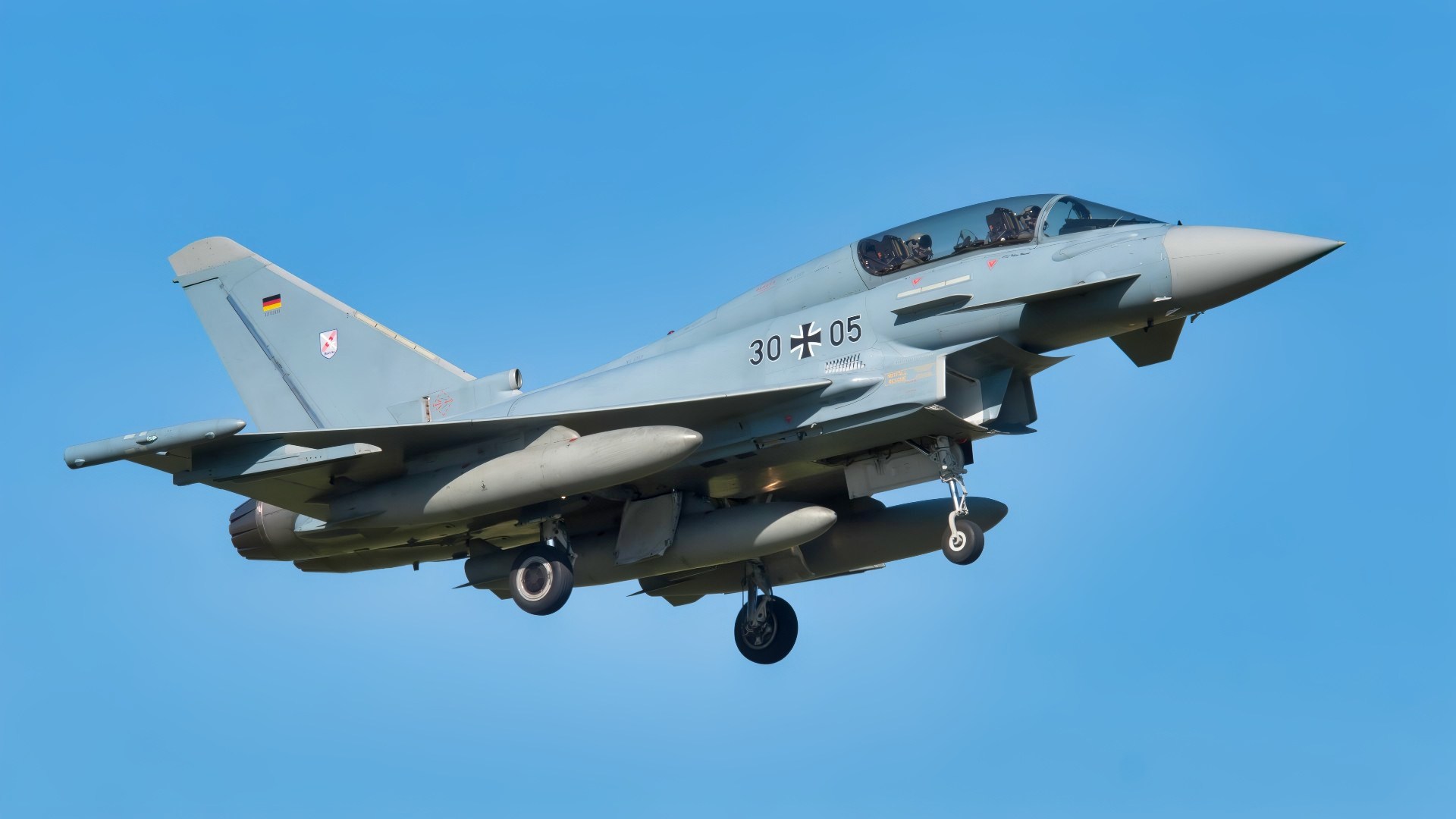
Key Points and Summary – The MBDA Meteor is Europe’s premier beyond-visual-range air-to-air missile, built around an active radar seeker, two-way datalink, and a throttleable ramjet that keeps thrust on all the way to impact.
-That propulsion gives Meteor a massive “no-escape zone” and far greater effective range than AIM-120 AMRAAM.
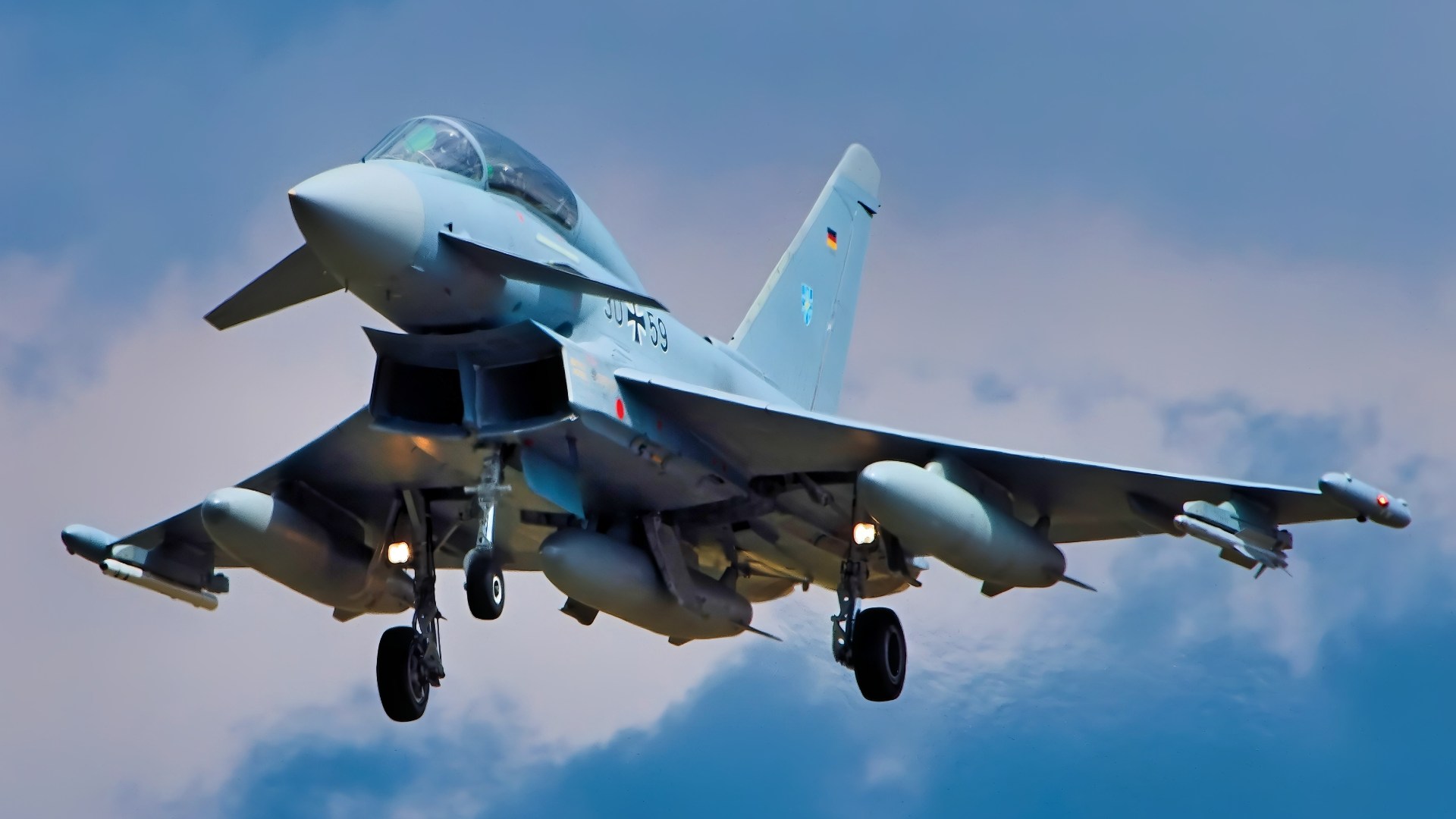
2017 Eurofighter Typhoon. Image Credit: Creative Commons.
-First fielded on Sweden’s JAS 39 Gripen and then the Eurofighter Typhoon, Meteor is now being adapted to fit cleanly inside the F-35’s weapons bay, boosting NATO interoperability.
-Although it has yet to score a combat kill, its kinematics and growth across multiple fleets make it a defining missile of future air battles.
The “No-Escape” Meteor Missile of the Eurofighter Typhoon and JAS 39 Gripen
Unsurprisingly, many heavenly bodies in the solar system have inspired the names of military aviation technologies. For example, the planet Saturn became the name of the Saturn AL-31 engine, which powers multiple Russian warbirds such as the Sukhoi Su-27 (NATO reporting name “Flanker”), Su-34 “Fullback,” and Su-57 “Felon.” Meanwhile, from shooting stars, we got the Lockheed P-80/F-80 Shooting Star, which became America’s first operational jet fighter and first to destroy enemy planes in aerial combat.
Then you have the Meteor moniker, which was bestowed upon (1) the British-made Gloster Meteor, which was the Allies’ only operational jet fighter of World War II (alas, she never got to duke it out with Nazi Germany’s Messerschmitt 262 Schwalbe jet fighter), and (2) our current subject at hand, the Meteor air-to-air missile (AAM). The latter Meteor is arguably Western Europe’s most capable AAM. It contributes heavily to the formidable arsenal of two of the continent’s most respected 4.5-generation jet fighters, the Eurofighter Typhoon and the JAS 39 Gripen.
MBDA Meteor Missile Basics
The Meteor is an active radar-guided beyond-visual-range air-to-air missile (BVRAAM) built by MBDA, a European multinational defense firm headquartered in Le Plessis-Robinson near Paris, France; MBDA came into existence in December 2001 via a merger of three of Europe’s most prominent missile systems makers, namely the French Aérospatiale Matra Missiles, the Anglo-French Matra BAE Dynamics, and the missile division of the Italian Alenia Marconi Systems.

The Saab JAS 39E Gripen is Sweden’s modern multi-role fighter, built specifically for versatility and resilience against Russian threats. Image Credit: Creative Commons.

A UK Typhoon flies above the Baltics on 25 May 2022.
UK and Czech fighter jets have been taking part in air defence training over the Baltic region. UK Eurofighter Typhoons, F-35s and Czech Gripens were involved in an exercise as part of Neptune Shield 22 (NESH22), a multinational maritime vigilance activity. NESH22 has seen a range of multi-domain activities between air, land and maritime assets across Europe and in the Baltic and Mediterranean Seas. It runs from 17 to 31 May 2022.
As MBDA’s official product info page states, “METEOR has been developed by a group of European partners led by MBDA to meet the needs of six European nations: the UK, Germany, Italy, France, Spain, and Sweden. All with a common need to defeat the threats of today and in the future…This ‘ramjet’ motor provides the missile with thrust all the way to target intercept, providing the largest No Escape Zone of any air-to-air missile system, several times greater than current MRAAMs. The fragmentation warhead ensures maximum lethality.”
That so-called “No-Escape Zone” is approximately 60+ kilometers (37+ miles). The official maximum range of the missile is 120 kilometers (75 miles), but *unofficially* the Meteor can reach out and touch an adversary much farther, estimated at 200 kilometers (120 miles).
Additional tech specs of the MBDA Meteor include a weight of 190 kilograms (418 lb.), a length of 3.7 meters (12 feet), a diameter of 178 millimeters (7 inches), and a max airspeed of Mach 4.
Arming Europe’s 4.5-Generation Fighters …
The aforementioned JAS 39 Gripen of the Swedish Air Force (Svenska flygvapnet or simply Flygvapnet) was the first aerial platform to employ the Meteor, doing so in April 2016, and officially achieved initial operating capability (IOC) in July 2016. The Gripen has eight hardpoints with a capacity of 5,300 kg (11,700 lb.), and that carrying capacity includes up to four Meteors.
Meanwhile, given that the Meteor is a multinational project, it’s highly apropos that a multinational warbird like the Eurofighter would also adopt it.
This became a reality on December 10, 2018, when Typhoons belonging to Great Britain’s Royal Air Force (RAF) flew their first active mission with the then-newfangled BVRAAM.
The Eurofighter has 13 pylon stations (8 underwing, five under the fuselage) with a total payload capacity of over 9,000 kilograms (19,800 lb.).
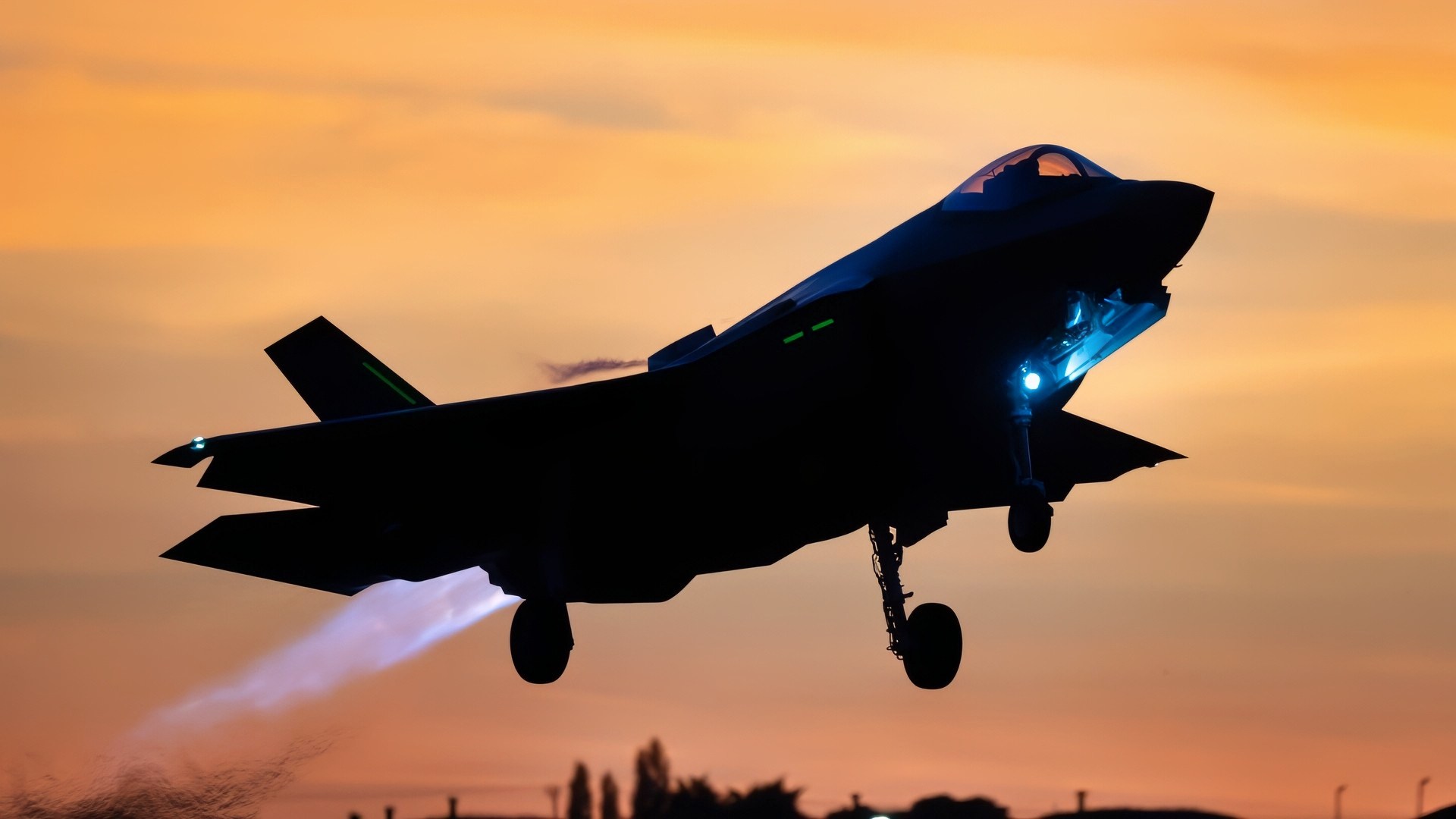
A U.S. Air Force F-35A Lightning II takes off at RAF Lakenheath, England, Sept. 16, 2024. The 48th Fighter Wing dedicates allotted flying hours during hours of darkness to ensure Airmen are prepared to deter potential adversaries and defend NATO territory anytime, anywhere. (U.S. Air Force photo by Airman 1st Class Alexander Vasquez)
… and America’s 5th-Generation Fighters for Good Measure
“Flexibility is the key to airpower,” quoth the famous early 20th-century airpower theorist General Giulio Douhet, and going hand-in-hand with that flexibility is versatility. The Meteor missile has demonstrated its versatility, going beyond Gen 4.5 fighters by proving itself adaptable to the United States of America’s top-of-the-line Gen 5 stealth fighter, the Lockheed Martin “Skunk Works” F-35 Lightning II.
A US Marine Corps F-35B recently flew for the first time with the MBDA missile, which was significant in more ways than one, as it proved that the European-made BVRAAM could fit cleanly inside the jet’s weapons bay without compromising stealth. The eventual game plan is to fully integrate the Meteors into F-35Bs flown by the UK and Italy alike, hopefully sometime during the 2030s.
Interoperability is a vital trait for weapons systems used by multinational alliances such as NATO, and the fact that the Meteor can be employed by the Eurofighter, Gripen, and Lightning II alike is a testament to the genius of its design.
Meteor v. Slammer
Speaking of US aerial weapons technologies, America’s closest counterpart to the Meteor is the AIM-120 AMRAAM (Advanced Medium-Range Air-to-Air Missile, affectionately nicknamed the “Slammer”).
Like its European counterpart, the “Slammer employs an active radar seeker and a two-way data link for accuracy; however, it has only half the range of the Meteor, with a top range of 49 nautical miles (90 kilometers).
That said, the AIM-120 does have a certain set of bragging rights that the Meteor does not yet have: a proven track record of air-to-air kills in real-world combat. The “Slammer” has 13 confirmed kills to date, and even more impressively, the American missile’s first such shootdown (which, for good measure, was also the first shootdown attained by a US Air Force-piloted F-16) was scored against the MiG-25 “Foxbat“, which is the fastest interceptor ever built, with a top speed of Mach 3.2.
(Yes, an RAF Typhoon driver did score a kill of a “small hostile drone” over Syria back in December 2021, but that was with a different MBDA product, the AIM-132 ASRAAM Advanced Short-Range Air-to-Air Missile [ASRAAM]).
Thus far, the Meteor hasn’t scored any aerial victories. But with the missile finding its way onto more countries’ aerial arsenals, and with the looming possibility of World War III breaking out in Europe and Asia alike, that currently empty scoreboard may very well soon fill up in major fashion.
About the Author: Christian D. Orr, Defense Expert
Christian D. Orr is a Senior Defense Editor. He is a former Air Force Security Forces officer, Federal law enforcement officer, and private military contractor (with assignments worked in Iraq, the United Arab Emirates, Kosovo, Japan, Germany, and the Pentagon). Chris holds a B.A. in International Relations from the University of Southern California (USC) and an M.A. in Intelligence Studies (concentration in Terrorism Studies) from American Military University (AMU). He is also the author of the newly published book “Five Decades of a Fabulous Firearm: Celebrating the 50th Anniversary of the Beretta 92 Pistol Series.”


