

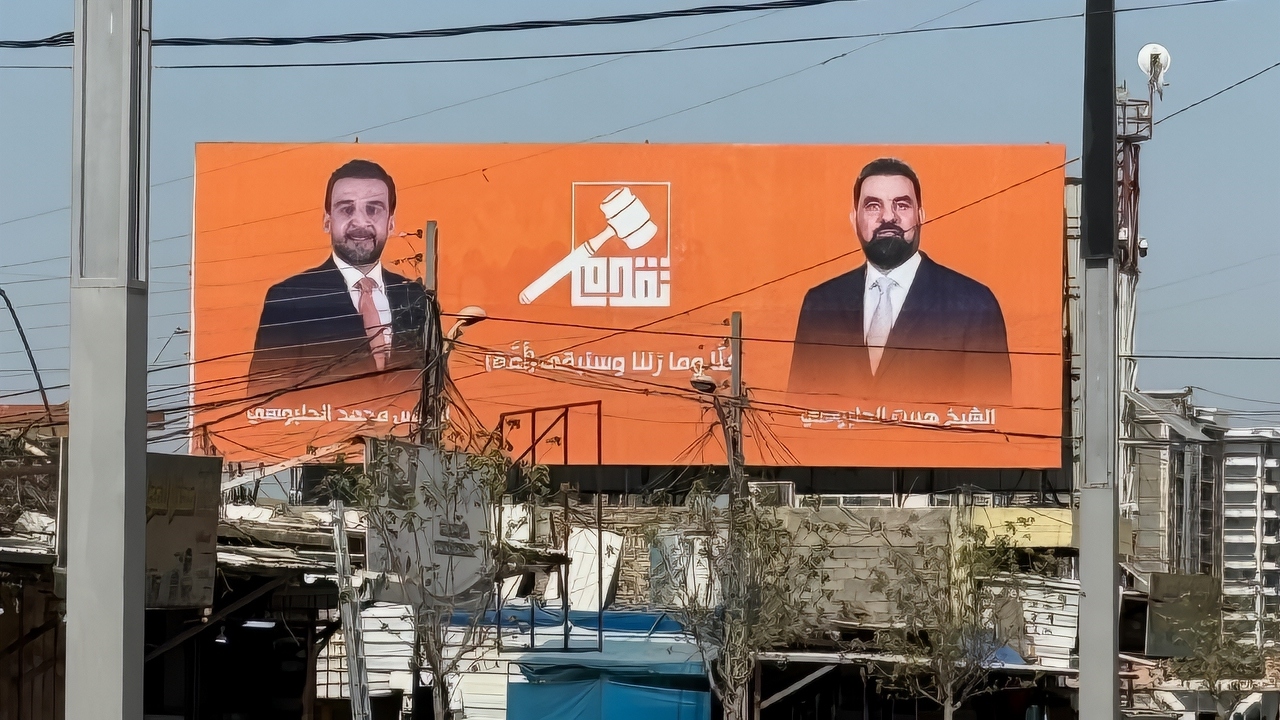
BAGHDAD, IRAQ—When the United States invaded Iraq in 2003, Iraq’s population was 26 million; today, it is approaching 48 million. Any visit to Iraq reflects what a different country it has become over 20 years. Gone is the bomb damage, ruins, and blast walls. In their place are high-rise complexes, malls, and overpasses.
The vast majority—Iraqi leaders estimate 80 percent–of Iraqis were not alive or too young to remember Saddam Hussein; a growing number had no personal recollection of interaction with Americans. Former firebrand militia leaders like Muqtada al-Sadr and Qais al-Khazali have tempered their rhetoric and quietly discuss working with the Americans.
This is not a tactical charade but, for many militia leaders, it is a strategic necessity. Among Iraqis, the general mood has turned on the militia leaders. Posters of Iraqi militia leader Abu Mahdi al-Muhandis and his Iranian controller Qassem Soleimani, killed together in a January 2020 American drone strike, dot Baghdad and checkpoints along the
Many Iraqis condemn the death of Muhandis especially—he was an Iraqi after all and Iraqis are nationalist—but the vision Muhandis once espoused increasingly chafes upon Iraqis who see the militias as corrupt. With the Americans largely gone and its diplomats out-of-sight, Iraqis describe the militias as mafia and lament innocent Iraqis caught in the cross fire of their turf wars and internecine battles. With the generational change, few Iraqis have any tolerance anymore for political violence. Across the political and sectarian spectrum, from Sunni Arabs in al-Anbar to the Sadrists and members of the Coalition Framework,
Iraqis will head to elections on November 11, 2025. Already, posters, billboards, and television commercials are up in Baghdad and cities across the country. Officials admit that any violence would likely do more harm than good as it would repulse Iraqis who overwhelmingly want to move on. Many Iraqis responded to Lebanese President Joseph Aoun’s decision to disarm Hezbollah, asking why the same could not happen in Iraq.
Within Washington’s political debate, both Republicans and Democrats view Iraq through the lens of 2005 rather than 2025. Iraqi democracy is real, even if dysfunctional. It is perhaps the only Arab country in which election outcomes are uncertain. “Anything could happen” is a refrain I heard from numerous Iraqi politicians on opposite slates. That is healthy and, because most Iraqis have now known nothing else, represents a fundamental and permanent change in Iraq’s political culture.
It is one thing to win elections; it is another thing to govern well. Adil Abdul-Mahdi’s sclerotic administration ended in street protests and his resignation. Mustafa al-Kadhimi largely disappointed Iraqis due to his office’s corruption and inefficiency. Incumbent Muhammad Shia al-Sudani has made real progress, despite some early own-goals and former Prime Minister Nouri al-Maliki’s endless attempts to hobble him. While Iraqis do not see a repeat of the Tishreen protests that ended Abdul-Mahdi’s term, they worry that growing electrical grid failures—and the endemic corruption they represent—could spark public protest across cities.
With such pressures, successive governments have succumbed to the temptation to play the short game and apply Band-Aids at the expense of macro-economic wisdom.
Iraq’s public sector is huge. Some government officials say four million Iraqis are on the payroll, and set to receive lifelong pensions; others say the actual figure is triple that. What is clear, though, is that successive Iraqi leaders mass hire at the expense of long-term financial solvency. After all, while the price of oil hovers at $63/barrel, just over half of what it was when Sudani took office, it could go even lower. Indeed, the only prime minister who took the long view and attempted serious reform to shift public workers to the private sector was Haider al-Abadi who left office almost seven years ago now.
The problem facing Iraq is not just oil price fluctuation, however. I caught up with Naufel Alhassan, Abadi’s former chief-of-staff, over coffee at a Baghdad restaurant. He made an excellent point: It is not just a decline of oil price about which Iraq must worry, but also the decline of market share. And end to the Russia-Ukraine War will eventually happen, opening the Russian market once again. Oil companies have discovered the largest recoverable ultra-deep oil reserves in the world off the coast of Brazil. Should regime change or simply meaningful moderation come to Iran ending sanctions there, Iraq could find itself participating in an increasingly crowded and competitive market.
Two decades ago, the United States sought to shape Iraq’s new political order. It largely succeeded although, as with everything, Iraqis put their own stamp and characteristics on it. The U.S. Embassy should keep diplomatic pressure on Iraq to disarm and decommission the militias, but if Washington seeks a partner for stability in the region, it should also support Baghdad’s efforts to strengthen its private sector and place Iraq on more stable financial ground.
Iraqis have a choice: If they pump money into salaries and the public sector just to keep themselves afloat, they will become a second Egypt; if they resist populism and support entrepreneurship, they could be the next Dubai, but with culture. Iraq is at an inflection point; whether or not its new generation of politicians will put the state above their immediate ambitions, however, remains to be seen.
About the Author: Dr. Michael Rubin
Michael Rubin is a senior fellow at the American Enterprise Institute and director of policy analysis at the Middle East Forum. The opinions and views expressed are his own. A former Pentagon official, Dr. Rubin has lived in post-revolution Iran, Yemen, and both pre- and postwar Iraq. He also spent time with the Taliban before 9/11. For more than a decade, he taught classes at sea about the Horn of Africa and Middle East conflicts, culture, and terrorism, to deployed US Navy and Marine units. The views expressed are the author’s own.


