

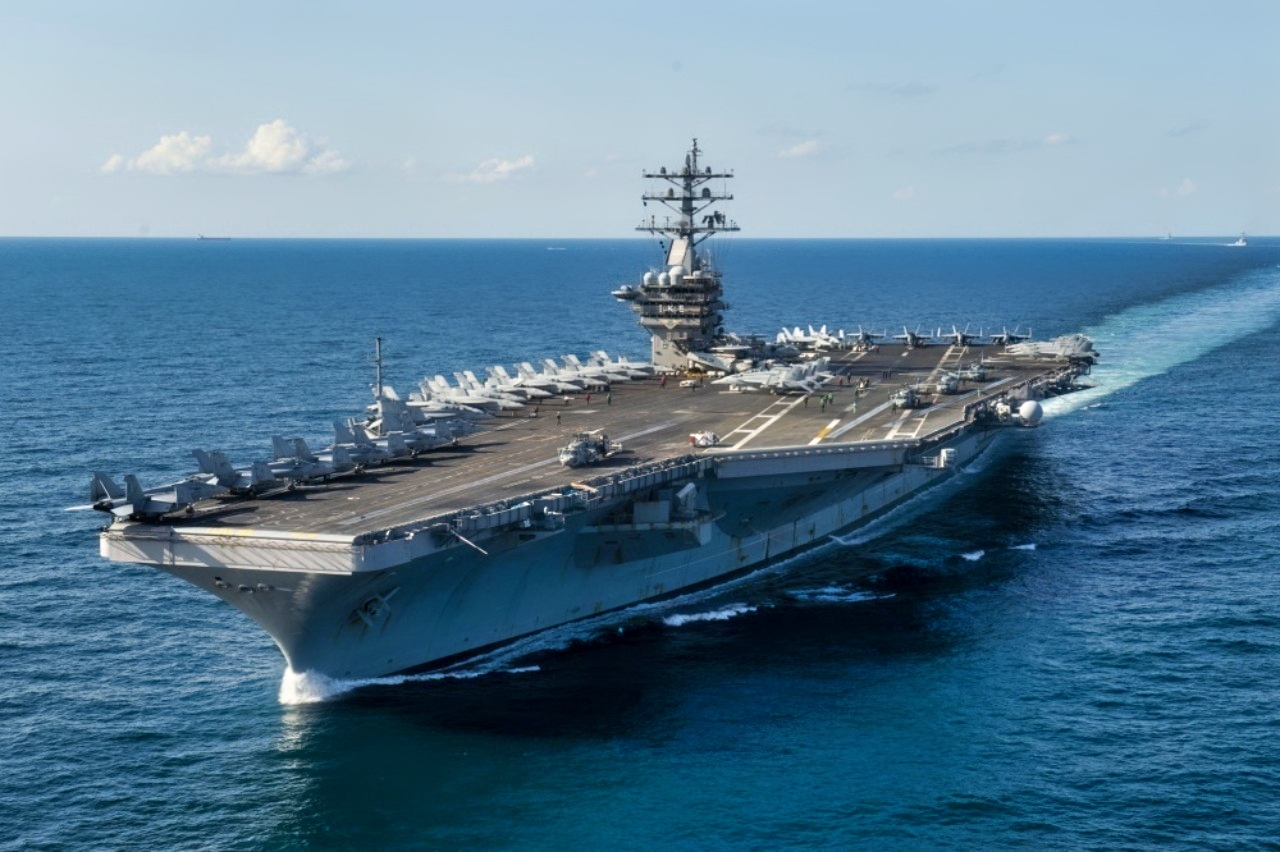
Key Points – History is replete with examples of seemingly antiquated submarines successfully “sinking” advanced US aircraft carriers during naval exercises, highlighting the persistent threat of undersea warfare.
-In a notable 1981 NATO wargame, a Canadian Oberon-class diesel-electric submarine slipped through a carrier strike group’s defenses and conducted a successful simulated torpedo attack on the USS Dwight D. Eisenhower.
-This incident is not isolated; Dutch, Chilean, Australian, and Swedish submarines have all achieved similar feats in various exercises over the decades, repeatedly demonstrating that even older, quiet conventional submarines, when skillfully commanded, can pose a lethal threat to the largest surface warships.
An Antiquated Canadian Submarine ‘Sank’ A Navy Aircraft Carrier
In the event of an actual shooting war with a near-peer enemy, the United States will attempt to protect its aircraft carriers from missiles, bombs, and torpedoes. These can come from a variety of sources, but one aspect that will demand close attention is the threat posed by submarines.
Submarines pose a significant threat to US aircraft carriers. While carriers are heavily defended and have advanced defensive measures, submarines’ stealth and potential for long-range attacks with torpedoes or missiles remain a concern.
The threat is not just from enemy submarines but also from the potential for miscalculation or unforeseen events during peacetime encounters, as highlighted by the collision between the USS Kitty Hawk and a Soviet submarine.
In one particular exercise, a Canadian Oberon-class submarine successfully “sank” the USS Dwight D. Eisenhower during a 1981 NATO wargame, showcasing the stealth capabilities of older submarine models. But it is far from the only example of such.
In another exercise, American officials were stunned by how Sweden’s Gotland-class subs managed to “run circles” around the $6 billion USS Ronald Reagan (CVN-76).
How Can Submarines Sink An Aircraft Carrier in Wartime?
Stealth: Submarines are inherently stealthy, making them difficult to detect and track, particularly advanced nuclear-powered submarines. As evidenced by numerous exercises, excellent captains and crews with good submarines can breach even the best defenses a carrier strike group can muster.
Long-Range Weapons: Submarines can launch torpedoes and potentially missiles (depending on the class) at significant ranges, potentially beyond the reach of some of the carrier’s defensive systems. US submarines carry Tomahawk cruise missiles.
Variety of Threats: Submarines can pose a threat with torpedoes, mines, and potentially even cruise or ballistic missiles, depending on the submarine’s capabilities.
Carrier Strike Group Defenses
And yet, the defenses of a carrier strike group, which includes other warships (such as destroyers, cruisers, and frigates) and submarines, are designed to protect the carrier and are very robust.
The strike group employs various Anti-Submarine Warfare (ASW) measures, including surface escorts with active and passive sonar, helicopters, and long-range aircraft.
Carriers also have multiple layers of defense against various threats, including missiles, aircraft, and even cyberattacks.
Canada Sinks the USS Eisenhower
Details are scarce on this particular exercise, but during the wargame, CVN-69 participated in the NATO exercises Ocean Venture/Magic Sword North, which were the largest exercises in the US Navy’s Atlantic Fleet history, involving the Royal Navy, Royal Canadian Navy, and several US Coast Guard vessels.
However, at some point during Phase IV of the exercise, a Canadian Oberon-class submarine slipped through the escort screen undetected and conducted a successful simulated torpedo attack on the USS Dwight D. Eisenhower. To make matters worse, another Canadian submarine reportedly also “sank” the USS Forrestal CV-59 later in the exercise.
RIMPAC Exercise in 1972
In 1972, the Canadian submarine Rainbow was tasked with simulating a Soviet “Echo II” class submarine, which had to surface to fire anti-ship missiles, ideally at a “high-value target,” in this case, the aircraft carrier USS Ticonderoga.
“Tico” was nine months older than Rainbow, but had been upgraded constantly and was now configured as an anti-submarine carrier (CVS in NATO classification) carrying an air wing of Tracker fixed-wing aircraft and Sea King helicopters.
And the Rainbow sank the Ticonderoga by surfacing and “launching” several missiles at the carrier. The year before, it sank the Ticonderoga at the end of an exercise by hiding at the entrance of Pearl Harbor and caught the carrier unaware.
Other mostly diesel submarines have ‘sunk’ US aircraft carriers in other exercises, and include:
1989: USS America sunk in the Atlantic Ocean by the Dutch Navy Zwaardvis Class diesel-electric submarine.
1996: USS Independence sunk by the Chilean Navy, a German-built Type-209 Class diesel-electric class submarine in the Pacific Ocean.
1999: USS Theodore Roosevelt sunk by the Dutch Navy Walrus Class diesel-electric submarine in the Atlantic Ocean.
2003: An Unidentified US Navy aircraft carrier was sunk by two Royal Australian Navy Collins-class diesel-electric submarines in the Pacific Ocean.
2005: USS Ronald Reagan sank by a Swedish Navy Gotland-class AIP submarine in the Pacific Ocean.
Although such losses occurred only in exercises, it highlights the fact that US Navy carrier battlegroups could be vulnerable to submarine attack. During the Cold War, the principal objective of the Soviet Navy was to eliminate US naval air superiority.
The principal means of doing that was through Soviet nuclear submarines, which were the Soviet Union’s primary maritime asset, and followed/shadowed US aircraft carriers and were trained to destroy them through conventional or nuclear means in wartime.
In the Twilight 2000 timeline, this could have resulted in significant American naval losses. The submarine threat was/is real.
About the Author:
Steve Balestrieri is a National Security Columnist. He served as a US Army Special Forces NCO and Warrant Officer. In addition to writing on defense, he covers the NFL for PatsFans.com and is a member of the Pro Football Writers of America (PFWA). His work was regularly featured in many military publications.
The Best Tanks on Earth
AbramsX: The Tank the US Army Wants


Pingback: Iran's Submarine Force Summed Up in 4 Words - National Security Journal
Pingback: Nimitz-Class Nuclear Navy Aircraft Carrier: ‘Sunk’ By Small Diesel Submarine - National Security Journal