
Iran launched another attack on a commercial tanker in the Strait of Hormuz on the morning of Tuesday, July 21, forcing its crew to abandon the vessel.
The strike came after the United States completed its tenth consecutive night of airstrikes against the Iranian regime.
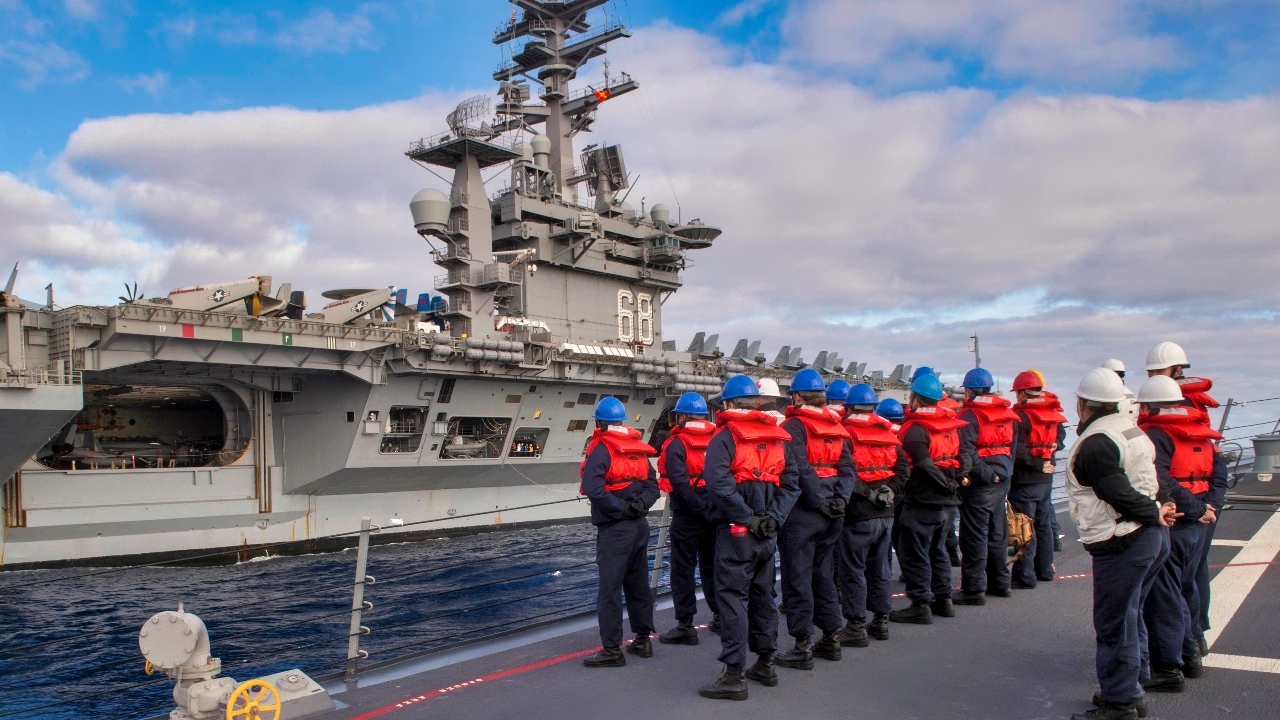
(June 11, 2017) Sailors aboard the Arleigh Burke-class guided-missile destroyer USS Pinckney (DDG 91) stand in formation as the ship pulls alongside the aircraft carrier USS Nimitz (CVN 68) to conduct a replenishment-at-sea. The Pinckney is currently underway as part of the Nimitz Carrier Strike Group on a regularly scheduled deployment to the Western Pacific and Indian Oceans. (U.S. Navy photo by Mass Communication Specialist 2nd Class Craig Z. Rodarte/Released)
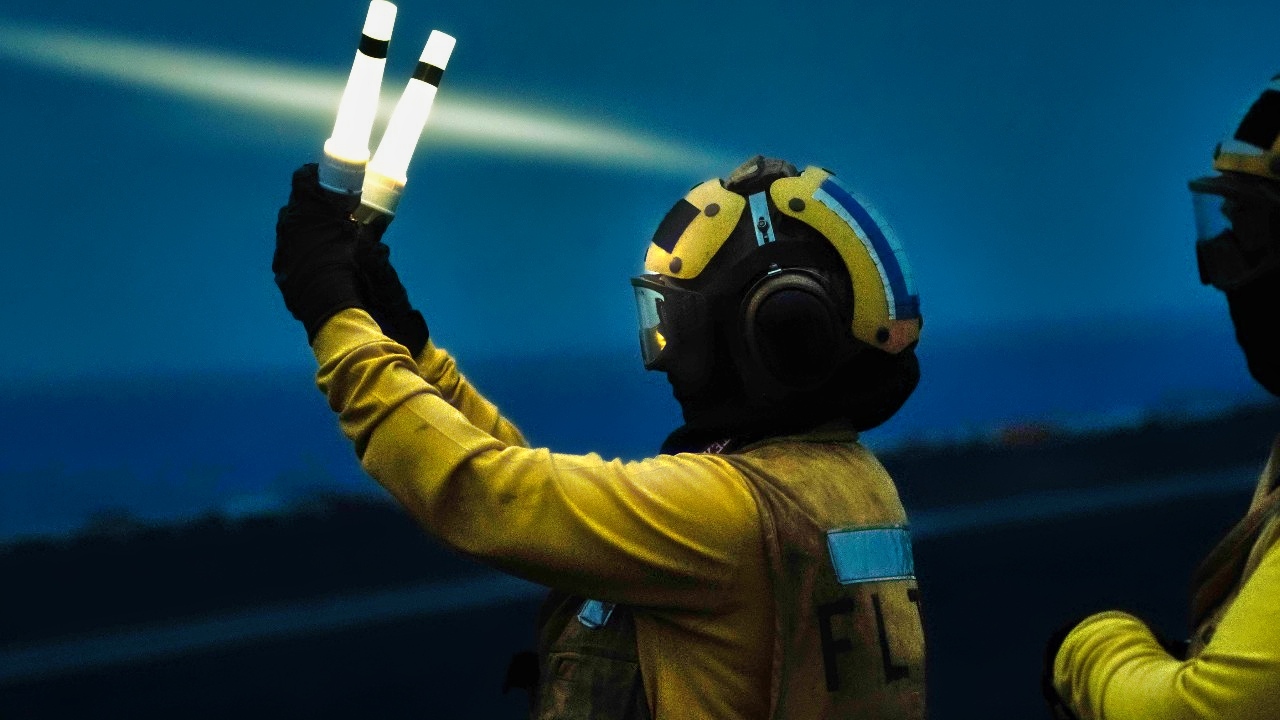
U.S. 5TH FLEET AREA OF OPERATIONS (Aug. 6, 2024) An Aviation Boatswain’s Mate (Handling) signals aircraft on the flight deck of the Nimitz-class aircraft carrier USS Theodore Roosevelt (CVN 71), Aug. 6. Theodore Roosevelt is deployed to the U.S. 5th Fleet area of operations to support maritime security and stability in the U.S. Central Command area of responsibility. (Official U.S. Navy photo)
The United Kingdom Maritime Trade Operations (UKMTO) center said that the incident occurred approximately eight nautical miles northeast of Limah, Oman, along the southern side of the strait.
It is just the latest indication that Iran is seeking to prevent ships from using U.S.-backed shipping lanes closer to the Omani coast, undermining Washington’s efforts to keep global oil trade flowing.
According to the UKMTO, the crew left the vessel in a lifeboat, and no environmental damage was reported.
Iran’s Islamic Revolutionary Guard Corps claimed responsibility for the attack, which came less than 24 hours after two other tankers were hit near Oman, and as traffic through Hormuz falls to a tiny fraction of normal levels.
Tanker Abandoned After Attack
UKMTO reports that the tanker was struck by an unidentified projectile early on Tuesday, though the organization did not initially name the ship.
Maritime-risk analyst Martin Kelly, head of advisory at EOS Risk Group, publicly identified the tanker as Kaifan, which is operated by the Kuwait Oil Tanker Company.
According to Kelly, the vessel broadcast a distress signal on VHF Channel 16 reporting that it had been struck by either a missile or a drone and that a fire had broken out in its engine room.
Ten Nights of Strikes Have Not Secured Hormuz
Ten nights of consecutive strikes, as confirmed by U.S. Central Command (CENTCOM), have not been enough to secure the Strait of Hormuz and bring Iran back to the negotiating table.
According to CENTCOM, the latest round of strikes concluded at 9 pm Eastern Time on Monday, with American forces once again targeting military command centers, maritime capabilities, air defense systems, and missile and drone launch sites.
“U.S. Central Command (CENTCOM) completed another round of strikes against Iran at 9 p.m. ET, July 20.
U.S. forces struck Iranian military command centers, maritime capabilities, missile and drone launch sites, and air defense systems to degrade Iran’s ability to continue attacking commercial vessels flowing through the Strait of Hormuz,” a statement reads.
Iran Isn’t Backing Down
If the objective of the sustained U.S. campaign against Tehran was to pressure the regime back toward negotiations, which it appears to have been, Iran’s public messaging suggests that it has had the opposite effect. The IRGC has since hardened its rhetoric, describing the conflict as one that must continue until the United States is deterred from conducting further attacks.
“Now, as criminal America has once again chosen the path of error, aggression, and adventurism, we remain committed to this pledge: we will deliver, with power, determination, wisdom, and authority, the ‘unforgettable lesson’ that you promised,” the IRGC said on Monday, vowing also to deliver an “unforgettable lesson” to the United States.
“A lesson that will prevent any aggressor from repeating its mistakes, break the ambitions of any aggressor, and record in history the truth of the Iranian nation’s unwavering will,” the statement continues.
Iran continues to fight, using all asymmetric tactics at its disposal – including using its proxy forces to cause additional disruption in the Red Sea.
And while U.S. strikes may have so far had the opposite effect to what Washington had hoped, that doesn’t mean not striking would have been much better – Tehran would inarguably be in a stronger military position than it is now if Washington had refrained from launching new strikes.
CENTCOM Says the Strait is Open
Nonetheless, Washington and CENTCOM continue to project confidence that the Strait of Hormuz is secure, and that commercial ships are still transiting the strait. According to the statement, CENTCOM has helped facilitate the transit of hundreds of vessels.
“Commercial vessel transits through the vital international maritime corridor continue.
Since early May, CENTCOM forces have helped facilitate the transit of approximately 900 commercial vessels and 450 million barrels of crude oil.
American forces remain postured and prepared to hold Iran accountable for unwarranted aggression toward civilian mariners seeking to freely and openly transit the strait,” the statement reads.
The problem for CENTCOM is that the shipping traffic data tells a different story.
Traffic Through Hormuz Has Collapsed
The latest shipping data suggests that confidence in the Strait of Hormuz, and indeed the U.S. Navy’s ability to secure it, continues to deteriorate.
Despite ongoing U.S. assurances, maritime intelligence firm Lloyd’s List Intelligence reported that non-Iran-linked transit fell from 108 during the week of July 6-12 to just 25 during July 13-19.
Inbound traffic also dropped from 43 vessels to eight. Overall traffic through the strait is now down by around 90 percent compared with the same period last year – meaning a major global oil crisis is coming unless something changes soon.
About the Author: Jack Buckby
Jack Buckby is a British researcher and analyst specializing in defense and national security, based in New York. His work focuses on military capability, procurement, and strategic competition, producing and editing analysis for policy and defense audiences. He brings extensive editorial experience, with a career output spanning over 1,000 articles at 19FortyFive and National Security Journal, and has previously authored books and papers on extremism and deradicalization.


