


Key Points and Summary – The era of the American aircraft carrier’s undisputed dominance is coming to an end due to the threat posed by China’s advanced anti-ship ballistic missiles, such as the DF-21D, also known as the “carrier killer.”
-These weapons attack at hypersonic speeds from the upper atmosphere, creating a “nightmarish problem” for U.S. naval defenses.
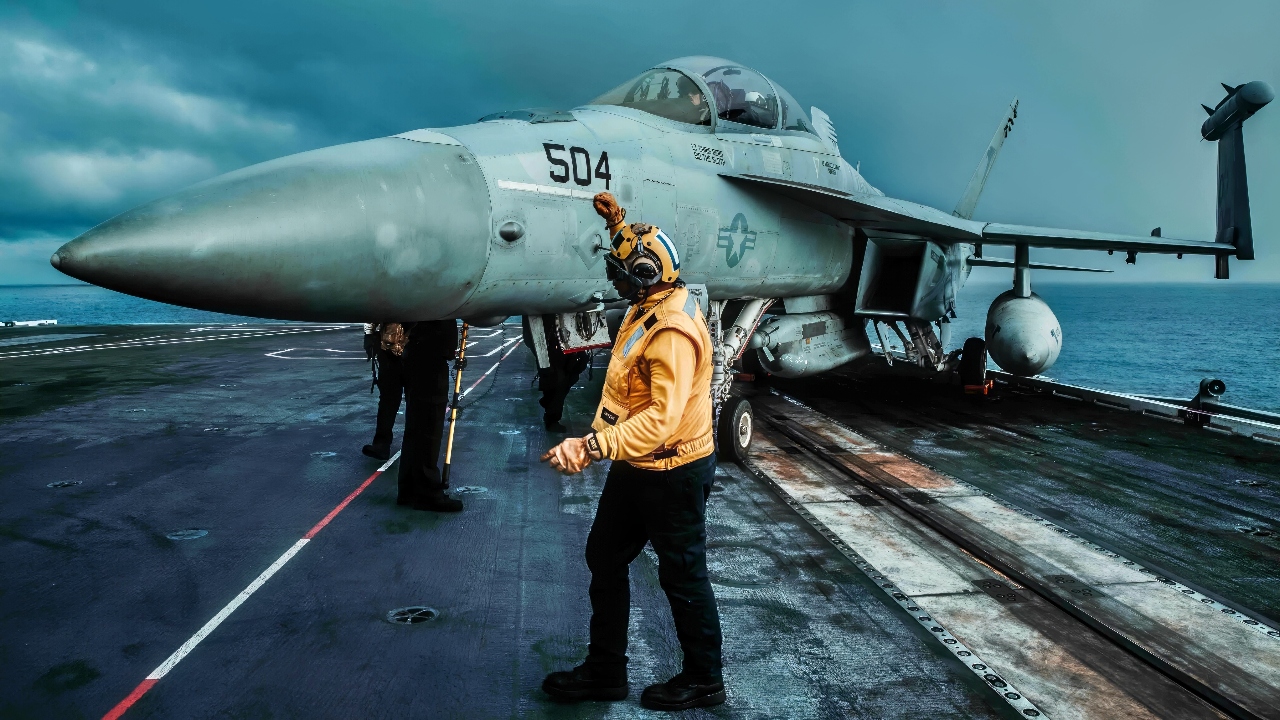
An E/A-18G Growler, attached to Electronic Attack Squadron (VAQ) 141, taxis on the flight deck of Nimitz-class aircraft carrier USS George Washington (CVN 73), while underway in the Indian Ocean, July 24, 2025. The USS George Washington Carrier Strike Group (GWA CSG) is conducting routine operations in the U.S. 7th Fleet area of operations. George Washington is the U.S. Navy’s premier forward-deployed aircraft carrier, a long-standing symbol of the United States’ commitment to maintaining a free and open Indo-Pacific region, while operating alongside allies and partners across the U.S. Navy’s largest numbered fleet. (U.S. Navy photo by Mass Communication Specialist Seaman Nicolas Quezada)
-Supported by a sophisticated “kill chain” of satellites and sensors, they can hold carriers at risk from hundreds of miles away.
-This forces the ships to operate so far out at sea that their own fighter jets are rendered useless, neutralizing the primary symbol of American power.
The Aircraft Carrier Era Could Come to a Spectacular End Thanks to China
For the better part of a century, the U.S. Navy aircraft carrier has been the ultimate symbol of global power.
It is more than a warship; it is 100,000 tons of sovereign American territory, a floating fortress capable of projecting overwhelming force anywhere on Earth.
From the decks of these steel behemoths, America has dictated the terms of international security, reassured allies, and punished adversaries.
The carrier strike group, with its layered defenses and unmatched lethality, was long considered an untouchable instrument of national will, the final arbiter in any geopolitical dispute.
That era of unquestioned dominance is over.
China Takes on a Complex Challenge
While Washington was mired in the deserts of the Middle East, fighting wars of counter-insurgency, Beijing was laser-focused on a single, existential problem: how to break American naval power in the Pacific.
For the last three decades, China has poured its national treasure and immense industrial might into building a force designed for one primary purpose: to hold America’s prized aircraft carriers at risk, to push them out of Asia’s waters, and, if war should come, to sink them.
This isn’t just about developing a few new missiles; it is about the methodical construction of the most sophisticated and dangerous anti-access/area denial (A2/AD) network ever conceived.
The U.S. Navy now sails in the shadow of a threat that is not only real but is growing in scope, scale, and lethality with each passing day.
A Strategy Born of Humiliation
To understand China’s obsession with killing aircraft carriers, you must go back to the Taiwan Strait Crisis of 1996.
As China conducted provocative missile tests to intimidate Taiwan, President Bill Clinton dispatched two U.S. carrier battle groups to the region in a clear show of force. The message was unmistakable, and for Beijing, it was a moment of profound humiliation.
The People’s Liberation Army (PLA) had no way to track the carriers, let alone challenge them. They were utterly powerless, forced to back down in their own backyard.
In the aftermath, a vow was made: never again. Chinese military strategists began to develop a new doctrine, an asymmetric approach focused on exploiting America’s vulnerabilities. They knew they could not match the U.S. Navy ship-for-ship or plane-for-plane.
Instead, they would create what they called an “assassin’s mace”—a suite of high-tech weapons that could cripple a technologically superior foe. The absolute centerpiece of this strategy became the PLA Rocket Force (PLARF), and its primary target became the American aircraft carrier.
The Original Sin: The DF-21D “Carrier Killer”
The first fruit of this strategy was a weapon that fundamentally altered the naval balance of power: the DF-21D, the world’s first operational anti-ship ballistic missile (ASBM). Before the DF-21D, the threat to a carrier came from cruise missiles, torpedoes, and aircraft—all threats its layered defenses were designed to counter. A ballistic missile, however, was an entirely different beast.

Aircraft Carrier Sinking in controlled demolition. Image Credit: Creative Commons.
Let’s wargame the mechanics. The DF-21D is launched like a traditional ballistic missile, screaming into the upper atmosphere. It then releases a highly maneuverable reentry vehicle (MaRV) that plummets back towards the earth at hypersonic speeds—reportedly in excess of Mach 10.
This MaRV is not on a fixed trajectory; it can make course corrections in its final moments, guided by its own onboard seeker or external data, allowing it to target a moving ship.
For a carrier strike group’s Aegis Combat System, this presents a nightmare scenario. A defender has only minutes, perhaps seconds, to detect, track, and attempt to intercept an object moving at several miles per second. With a range of over 1,500 kilometers, the DF-21D effectively created a “no-go” zone for U.S. carriers, pushing them beyond what is known as the “first island chain” (stretching from Japan through Taiwan to the Philippines) and making direct intervention in a Taiwan scenario infinitely more difficult.
Going Long: The DF-26B “Guam Killer”
As formidable as the DF-21D was, China knew the U.S. could still project power from its key bases in the “second island chain.” The most important of these is Guam, a critical hub for Air Force bombers and Navy submarines. In response, the PLARF unveiled an even more ambitious weapon: the DF-26B.
With a range estimated at over 4,000 kilometers, the DF-26B earned its moniker as the “Guam Killer” because it could strike this vital American territory from mobile launchers deep within mainland China. But its most sinister feature is its dual-purpose nature. The DF-26B is not only capable of striking land targets but also has an anti-ship variant designed to hunt carriers operating much further than the DF-21D can range.
This weapon forces U.S. naval commanders to make an impossible choice: either operate within the DF-26B’s massive engagement envelope and accept the risk, or stay so far out in the Pacific that their carrier-based aircraft, like the F-35C, lack the range to be effective in a fight.
The DF-26B is a weapon of strategic coercion, designed to cripple American power projection before the first shot is even fired.
The Unstoppable Arrow: Hypersonic Glide Vehicles
Just as the U.S. military began to develop potential countermeasures against traditional ballistic missile trajectories, China introduced a new wild card: the hypersonic glide vehicle (HGV), delivered by missiles like the DF-17. This weapon represents a quantum leap in offensive capability.

DF-17 Missile from China. Image Credit: PLA.

DF-17 Missile from China. Image Credit: Creative Commons.
Unlike a ballistic reentry vehicle, which follows a predictable, arching path, an HGV is released at the edge of space and then “skips” along the upper atmosphere at speeds exceeding Mach 5. It can perform extreme, unpredictable maneuvers, flying on a relatively flat trajectory.
This makes it effectively invisible to most ground-based radars until its final moments and renders it nearly impossible for our current generation of missile interceptors, like the SM-3, to engage. It is a weapon designed to bypass the carrier strike group’s defenses entirely, a hypersonic silver bullet for which we currently have no shield.
The Kill Chain: It’s Not the Arrow, It’s the Entire System
A missile is useless if you cannot find and track your target. The most terrifying aspect of China’s carrier-killer strategy is not the missiles themselves, but the vast, multi-layered intelligence, surveillance, and reconnaissance (ISR) network—the “kill chain”—that Beijing has constructed to guide them.
This is a system of systems designed to achieve one goal: to find a U.S. carrier strike group anywhere in the Western Pacific and provide a constant stream of targeting data to the PLARF. This network includes:
-A Constellation of Satellites: China has launched a massive fleet of reconnaissance satellites, including high-resolution electro-optical satellites to see the carriers and radar satellites that can see them through clouds and at night.
-Over-the-Horizon Radars: Giant land-based radar installations that can bounce signals off the ionosphere to detect ships hundreds or even thousands of miles from China’s coast.
-Unmanned Aerial Vehicles: A growing fleet of long-range drones, including the WZ-8 supersonic reconnaissance drone, designed to fly high-speed missions to pinpoint the location of a carrier group.
-A Web of Human and Naval Sensors: Everything from maritime patrol aircraft and the Chinese fishing fleet to its own submarine force is tasked with acting as a spotter, reporting any contact with U.S. naval forces.
All of this data is fused at command centers that can then task the PLARF’s mobile missile launchers with a targeting solution. It is a sprawling, redundant, and deeply sophisticated system designed to turn the entire ocean into a transparent kill box.
The Tyranny of Numbers for America’s Aircraft Carriers
The final piece of China’s strategy is simple, brutal math.
China is not planning to launch one or two missiles at an aircraft carrier; it is planning to launch dozens, if not hundreds. The PLARF possesses the largest and most diverse missile arsenal in the world, with thousands of launchers. In a conflict, they would unleash a massive, coordinated salvo attack designed to overwhelm any defense.
Imagine a scenario where a carrier strike group is simultaneously targeted by waves of DF-21Ds on steep trajectories, DF-26Bs coming from longer ranges, and DF-17s screaming in on flat, unpredictable paths. Even with the formidable capabilities of the Aegis system, the sheer number of incoming threats, arriving from different angles and at different speeds, would saturate the defenses. Not every missile needs to get through. A single conventional warhead hitting a carrier’s flight deck at Mach 10 would inflict catastrophic damage, rendering it combat-ineffective. A few such hits could send a $13 billion warship and its 5,000 sailors to the bottom of the Pacific.
The U.S. Navy Must Think Long and Hard
This is the uncomfortable reality of the new era of naval warfare. The aircraft carrier, for so long the uncontested queen of the seas, is now a hunted king. China has spent three decades and untold billions of dollars building a crossbow aimed directly at the heart of American power. It is a threat we can no longer ignore.
About the Author: Harry J. Kazianis
Harry J. Kazianis (@Grecianformula) is Editor-In-Chief and President of National Security Journal. He was the former Senior Director of National Security Affairs at the Center for the National Interest (CFTNI), a foreign policy think tank founded by Richard Nixon based in Washington, DC. Harry has over a decade of experience in think tanks and national security publishing. His ideas have been published in the NY Times, The Washington Post, The Wall Street Journal, CNN, and many other outlets worldwide. He has held positions at CSIS, the Heritage Foundation, the University of Nottingham, and several other institutions related to national security research and studies. He is the former Executive Editor of the National Interest and the Diplomat. He holds a Master’s degree focusing on international affairs from Harvard University.
More Military
The Eurofighter Typhoon Belongs in a Museum Near You
The Seawolf-Class Submarine Disaster
3 Ohio-Class Submarines Surfaced in a Warning to China
Study This Photo: Boeing Just Dropped New F/A-XX Fighter Image


David Keystone
September 2, 2025 at 1:55 pm
A very sobering article. By the time I reached the end, all I could think of was that we need more Trident D5 launchers, and a defensive satellite network. Protect our GPS network and launch a MIRV strike from the arctic or Indian Ocean. If we are going to have to fight, then let’s fight.