


Most China watchers assume that leaders in Beijing always want to go on the offensive militarily, whether it is attacking Taiwan, taking more island territory, or exporting its authoritarian government system to other countries in the developing world.
But another way to look at it is that China is playing defense, and it can accomplish this strong posture by focusing on anti-ship missiles, drones, plus manned fighters and bombers to create a defensive arc or bubble.
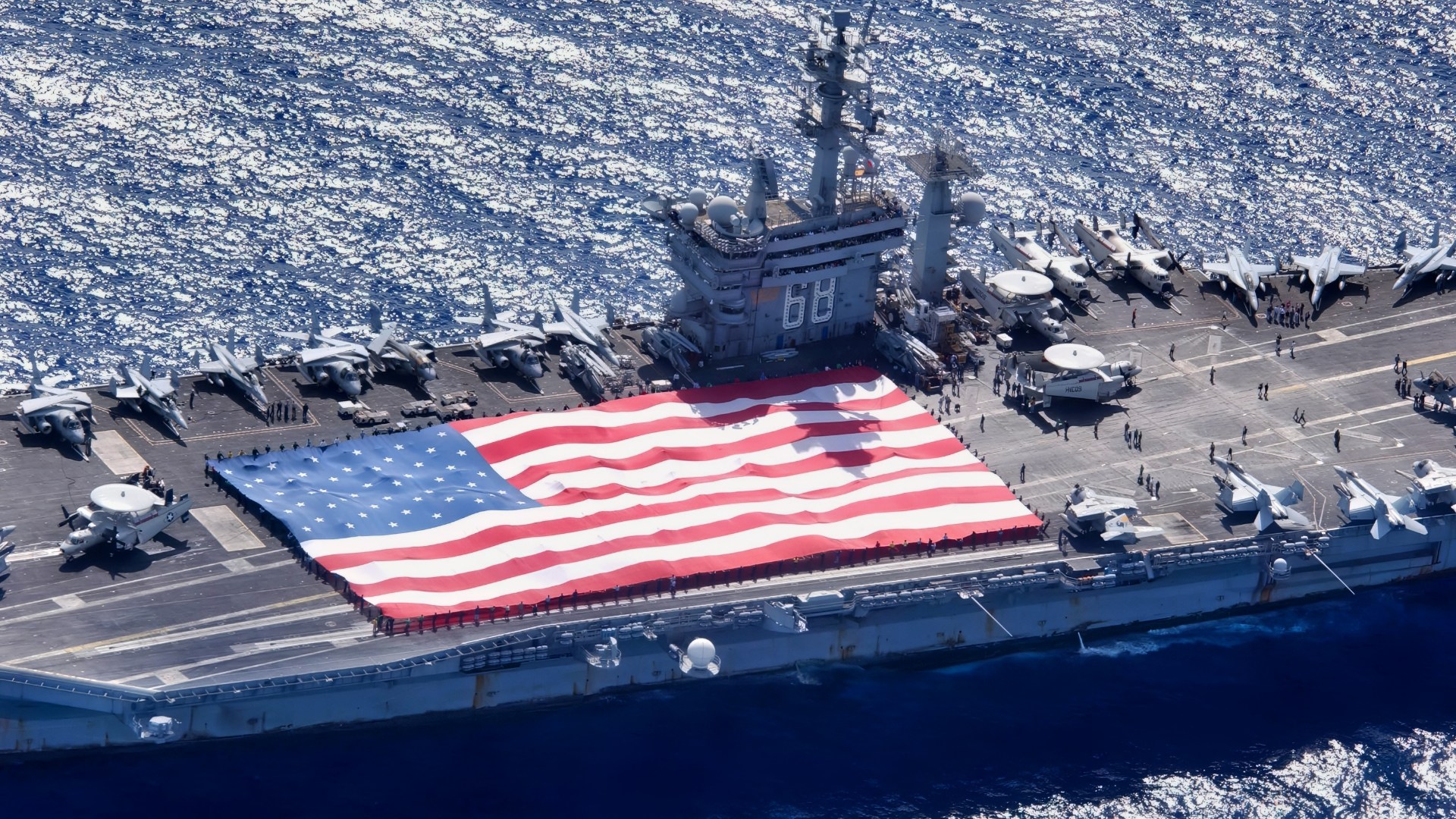
Pacific Ocean (November 3, 2003) — During Tiger Cruise aboard USS Nimitz (CVN 68), Nimitz and Carrier Air Wing Eleven personnel participate in a flag unfurling rehearsal with the help of fellow tigers on the flight deck. The Nimitz Carrier Strike Force and Carrier Air Wing Eleven (CVW-11) are in route to Nimitz homeport of San Diego, California after an eight-month deployment to the Arabian Gulf in support of Operation Iraqi Freedom. U.S. Navy photo by Photographer Mate 3rd Class Elizabeth Thompson
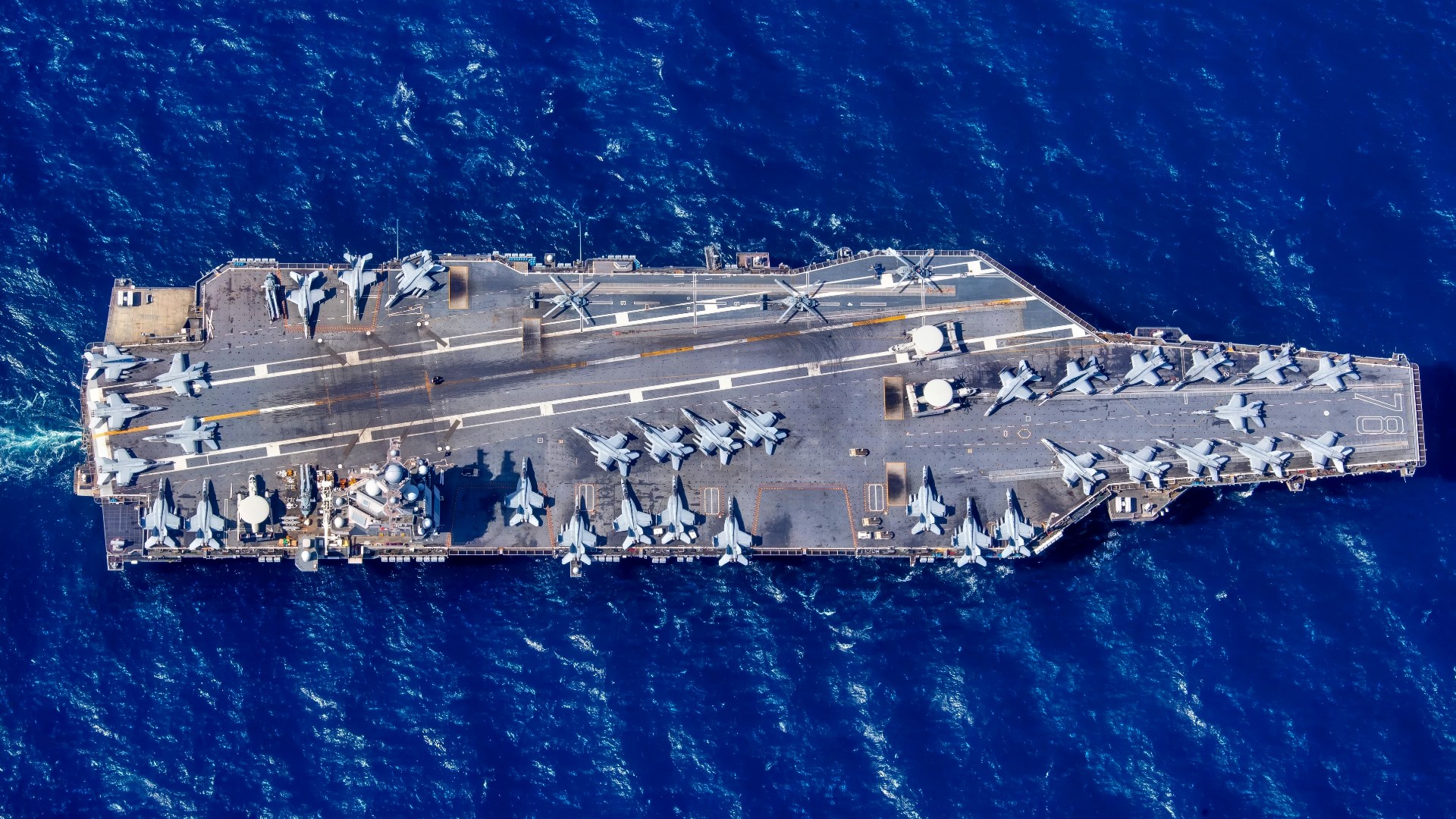
The first-in-class aircraft carrier USS Gerald R. Ford (CVN 78) transits the Atlantic Ocean, March 19, 2023. Ford is underway in the Atlantic Ocean executing its Composite Training Unit Exercise (COMPTUEX), an intense, multi-week exercise designed to fully integrate a carrier strike group as a cohesive, multi-mission fighting force and to test their ability to carry out sustained combat operations from the sea. As the first-in-class ship of Ford-class aircraft carriers, CVN 78 represents a generational leap in the U.S. Navy’s capacity to project power on a global scale. (U.S. Navy photo by Mass Communication Specialist 2nd Class Jackson Adkins)
Defense can often be more potent than offense, and we know that China is looking several moves ahead and planning decades to build a grand strategy that will enable the Middle Kingdom to have the strongest military and economy in the world.
China’s Aircraft Carriers Have an Advantage: The 1 Word That Is A2/AD
Military planners in the West call this defensive bubble “Anti-Access/ Area Denial” or A2/AD. It aims to keep the United States and its allies from encroaching on the First Island Chain of territorial claims closest to the Mainland.
The great thing about A2/AD is that China doesn’t need aircraft carriers to accomplish its defensive objectives and goals. A2/AD allows the aircraft carriers to be a “bonus” for projecting power outside the region.
The navy has submarines that can be used for A2/AD, beyond the missiles and aircraft mentioned above.
China May Not Even Need Aircraft Carriers for A2/AD
Sure, it wants six carriers by 2030, with at least half of them in the water at all times.
China has three conventionally-powered flat-tops and the next one most likely will be nuclear-powered.
The United States may not be able to operate closely to China due to A2/AD and its stingy defensive posture. This creates the bubble, and then the hammer is the Chinese aircraft carrier.
Three is enough for the time being. Numbers four, five, and six can come later and will not affect the efficacy of the current A2/AD bubble.
The New Great Wall of China
Thus, Beijing is in a great position militarily. The country has built a wall around the Mainland. China can use its carriers to become a true Blue Water navy that operates outside its region. It can protect sea lanes in the Middle East that bring in oil.
China may also execute the overseas “String of Pearls” strategy, which involves building a series of bases that can maintain carriers and support ships in ports outside of East Asia.
Even if Xi Jinping decided to stop building carriers today, China’s A2/AD bubble is sufficient to stymie the Americans. The U.S. Navy is forced to keep its own aircraft carriers outside the First Island Chain and out of range of ship-killing missiles. That’s the denial of access part.
The U.S. Navy and Its Aircraft Carriers Have No Intention of Slinking Away
Of course, the United States has no intention of staying outside the bubble. The Americans want sea lines of communication and freedom of maneuver in the Indo-Pacific open at all times.
But the U.S. Navy will have to come to terms with the possibility of losing an aircraft carrier in any shooting war with China.
This would devastate American morale and likely force Washington to seek a cease-fire in the event of such a conflict.
I have spoken to U.S. Navy surface fleet officers and submariners, who claim the Navy would “roll up” so many Chinese ships that Xi Jinping would sue for peace. Perhaps both sides are overconfident.
It remains to be seen what President-elect Donald Trump has in store for China strategy-wise. National Security Advisor Mike Waltz, as does Secretary of State nominee Marco Rubio, has a reputation for being a China hawk.
They will have to deal with the A2/AD defensive bubble and figure out if the United States would intervene in a Chinese attack on Taiwan. More American surface vessels and submarines would be nice, plus additional long-range JASSM missiles and combat drones.
Will ‘Peace Through Strength’ Work?
The time is over for the United States to guess and yearn for a China strategy in the Indo-Pacific. Beijing’s defensive bubble has been established.
The United States may be unable to defend its allies due to the American public’s aversion to war. ” Peace through Strength” has a nice bumper-sticker ring to it. Still, this slogan must be accompanied by a specific tactical, operational, and strategic doctrine if the United States is to achieve peace in East Asia.
However, the new Trump security team must still be prepared for war. China has the carriers and the surface ships to be a global power someday. And I have not even mentioned nuclear weapons. China has at least 500 warheads and wants 1,000 by 2030. They also have no intention of entering into arms control talks soon.
China has an A2/AD defensive bubble around the First Island Chain, keeping the United States out of that protective arc. It is building more carriers as a “bonus” for someday steaming outside the region to project power and establish new military bases beyond the ones in Pakistan and Djibouti.
It can someday attack Taiwan with a 50-50 chance that Trump won’t intervene. It could sink a U.S. aircraft carrier and watch the American people recoil in terror. And it is building more nuclear weapons. This all adds up to a formidable strategy.
Let’s hope that the best American minds are working to devise a Trump doctrine to answer China’s formidable plans and objectives.
About the Author: Dr. Brent M. Eastwood
Brent M. Eastwood, PhD, is the author of Don’t Turn Your Back On the World: A Conservative Foreign Policy and Humans, Machines, and Data: Future Trends in Warfare, plus two other books. Brent was the founder and CEO of a tech firm that predicted world events using artificial intelligence. He served as a legislative fellow for U.S. Senator Tim Scott and advised the senator on defense and foreign policy issues. He has taught at American University, George Washington University, and George Mason University. Brent is a former U.S. Army Infantry officer. He can be followed on X @BMEastwood.


