

China is rapidly expanding its military power across the Indo-Pacific, fielding advanced missile systems and modern warships, constructing supercarriers, building a growing carrier fleet designed to challenge U.S. dominance in the region, and rapidly closing the technological gap with the U.S. aerospace sector. But at the center of its massive buildup is a project that has yet to fully appear in public view: the Xi’an H-20 stealth bomber.
First announced in 2016, the aircraft is intended to give China a true long-range strike capability – but nearly a decade later, it remains unconfirmed and is rumored to be delayed. For those familiar with China’s current capabilities, though, there is an obvious question here: if China already possesses one of the world’s most formidable missile arsenals, capable of striking U.S. bases and naval forces across the Western Pacific, is a bomber like the H-20 even necessary?

H-20 Bomber from China. Image Credit: Creative Commons.
With its long-range missile capability growing seemingly by the week, does China really need to invest in a complex and expensive stealth bomber at all? The answer depends on whether China intends to simply start a war or sustain one.
The H-20, and Why China Wants It
The Xi’an H-20 is widely expected to be China’s first true strategic stealth bomber – a flying-wing, low observable aircraft designed for long-range nuclear and conventional strike missions.
Open-source assessments suggest it will have a range of at least 8,500 kilometers and the ability to carry both nuclear and conventional payloads, potentially enabling strikes against U.S. bases in Guam and Hawaii.
Given that it is a stealth bomber, the H-20 will be capable of evading radar detection through its shaping and radar-absorbing materials, allowing it to penetrate advanced air defense systems.
Much like the American B-2 Spirit and upcoming B-21 Raider, the H-20 will theoretically be capable of penetrating strike attacks against heavily defended targets, including hardened bases and air defense networks.

(Dec. 9, 2019) This poster is designed to communicate the aircraft specifications of the B2 Spirit Stealth Bomber. The B2 bomber was introduced on Jan. 1, 1997 by the Northrop Corporation.
For China, the H-20 serves two strategic purposes.
First, it would complete a nuclear triad, adding an air-delivered nuclear capability to its land-based missiles and submarine-launched systems.
Second, it would extend China’s reach beyond its current regional bomber force, which relies heavily on the non-stealth H-6 platform. But with powerful long-range strike options already available, it’s only natural to wonder whether a stealth bomber is even necessary.
China’s Current Long-Range Options
China’s current military strength is built around what analysts call anti-access/area denial (A2/AD) – a layered system of missiles, sensors, and defenses designed to keep U.S. forces at a distance.
At the core of that system are ballistic missiles such as the DF-21D and DF-26.
The DF-21D is widely regarded as the world’s first anti-ship ballistic missile capable of targeting moving aircraft carriers, while the DF-26 has a range exceeding 5,000 kilometers and is capable of striking targets such as Guam.
Those systems enable what is known as a “saturation strike” – launching large numbers of missiles simultaneously to overwhelm enemy defenses. In a conflict, it would allow China to threaten U.S. carrier strike groups and forward bases across the Indo-Pacific.
This is already possible without a stealth bomber – and missiles offer some clear advantages, including speed and low operational risk. They do not require pilots, and they can deliver devastating effects early in a conflict, striking with great precision.
That being said, these systems are optimized for initial strikes – and are, in most cases, not suitable for prolonged warfare.
Why Missiles and Carriers Alone Are Not Enough
The key limitation of missile warfare is that supplies are inherently finite.
Missiles are expensive to produce and are quickly depleted during high-intensity warfare. What’s more, once launched, they cannot typically be recalled or retargeted.
They certainly cannot be reused.
That creates a re-strike problem, whereby targets – particularly mobile ones like naval forces – must be hit repeatedly as they relocate or recover from previous strikes. Missiles depend heavily on ISR (intelligence, surveillance, and reconnaissance) networks to track those targets, and those networks can be degraded or disrupted during conflict.
China’s growing carrier fleet adds another layer of capability, but it also introduces vulnerabilities. Even with the best air defenses, they are visible and easily detectable – and they are also extremely high-value targets.
When working together, missiles and carriers can generate significant early pressure – but unlike long-range stealth bombers, they cannot provide persistent and adaptable strike capability over time.
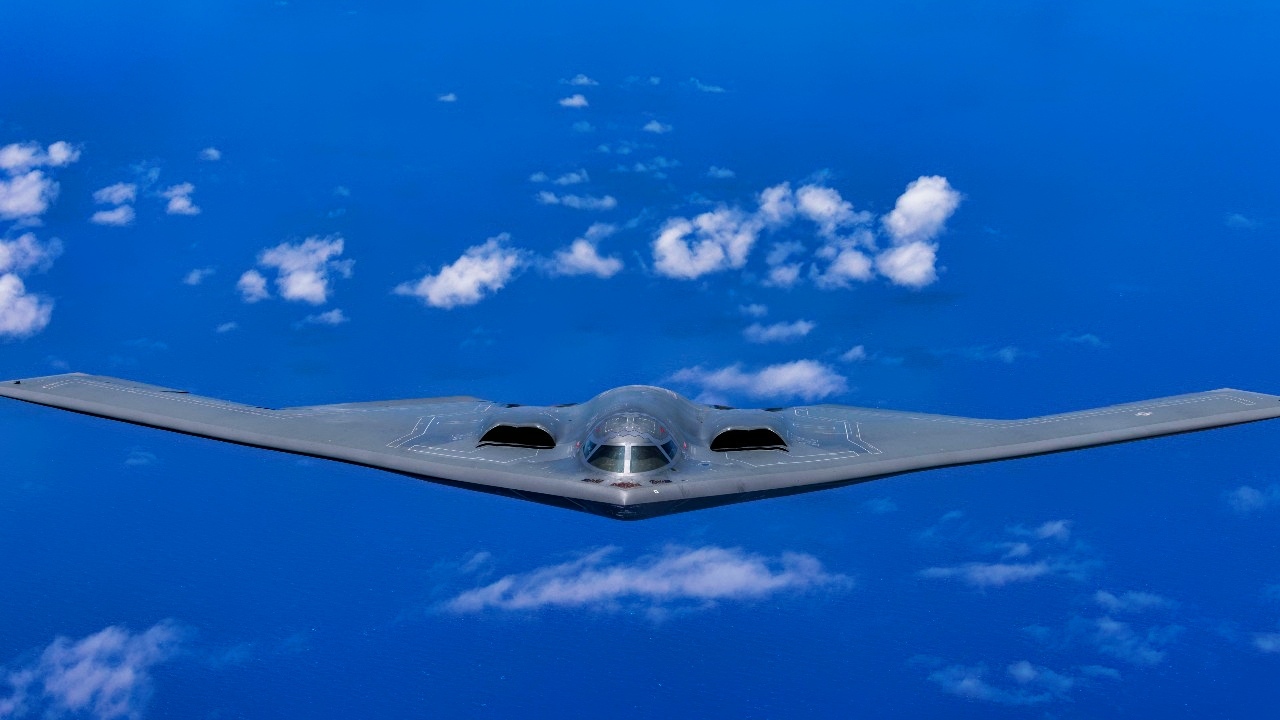
A U.S. Air Force B-2 Spirit bomber flies over the North Pacific Ocean, June 13, 2024. The speed, flexibility, and readiness of the Air Force’s strategic bombers plays a critical role in deterring potential adversaries and signaling unwavering support to allies and partners. Counter-maritime missions provide valuable training opportunities to improve interoperability and demonstrate that Air Force forces are capable of operating anywhere, anytime, to meet any challenge decisively. (U.S. Marine Corps photo by Sgt. Jose Angeles)
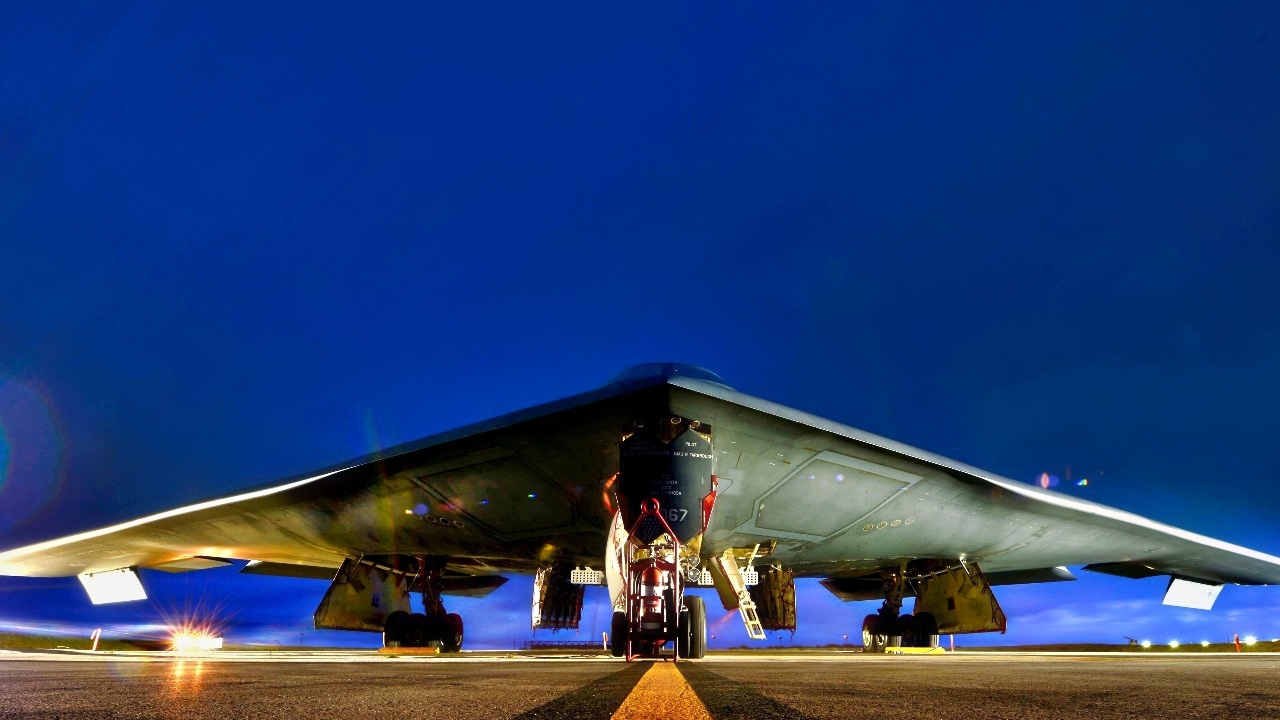
A U.S. Air Force B-2 Spirit aircrafts deployed from Whiteman Air Force Base, Mo., sits on the parkway after landing from a local training flight at Andersen Air Force Base, Guam, Jan. 17, 2017. Close to 200 Airmen and three B-2s deployed from Whiteman Air Force Base, Mo., and Barksdale Air Force Base, La., in support of U.S. Strategic Command Bomber Assurance and Deterrence missions. USSTRATCOM units regularly conduct training with and in support of the Geographic Combatant Commands. USSTRATCOM, through its global strike assets, helps maintain global stability and security while enabling units to become familiar with operations in different regions. (U.S. Air Force photo by Tech. Sgt. Andy M. Kin)
That gap will be filled by the H-20, whenever it appears.
Until then, China’s strike capacity remains optimized for initial strikes rather than sustained pressure, potentially putting off a major conflict until its stealth bomber fleet is ready.
About the Author: Jack Buckby
Jack Buckby is a British researcher and analyst specializing in defense and national security, based in New York. His work focuses on military capability, procurement, and strategic competition, producing and editing analysis for policy and defense audiences. He brings extensive editorial experience, with a career output spanning over 1,000 articles at 19FortyFive and National Security Journal, and has previously authored books and papers on extremism and deradicalization.


