

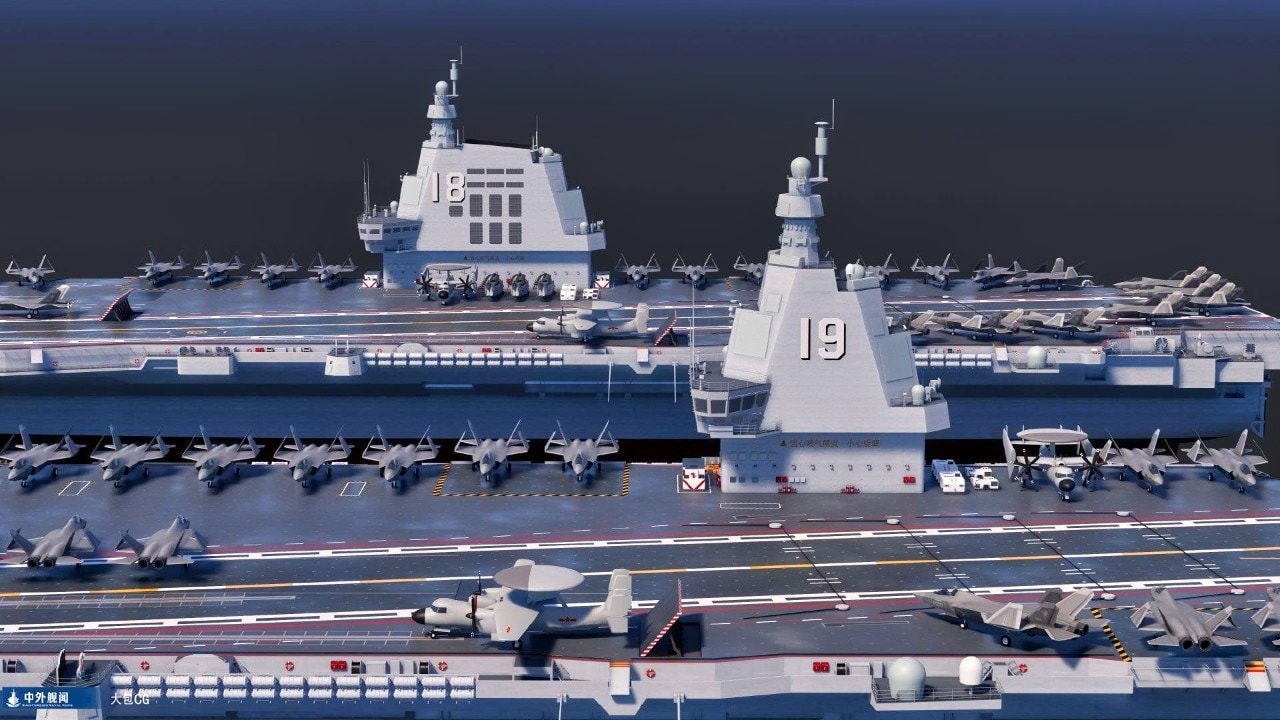
The newest aircraft carrier for the People’s Liberation Army Navy, or the PLAN, is still under construction, and many of its specifics have not been publicly confirmed.
But the evidence that is available points to a much larger, nuclear-powered aircraft carrier designed to give the PLAN a genuine, long-range, high-tempo carrier force in what is a significant step forward for a navy that has for decades been a regional force rather than one intended for sustained power projection. Here’s what we know.
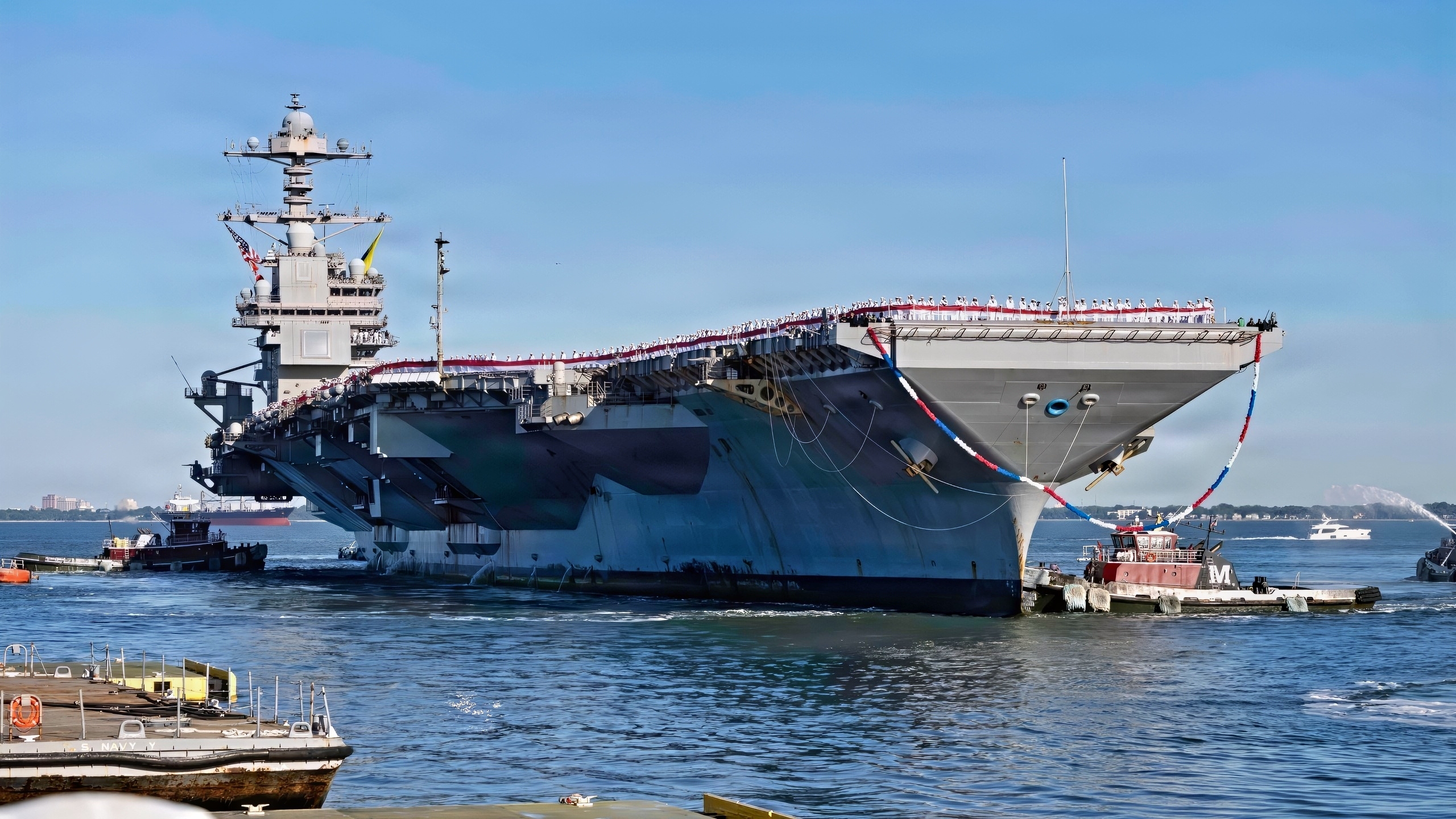
260516-N-EE423-1027 NORFOLK, Va. (May 16, 2026) – The world’s largest aircraft carrier, USS Gerald R. Ford (CVN 78), returns to Naval Station Norfolk, May 16, 2026, following a historic 11-month deployment to U.S. 2nd, 4th, 5th, and 6th Fleets as part of the Gerald R. Ford Carrier Strike Group. Before returning to Norfolk after 326 days, the Gerald R. Ford crew conducted 23 replenishments-at-sea, sailed over 57,713 nautical miles, and safely transferred 14 million gallons of fuel. Embarked Carrier Air Wing 8 logged more than 5,760 flight hours and 12,200 flight launches. (U.S. Navy photo by Mass Communication Specialist 1st Class Sophie Pinkham)
The Type 004
China’s Type 004 is the fourth aircraft carrier for the PLAN. It was designed from the outset as a large-deck, catapult-equipped ship rather than just an evolution of the Soviet-derived Liaoning and Shandong carrier designs.
Satellite imagery has shown a hull approaching roughly 322 meters, with analysts expecting a completed length nearer to 336 or 339 meters, putting the ship nearly on par with the United States Navy’s Nimitz and Ford-class aircraft carriers.
The Type 004’s most consequential design feature is its nuclear propulsion. CSIS, a think tank, judges the likelihood of the Type 004 having this power plant as very probable and cites two large shielded compartments that closely resemble reactor spaces aboard the ship as evidence.
But Beijing is understandably cagy about the design, and imagery alone cannot settle the question definitely.
How is the Type 004 Different?
China’s first two aircraft carriers use a ski-jump ramp and conventionally powered steam turbines, as do the two aircraft carriers in service with the British Royal Navy.
They can operate fixed-wing aircraft, but their launch method limited fuel and weapon loads, and their endurance is constrained by shipboard fuel. The third, the Fujian, introduced electromagnetic catapults, allowing heavier aircraft to launch with fuller loads. Like its predecessors, it is conventionally powered.

J-35 Fighter on Chinese Aircraft Carrier. Image Credit: X Screenshot.

China New J-35 Fighter on Aircraft Carrier. Image Credit: Chinese Weibo.
The Type 004 would combine the Fujian’s catapult-based aviation component with nuclear propulsion, greatly aiding sustained operations.
A nuclear-powered ship does not need to refuel and can sustain high-speed sprints without a dramatic increase in fuel consumption. It can also potentially allocate more of the ship’s internal volume to aviation fuel, munitions, and electrical generation.
Estimates of the Type 004’s air wing range from 75 to 90 aircraft, potentially up to 100. The anticipated mix of aircraft includes J-35 stealth fighters, catapult-capable J-15T fighters, electronic warfare aircraft, airborne early warning aircraft, helicopters, and uncrewed aircraft.
Comparison to the United States
In terms of pure size and air wing capacity, the Type 004 may approach the Nimitz-class and Ford-class carriers. The Ford-class typically embarks with about 100 aircraft, so a Type 004 with a 75- to 100-aircraft complement would place it in the category of supercarriers. But the comparison should not necessarily be overstated.
The United States Navy has operated nuclear carriers for decades. It has accumulated experience in reactor reliability, nuclear shipbuilding, crew training, damage control, and myriad other operational factors that are difficult to pick up quickly from training manuals.
A first Chinese nuclear aircraft carrier may match the concept of an American supercarrier. Still, operational maturity is separate from hull size or aircraft count and does not reflect performance under harsh, real-world combat operations.
The Ford-class remains the benchmark for electrical generation and launch systems. Its two A1B reactors support electromagnetic launch equipment and the electrical demands of a modern air wing; whether China’s reactors, catapults, maintenance cycles, and sortie generation rate can match that of its American counterpart remains to be seen.
A Blue Water Navy
The implications of the Type 004 for the PLAN are clearer than any single facet of the ship’s design. For much of its history, the PLAN was structured around coastal defense and aimed at denying access to Chinese waters. Since the 1990s, however, it has built a fleet intended to operate farther offshore and invested in high-endurance vessels of increasingly long range.
Aircraft carriers—and the Type 004 in particular—are vital for the PLAN because they allow Beijing to project potent naval power over significant distances. A conventional carrier can deploy abroad, but its range and operational tempo depend on fuel and replenishment.
A nuclear Type 004 carrier is essentially untethered to the logistical constraints of conventional propulsion. Consequently, it can stay at sea much longer than its conventionally powered counterparts and rely less on Pacific bases.
That being said, the Type 004 has not been launched or operationally tested. Many aspects of its operations are unverified. But more concretely, the Type 004 is intended to be China’s first carrier designed for sustained, long-range operations at the scale of American supercarriers. It is likely an important first step for the PLAN to become a significant carrier force.
About the Author: Caleb Larson
Caleb Larson is an American multiformat journalist based in Berlin, Germany. His work covers the intersection of conflict and society, focusing on American foreign policy and European security. He has reported from Germany, Russia, and the United States. Most recently, he covered the war in Ukraine, reporting extensively on shifting battle lines in Donbas and writing about the war’s civilian and humanitarian toll. Previously, he worked as a Defense Reporter for POLITICO Europe. You can follow his latest work on X.


