
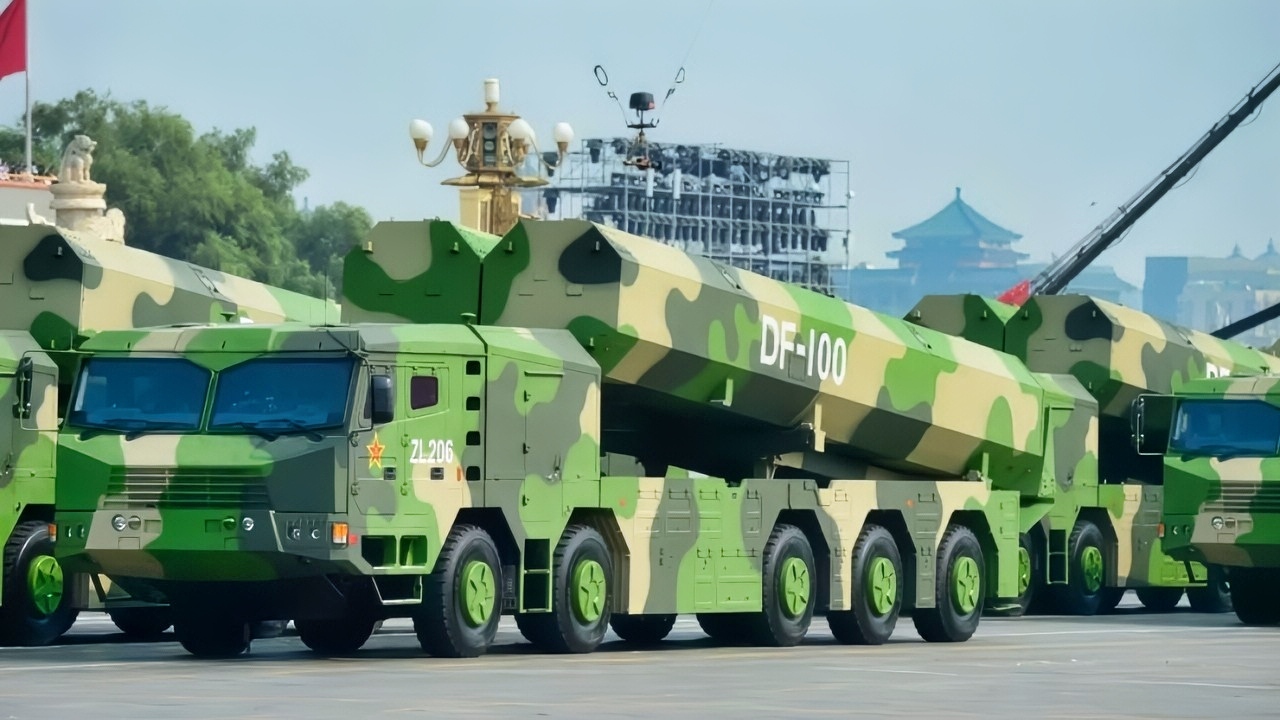
PUBLISHED on August 12, 2025, 3:54 PM EDT – Key Points and Summary – China has released rare and unusually detailed footage of its DF-100 supersonic cruise missile, a deliberate show of force ahead of a major military parade on September 3.
-The video, aired on state television, shows the highly secretive weapon being fired from a mobile launcher in an urban environment, highlighting its operational flexibility.
-With a range of up to 4,000 km and a speed of Mach 4, the DF-100 poses a serious threat to U.S. and allied forces across the Indo-Pacific, including key bases in Guam and Okinawa. It is a critical component of China’s anti-access/area denial strategy.
China Unveils Rare DF-100 Missile Footage in Latest Show of Force
China has offered an unexpected and unusually detailed glimpse into one of its most secretive new weapons, releasing nearly two minutes of video footage that shows the DF-100 supersonic cruise missile in action.
The rare public display comes shortly after Chinese state media aired another documentary, authorized by the Central Military Commission, offering viewers a look at catapult-assisted takeoff technology in action on the new Fujian aircraft carrier.
The latest look at one of China’s most terrifying weapons projects also comes ahead of a high-profile military parade set to take place in Beijing on September 3 to mark the 80th anniversary of Japan’s defeat in World War II.
Meet the DF-100
The DF-100, first unveiled during the People’s Republic of China’s 70th anniversary parade in 2019, is designed to take on U.S. and allied forces across the Indo-Pacific.
With a reported range of 3,000 to 4,000 km, a Mach 4 cruising speed, and precision striking capabilities that allow it to hit targets within meters, the missile poses a threat to U.S. bases in Okinawa and Guam. Analysts have also noted that, when deployed from China’s H-6N bomber, its range could extend beyond 6,000 km.
The missile presents a serious challenge to American forces – and, in particular, its carrier strike groups.
What We Saw
The new footage, aired on China Central Television as part of a documentary series, depicts a Rocket Force brigade conducting a pre-dawn cable communications drill under simulated full-spectrum jamming. The electronic interference forces operators to switch to wired communications before firing.
Brigade deputy commander Lieutenant Colonel Zhang Guodong told filmmakers that the constant movement of both targets and launch units meant crews had to remain ready to deploy at short notice.
“We are on standby for long periods,” Guodong said, adding that sometimes his team “can’t get a solid night’s sleep for days.”
Unlike earlier images of the missile shared online, which were taken in remote desert launch zones, the missile in the documentary is shown being fired from an urban backdrop. That setting, one analyst said, is important.
According to Yun Sun, director of the China program at the Stimson Centre, the visuals are “evidently aimed at illustrating the flexibility and mobility of DF-100’s launching capability.”
“If it can be launched close to urban areas, it will be more difficult for adversaries to locate, identify, target, and destroy it,” Sun said.
Deployable from both land-based launchers or bombers, the DF-100 aids China’s anti-access/area denial (A2/AD) strategy, intended to push U.S. forces further from the western Pacific.
And after maintaining tighter secrecy over the missile than some of its fifth-generation stealth fighter programs, the new footage suggests Beijing is deliberately signaling its growing long-range strike capabilities both to domestic audiences and foreign adversaries ahead of next month’s military parade.
About the Author:
Jack Buckby is a British author, counter-extremism researcher, and journalist based in New York. Reporting on the U.K., Europe, and the U.S., he works to analyze and understand left-wing and right-wing radicalization, and reports on Western governments’ approaches to the pressing issues of today. His books and research papers explore these themes and propose pragmatic solutions to our increasingly polarized society. His latest book is The Truth Teller: RFK Jr. and the Case for a Post-Partisan Presidency.
Military Matters
The F-22 Raptor Just Keeps Getting Better


