


Summary and Key Points: The B-47 Stratojet is one of the least-celebrated Cold War bombers — and one of the most influential.
-To build it, Boeing drew on captured German swept-wing research, pairing those wings with a cylindrical fuselage and podded jet engines.
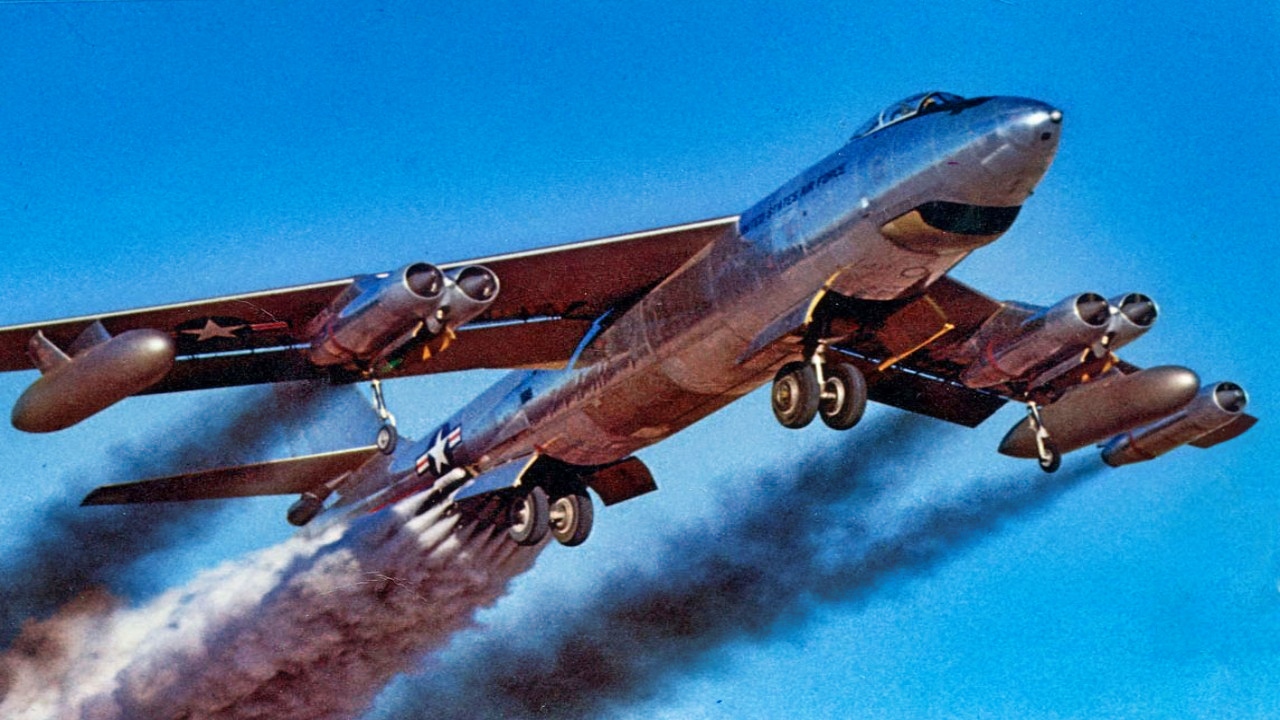
B-47 Bomber. Image Credit: U.S. Air Force.
-That formula proved so sound it shaped the KC-135 tanker, the Boeing 707, and nearly every airliner since, from the 737 to Airbus.
-The B-47 was fast but flawed — six crashed in four days from metal fatigue — and retired by 1966.
The B-47 Bomber from the U.S. Air Force Was Massive
In 1944, shortly before the end of the Second World War, the U.S. Army Air Forces, the forerunner to the U.S. Air Force, issued a requirement for a medium bomber powered by jet engines. The desired specifications were remarkable for the time: The new jet-powered design had to reach 550 miles per hour, have a 4,100-mile range, and achieve 45,000 feet in flight altitude.
Though perhaps unremarkable by today’s standards, the service was asking for a significant step up in capabilities compared to the B-29 Superfortress, then a state-of-the-art aerospace project that cost more than the Manhattan Project.
That bomber would ultimately secure its place as the delivery platform for the Fat Man and Little Boy atomic weapons dropped on Japan. It had a top speed of 358 miles per hour, a 3,500-mile range, and a service ceiling of 31,850 feet.
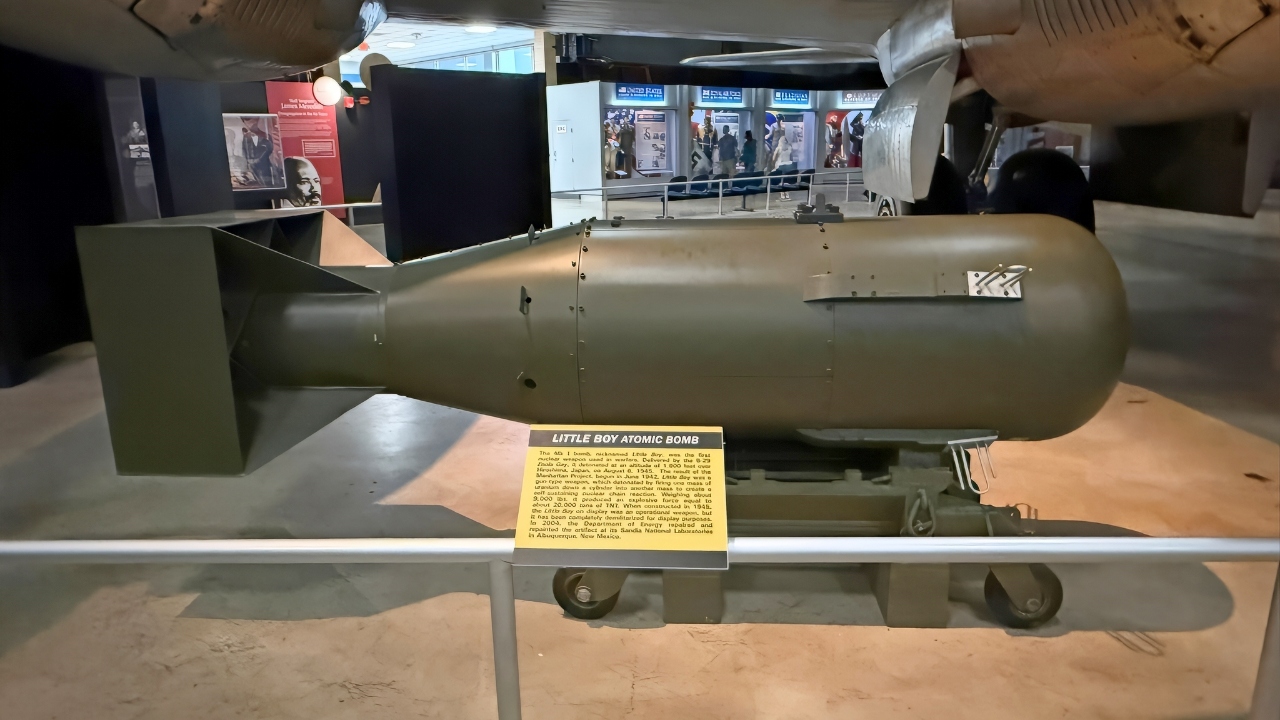
Little Boy Atomic Bomb. Image Credit: Harry J. Kazianis/National Security Journal.

DAYTON, Ohio — “Fat Man” atomic bomb at the National Museum of the United States Air Force. (U.S. Air Force photo).
George Schairer, an aerodynamicist at Boeing, incorporated captured German aerospace data on swept-wing aircraft designs to give the B-47 swept wings, and this proved to be a winning design feature.
Commercial Airline Influence
The B-47’s design was particularly solid, even outside the realm of military aircraft. An article marking five decades since the Stratojet’s first flight lauded the aircraft, explaining that the B-47’s “basic design characteristics were so fundamentally sound that they dominated the aviation industry for decades. Its combination of cylindrical fuselage, swept wings, and podded engines would be adopted not only by tankers and the next generation of bombers but also by most of the world’s commercial jet transports.”
The article added that, “The basic B-47 design was translated directly into the KC-135 tanker and the Boeing 367-80 prototype. The latter led to a series of epoch-making 707 airliners, which in turn spawned all of the follow-on aircraft from the 727 to the 777 that have made Boeing an industry giant. The B-47’s basic formula was also seen in the designs of other U.S. and foreign manufacturers, including the Convair 880/990, the Douglas DC-8, and the European Airbus Industrie series.”
A Revolutionary Design that Was Not Problem-free
Although the B-47 might have been the fastest bomber in the world in the late 1940s, as the U.S. Air Force claimed, its early jet engines were severely underpowered by today’s standards, generating just 4,000 foot-pounds of thrust each.
When heavily laden with bombs, the jet was outfitted with a total of nine solid-fuel rocket-assisted take-off rockets, each of which produced 1,000 foot-pounds of thrust, to help it get off the ground and into the air.
Thanks to the B-47’s high top speed relative to the fighters of that era, the bomber’s only defensive armament was a pair of Browning .50-caliber heavy machine guns, which were later upgraded to a pair of 20-mm autocannons.
Despite the B-47’s many positive qualities, one problem plagued the jet bomber more than anything else: metal fatigue. From March 13-16, 1958, a total of six B-47s crashed. Cracking due to stress and fatigue was the main culprit.
Additional strain was put on the bomber fleet as the Cold War accelerated. In the late 1950s, fully 50 percent of the American B-47 fleet was put on high alert as a deterrent to the Soviet Union. This increase in operational tempo put additional stress on the B-47 fleet, and on its maintainers.
With the advent of intercontinental ballistic missiles as a more effective delivery platform for American nuclear weapons, and with the the longer-range, higher-payload B-52 Stratofortress entering service, the B-47’s days appeared to be numbered—but world events conspired to keep the bomber in service a little longer.

A U.S. Air Force B-52H Stratofortress flies a show of presence mission over the U.S. Central Command area of responsibility, Feb. 20, 2025. Strategic bombers contribute to stability in the CENTCOM theater by demonstrating the credibility, capability, and readiness of the U.S. bomber force, which is critical to deterring attacks against the U.S. and its allies and partners. (U.S. Air Force photo by Staff Sgt. Jackson Manske)

A U.S. Air Force B-52H Stratofortress bomber, deployed from Barksdale Air Force Base, La., lands at Andersen Air Force Base, Guam, July 4, 2020. The B-52 flew the 28-hour mission to demonstrate U.S. Indo-Pacific Command’s commitment to the security and stability of the Indo-Pacific region. (U.S. Air Force photo by Master Sgt. Richard P. Ebensberger)

B-52 Bomber. Image Credit: Creative Commons.
Geopolitical Crises
In 1962, the Cuban Missile Crisis sent U.S. President John F. Kennedy and the Department of Defense scrambling, both to assess the extent of the new Soviet missile threat on Cuba and to build a credible plan in case of war. The B-47 factored into that plan.
Postscript
But by 1966, virtually the entire B-47 fleet had been retired, save for a few specialized variants used for surveillance and reconnaissance. It was the end of an era for the first generation of U.S. jet bombers, but the aircraft’s influence on the commercial sector was significant and enduring.
Cylindrical fuselages and swept wings would become the norm, even until the present era. Although the B-47 was not the best-known U.S. bomber of the Cold War, it was, in some respects, one of the most influential.
About the Author: Caleb Larson
Caleb Larson is an American multiformat journalist based in Berlin, Germany. His work covers the intersection of conflict and society, focusing on American foreign policy and European security. He has reported from Germany, Russia, and the United States. Most recently, he covered the war in Ukraine, reporting extensively on the war’s shifting battle lines from Donbas and writing on the war’s civilian and humanitarian toll. Previously, he worked as a Defense Reporter for POLITICO Europe. You can follow his latest work on X.


