


Summary and Key Points: China has fielded a weapon that can threaten a US aircraft carrier from a launcher sitting thousands of miles inland — and according to the Pentagon’s most recent assessment, that same missile can reach parts of the American homeland with a conventional warhead. The DF-27 is the newest and longest-legged member of a carrier-killer family that has spent fifteen years pushing the US Navy out of waters it once dominated, the moment the threat stopped being regional and became global.
The Missile That Can Reach America: How The DF-27 Became The Most Dangerous Carrier Killer Ever Built
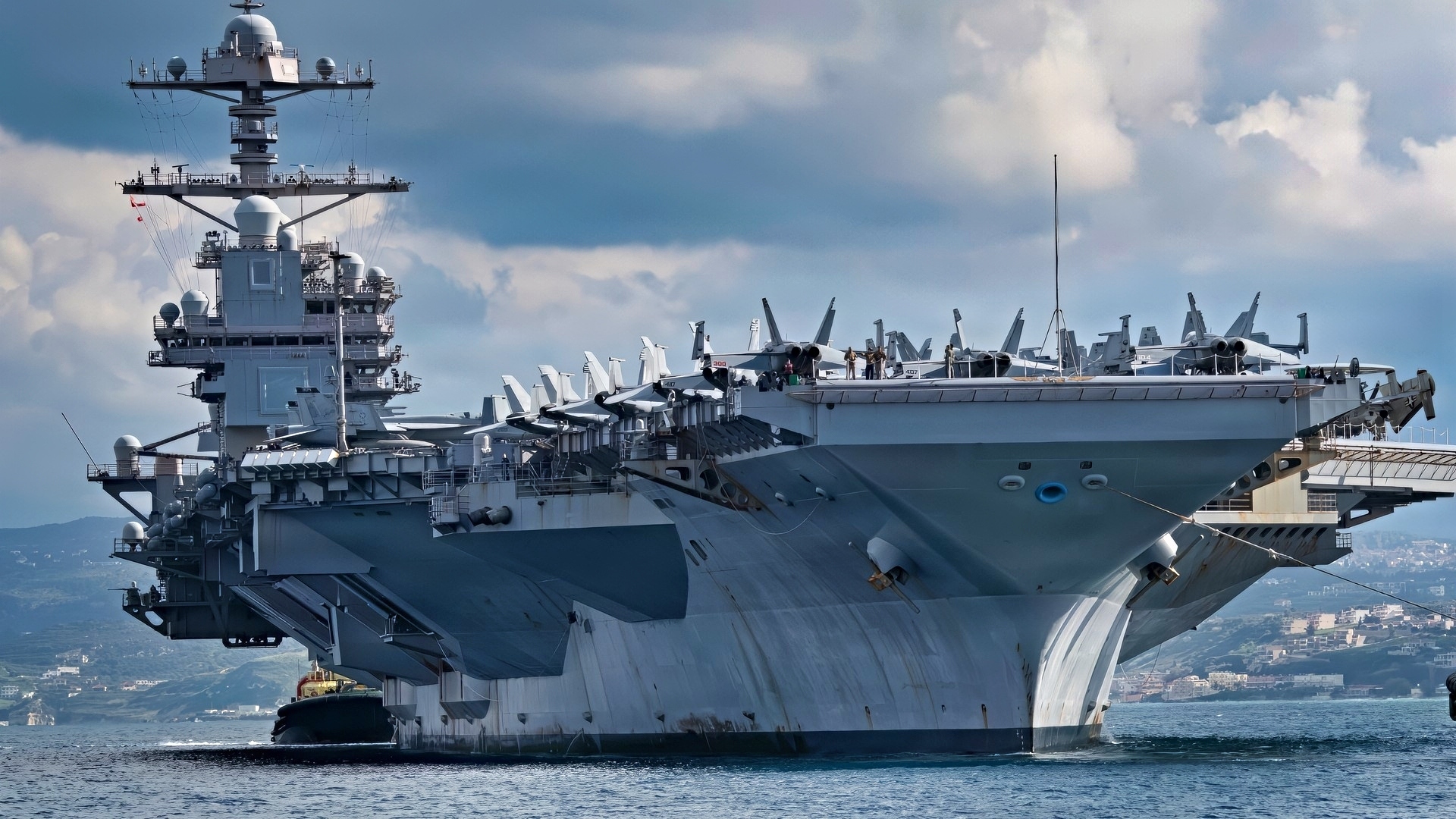
NAVAL SUPPORT ACTIVITY SOUDA BAY, Greece (Feb. 23, 2026) The world’s largest aircraft carrier, Ford-class aircraft carrier USS Gerald R. Ford (CVN 78) arrives at the NATO Marathi Pier Complex in Souda Bay, Crete, Greece, during a scheduled port visit on Feb. 23, 2026. NSA Souda Bay is an operational ashore installation that enables and supports U.S., Allied, Coalition, and partner nation forces to preserve security and stability in the European, African, and Central Command areas of responsibility. (U.S. Navy photo by Mass Communication Specialist 3rd Class Hannah Donahue)
China has fielded a weapon that can threaten a United States aircraft carrier from a launcher sitting thousands of miles inland, and as of the Pentagon’s most recent assessment, that same missile can reach parts of the American homeland with a conventional warhead.
The DF-27 is the newest and most capable member of a family of Chinese anti-ship ballistic missiles that has spent fifteen years steadily pushing the US Navy farther and farther from the waters it once dominated, and it represents the moment the carrier-killer concept stopped being a regional problem and became a global one.
Understanding how serious this threat actually is requires understanding both the missile itself and the man whose decade of research is why the rest of us take it seriously.
DF-27: A Threat Confirmed In Black And White
The DF-27 moved from rumor to confirmed reality with the release of the Pentagon’s 2025 China Military Power report on December 23, 2025.
The report’s accounting of China’s fielded conventional strike forces identified the DF-27 as a conventional intercontinental ballistic missile with an estimated 5,000 to 8,000 km range, and explicitly denoted an anti-ship ballistic missile variant. That single line in a government report describes a capability no nation has ever fielded before.
The numbers carry enormous strategic weight. The DF-27’s maximum stated range covers not only Alaska and Hawaii but also parts of the continental United States, which makes China, in the words of the Naval War College scholar who has tracked these weapons longest, the first nation publicly assessed to have fielded an operational, conventionally armed ICBM, albeit at the low end of the intercontinental range band.
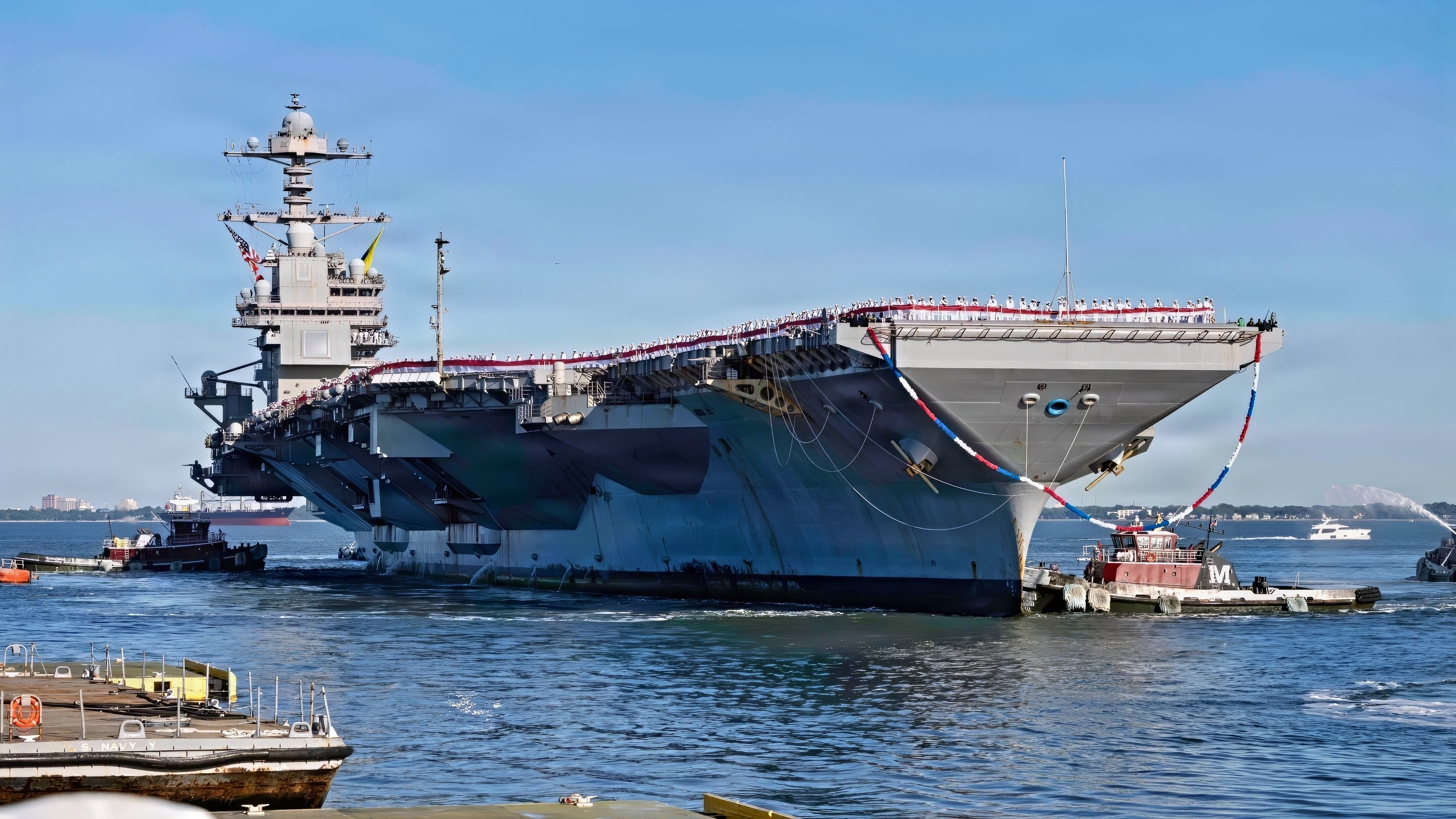
260516-N-EE423-1027 NORFOLK, Va. (May 16, 2026) – The world’s largest aircraft carrier, USS Gerald R. Ford (CVN 78), returns to Naval Station Norfolk, May 16, 2026, following a historic 11-month deployment to U.S. 2nd, 4th, 5th, and 6th Fleets as part of the Gerald R. Ford Carrier Strike Group. Before returning to Norfolk after 326 days, the Gerald R. Ford crew conducted 23 replenishments-at-sea, sailed over 57,713 nautical miles, and safely transferred 14 million gallons of fuel. Embarked Carrier Air Wing 8 logged more than 5,760 flight hours and 12,200 flight launches. (U.S. Navy photo by Mass Communication Specialist 1st Class Sophie Pinkham)
The Pentagon had been circling the system for years. The Defense Department’s 2021 report to Congress acknowledged the DF-27’s development, and a 2023 leak first surfaced the Pentagon’s assessment of its anti-ship capabilities, but the 2025 report was the document that confirmed the weapon had been fielded as part of the PLA Rocket Force’s operational arsenal.
How It Outranges Everything Before It
The DF-27 did not appear in isolation. I know this well, as I have been studying these missiles and their variants for years now.
It sits at the apex of a lineage of Chinese anti-ship ballistic missiles, each extending the reach of the one before it. The DF-21D, the original carrier killer, has a range of roughly 1,500 kilometers. The DF-26 that followed pushed that to 4,000 to 5,000 kilometers, far enough to earn its nickname as the “Guam killer.” The DF-27 extends the engagement envelope significantly beyond Guam into a broader Pacific area, enabling coverage of targets within the second island chain and beyond, depending on where it is launched from.

(March 7, 2016) An F/A-18E Super Hornet assigned to the Warhawks of Strike Fighter Squadron (VFA) 97 performs a flyby during an aerial change of command ceremony above USS John C. Stennis (CVN 74). Providing a ready force supporting security and stability in the Indo-Asia-Pacific, Stennis is operating as part of the Great Green Fleet on a regularly scheduled 7th Fleet deployment. (U.S. Navy photo by Mass Communication Specialist Seaman Tomas Compian/Released)
That progression is the entire story of the threat in miniature. For decades, the central assumption of American naval power was that a carrier strike group could position itself in the Western Pacific and operate with relative impunity, close enough to project force but far enough to stay safe. Each new missile in this family has chipped away at that assumption by extending the distance at which a carrier can be held at risk. The DF-27 effectively erases the old idea of a safe standoff distance, because it holds vessels at threat at distances surpassing China’s current inventory of cruise, supersonic and hypersonic missiles.
A carrier captain who once worried about staying outside 1,500 kilometers now has to reckon with a weapon that can reach far past the second island chain, and there is no longer an obvious place in the theater to hide.
The Physics That Make It So Hard To Stop
What separates the DF-27 from a conventional ballistic missile is what it does in the final phase of flight.
A standard ballistic warhead follows a predictable arc that defensive systems can calculate and intercept. The DF-27 is assessed to carry an optional hypersonic glide vehicle, and its maneuvering profile changes the math entirely.
Earlier missiles in this family already used maneuverable reentry vehicles with terminal guidance to strike warships at hypersonic speeds, and the DF-27 carries that lethality further, with a maneuvering capability that lets it adjust its terminal approach angle and defeat the predictive geometry that missile defense depends on. A weapon that can alter its course in the seconds before impact is a far harder problem than a warhead falling along a fixed arc.
The performance figures that have leaked are sobering. According to a reported Pentagon document, a DF-27 test vehicle flew for 12 minutes over 2,100 kilometers and had a “high probability” of breaching American ballistic missile defense systems. For the anti-ship mission specifically, this combination of intercontinental range and terminal maneuverability is what makes the weapon so dangerous. It can be launched from deep inside China, well beyond the reach of American strike aircraft, and arrive at a carrier moving at sea while retaining the ability to adjust its aim against a target that has moved since the missile was fired.

(Left to right) Australian ANZAC Class frigate HMAS Stuart (FFH 153) and USS Jack H. Lucas (DDG 125) wait off the coast of the Pacific Missile Range Facility in Kauai, Hawaii, as they prepare for Flight Test Aegis Weapon System-32 (FTM-32), held March 28, 2024.
The One Man Without Whom None Of This Would Be News
Here is the part of the DF-27 story that almost never gets told. The reason this missile commands the attention it does, the reason a line in a Pentagon report becomes front-page defense news, traces back in large part to the work of one scholar. Dr. Andrew Erickson, a professor of strategy at the US Naval War College’s China Maritime Studies Institute, has spent more than fifteen years documenting the Chinese anti-ship ballistic missile program from original Chinese-language sources, and his research is the foundation on which nearly all Western understanding of these weapons rests.
Erickson’s foundational work came at a time when the very concept of a land-based missile capable of striking a moving warship was met with skepticism in many Western defense circles. In 2009, he and his colleague David Yang published a study examining how Chinese analysts themselves were thinking about using the land to control the sea through the anti-ship ballistic missile, drawing directly on PLA writings rather than speculation. That same year he published “Chinese ASBM Development: Knowns and Unknowns” and an article in U.S. Naval Institute Proceedings warning the American defense establishment to take the capability seriously when many were inclined to dismiss it.
When the DF-21D crossed the threshold from concept to deployed weapon, Erickson was the one who documented it. In December 2010, he and Gabriel Collins published the assessment that China had deployed the world’s first long-range, land-based carrier killer, reporting that the DF-21D had reached initial operational capability as the world’s first weapons system capable of targeting a moving carrier strike group from land-based mobile launchers. He later expanded that body of work into a 2013 book-length study that examined the ASBM’s capability and history and laid out in detail how the weapon threatened the foundations of American power projection in Asia. The whole framework that the defense world now uses to think about Chinese carrier killers, the kill chain, the targeting challenge, and the strategic implications, was built substantially on his foundation.
The early DF-21D research mattered far beyond that one missile. By establishing, from Chinese sources and with rigorous analysis, that Beijing was serious about the anti-ship ballistic missile and capable of building one, Erickson’s work in the early 2010s gave the United States the conceptual vocabulary and the years of advance warning it needed to begin investing in countermeasures.
Without that early documentation, the DF-26 and now the DF-27 would be arriving as nasty surprises rather than as the latest, expected steps in a program the West has been tracking for a decade and a half. The reason a journalist or an analyst today knows that the DF-27’s anti-ship variant is a categorical shift rather than just another missile is that Erickson built the scaffolding of understanding that makes the significance legible.
A New Form Of Naval Force
Erickson’s assessment of the DF-27 itself is characteristically measured but pointed. He argues that China’s anti-ship ballistic missiles, now potentially extending to intercontinental ranges with the DF-27, pose a potent threat to surface ships across much of the Pacific, and in effect constitute a new form of naval force. That phrase captures the strategic essence of the weapon. A land-based missile that can sink a ship at intercontinental range functions as a kind of navy without hulls, a way for China to project sea-denial power across the Pacific without building the fleet such reach would otherwise require.
He also flags a danger that goes beyond the anti-ship mission. Because the DF-27 comes in variants with different roles, and because the missile families beneath it carry both conventional and nuclear-capable versions, their operational use could increase the risk of warhead ambiguity or misinterpretation in a crisis. An incoming DF-27 launched at a carrier might be indistinguishable, in the critical minutes of flight, from one carrying a nuclear payload aimed at a city, and that ambiguity is its own escalation hazard in a fast-moving confrontation.
The Honest Counterweight
The threat is real, but a responsible assessment has to note that it is not uncontested, and Erickson himself is no alarmist.
He is careful to point out that American defenses are not standing still. Aegis ballistic missile defense and electronic warfare systems capable of generating false targets represent a serious and evolving countermeasure to the anti-ship ballistic missile threat, and the Chinese answer to those defenses comes down to volume, firing enough missiles to overwhelm what the defenders can engage.
The deeper vulnerability of the entire concept is the kill chain. Hitting a maneuvering warship at intercontinental range is not simply a matter of building a missile. China must first find the carrier across thousands of miles of open ocean, fix its position, track it continuously, and feed targeting data to the missile in near real time, all while the carrier is moving and actively trying to defeat each step. Every link in that chain is something the United States can attack through jamming, spoofing, concealment, and the destruction of the satellites and sensors that enable targeting. There is also the simple fact that no anti-ship ballistic missile has ever sunk a maneuvering warship in combat. The capability is formidable on paper and unproven in the one test that ultimately matters, which is why some serious analysts argue the DF-27 raises the cost and risk of operating carriers in the Western Pacific without fundamentally rewriting the naval balance the way its most dramatic descriptions suggest.
What It All Adds Up To
The DF-27 is the most dangerous carrier killer China has yet fielded, and its significance lies less in raw destructive power than in reach. It extends Beijing’s ability to threaten US warships from the first island chain out past the second and, in its land-attack role, all the way to the American homeland, complicating every assumption the US Navy makes about where it can safely operate in a Taiwan or South China Sea contingency.
Stacked atop the DF-21D and DF-26 and fielded alongside the DF-17 hypersonic glide vehicle, it is another layer in the most formidable anti-access system any adversary has ever arrayed against American sea power.
It is also not an unstoppable super-weapon, and the same scholar whose work made the world take it seriously is equally clear that the US response is a live and evolving contest rather than a lost cause. The targeting kill chain it depends on is its greatest weakness and the focus of intense American countermeasure investment, and its capability against a maneuvering carrier has never been demonstrated in war.
About the Author: Harry J. Kazianis
Harry J. Kazianis (@Grecianformula) was the former Senior Director of National Security Affairs at the Center for the National Interest (CFTNI), a foreign policy think tank founded by Richard Nixon based in Washington, DC. Harry has over a decade of experience in think tanks and national security publishing. His ideas have been published in the NY Times, The Washington Post, The Wall Street Journal, CNN, and many other outlets worldwide. He has held positions at CSIS, the Heritage Foundation, the University of Nottingham, and several other institutions related to national security research and studies. He is the former Executive Editor of the National Interest and the Diplomat. He holds a Master’s degree focusing on international affairs from Harvard University.


rosy dawn
June 2, 2026 at 12:24 am
Along with the df-27 is the cj-1000, which is designed to tackle a hoon nation like Australia.
Australia, for quite a long time already, has been hurling a great number of threats and insults at Beijing, and also providing bases and buying and developing weapons with uncle Sam.
As such, the cj-1000 is just exactly what the Beijing doctor has ordered for Canberra.
It has a scramjet engine, able to maneuver while in flight, and supposedly able to hit large moving targets, like the E-7 that the RAAF has right now.
I wonder what Richard marles is thinking right now.