

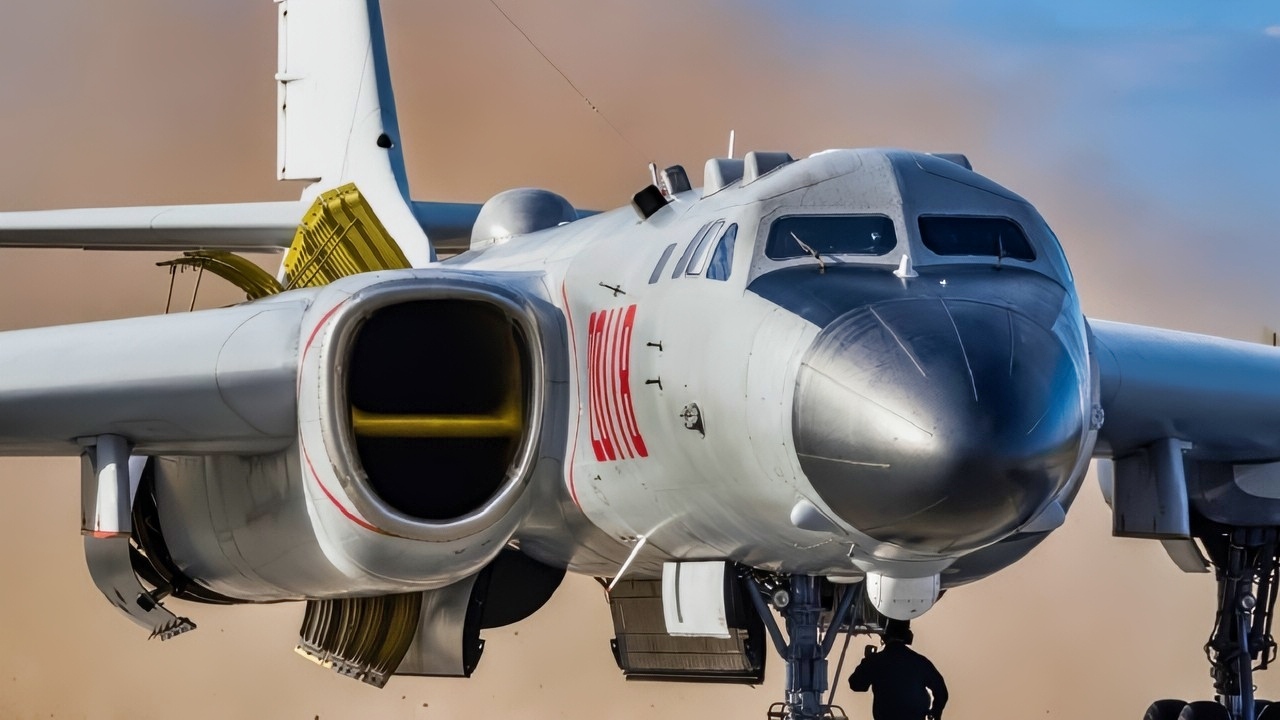
Key Points and Summary – China’s Xi’an H-6 bomber, a licensed-built version of the 1950s Soviet Tu-16, remains the backbone of its bomber force after over 60 years of service.
-Much like the American B-52, this ancient airframe has been continuously upgraded to remain a potent threat.
-The newest variants, like the H-6K, no longer rely on dropping bombs.
-Instead, they serve as standoff platforms for launching a variety of advanced weapons, including the YJ-12 supersonic anti-ship missile and the nuclear-capable CJ-10A “carrier killer” cruise missile, posing a serious threat to the U.S. Navy.
Meet China’s Old H-6 Bomber
China has used the H-6 bomber since 1959. The Soviet Union delivered the first Tu-16 Badger to China in 1958, and the Xi’an Aircraft Industrial Corporation (XAC) began licensed aircraft production shortly after. The company designated it the H-6, which flew for the first time in 1959. China produced the first domestically built H-6 in 1968.
It is still a considerable part of China’s Air Force. About 150 of its bombers have been built, and about 120 are still operational.
Like the United States B-52 Stratofortress, the H-6 has endured a very long operational life due to its design and versatility. The H-6 has also adapted to carry modern weapons.
The Chinese believe that the bomber will continue to serve as a nuclear deterrent and a maritime attack aircraft for many years to come despite its advanced age.
Key Details
The H-6 was a license-built version of the Soviet Tu-16 Badger bomber that first flew in 1952. The two sides worked together in a joint-production program to build aircraft and other projects until the great Sino-Soviet split.
In 1969, they actually fought each other over disputed borders but were able to avert an all-out war.
China sold H-6s to both Egypt and Iraq, but those countries no longer have their bombers operational. According to the Washington D.C. think tank, Center for Strategic and International Studies (CSIS), Iraq’s four H-6s were destroyed while in service.
The H-6 has four crew and is powered by two Soloviev D-30KP-2 turbofan engines, each with 27,000 pounds of thrust. Its top speed is 670 mph, and its cruising speed is 477 mph. Its combat range is 2,200 miles.
The H-6 can now carry various air-to-surface, anti-ship, air-launched cruise missiles, and hypersonic missiles. Included in these are nuclear-capable air-launched ballistic missiles.
It can also carry 26,500 pounds of bombs, both guided and unguided (dumb bombs), but no longer carries free-fall nuclear bombs, as the H-6 could not be relied upon to penetrate an enemy’s air space.
The H-20 Will Replace the H-6
The H-6 will not serve much longer; it has had a long service life, but China has found a replacement, the H-20. Recent images on social media show a stealthy diamond-shaped aircraft.
It is not, however, a “flying wing,” with distinct and lengthy wings, a large empennage, and a large central fuselage, as initially believed.
China expects the H-20 to be operational in the 2030s. Many anticipate the airframe to have a 10,000-mile range, allowing China to project power beyond the “Second Island Chain” of its strategic defense concept. With aerial refueling, the aircraft could “cover the globe,” the Pentagon said, adding, “It is expected to employ conventional and nuclear weaponry and feature a stealthy design.”
Until then, the platform has remained the backbone of China’s bomber force. With upgraded weapons and equipment, the PRC uses the H-6 to terrorize Taiwan.
The Chinese often fly to Taiwan’s Air Defense Identification Zone (ADIZ) to make political statements against Taiwan’s desire to remain independent. China will always consider it to be part of the PRC.
The newest variant, the H-6K, carries the YJ-12, which, when fired in numbers, can overwhelm US Navy air defenses. The YJ-12 has a long range and is particularly fast, reaching Mach 3. Its warhead is big enough to destroy large ships.
The YJ-12 is also accurate, with an inertial navigation system linked to satellite guidance.
Another missile that has the attention of the US Navy is the supposed “carrier killer cruise missile,” the nuclear-capable CJ-10A, which has a range of nearly 1,400 miles.
H-6 in 4 Words: Ready for a War?
China has made it clear that it wants its military to be prepared for war by 2027. And it wants Taiwan, preferably without firing a shot, because it would like to take over Taiwan’s lucrative microchip manufacturing.
So, they’ll keep pushing the envelope over Taiwan’s airspace, and playing a big part of that will continue to be the H-6 bombers with fighter support. And the US Navy’s carriers will be forced to keep their distance.
About the Author: Steve Balestrieri
Steve Balestrieri is a National Security Columnist. He served as a US Army Special Forces NCO and Warrant Officer. In addition to writing on defense, he covers the NFL for PatsFans.com and is a member of the Pro Football Writers of America (PFWA). His work was regularly featured in many military publications.
More Military
We Almost Touched the F-117 Stealth Fighter


