


The J-15 Fighter in One Word: Heavy – The Shenyang J-15 “Flying Shark” is among the heaviest fighters ever flown from the deck of a ship, and every argument anyone has had about this aircraft for twelve years traces back to that one fact.
The J-15: Explained
The weight is inherited. The J-15 was reverse-engineered from an unfinished Su-33 prototype that China acquired from Ukraine in the early 2000s, and the Su-33 is the naval branch of the Sukhoi Flanker, a big, long-ranged, twin-engine air-superiority design that was never small to begin with.
Navalizing a Flanker means adding folding wings, a strengthened structure, an arrestor hook, and reinforced landing gear, none of which makes anything lighter.
What China ended up with was a carrier fighter with impressive range and payload figures on paper, and a serious problem in practice.

Sukhoi Su-33 launching from the Admiral Kuznetsov.
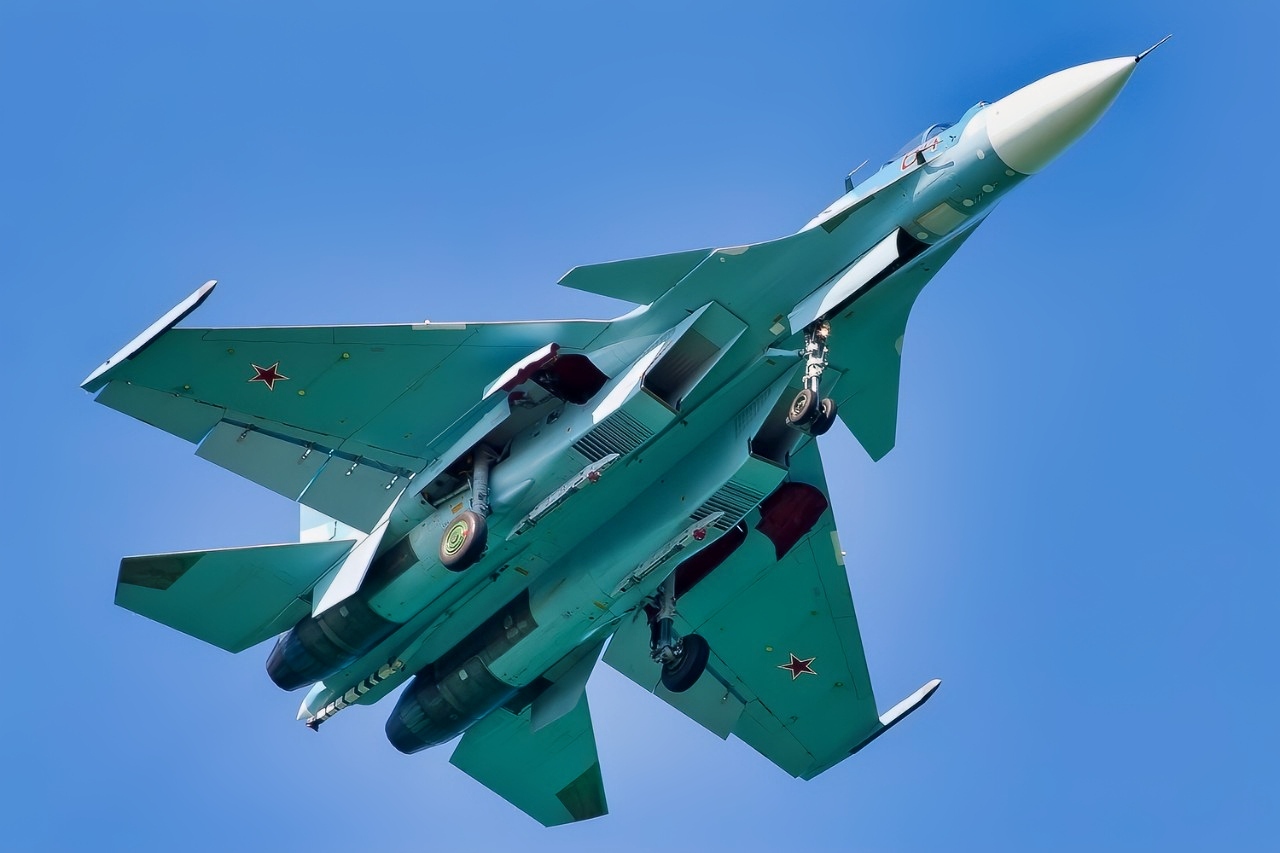
Su-33 Flanker from Russia. Image Credit: Creative Commons.
The Arithmetic of a Ramp
China’s first two carriers, the Liaoning and the Shandong, launch aircraft off a ski-jump ramp. There is no catapult. The aircraft accelerates under its own power down a short deck and up a curved ramp, and whether it flies depends entirely on the ratio between its engine thrust and its weight at that moment.
For a heavy fighter, that math is brutal. The J-15 could take off with a full internal fuel load or with a full weapons load, but not reliably with both. So it flew compromised: long range and light armament, or a useful weapons load and a short combat radius. An aircraft designed around reach could not consistently exercise it.
Layered on top were real reliability problems. Early aircraft flew on Russian AL-31 engines while China worked to substitute the domestic WS-10, a transition that took years and produced mixed results. There have been crashes, including accidents attributed to flight control failures. Chinese commentary itself began describing the type as an interim carrier fighter, a placeholder until a fifth-generation aircraft arrived. The reputation hardened: a heavy, underpowered clone that could not do the job.
What Actually Changed
The fix, when it came, was not a new engine or a lighter airframe. It was a different ship.
The Fujian, China’s third carrier and its first designed for catapult operations, was commissioned on 5 November 2025 at Sanya on Hainan, with Xi Jinping presiding. At roughly 80,000 tonnes with a flat deck and three electromagnetic catapults, it made China the second country in the world, after the United States, to put an electromagnetic launch system to sea.
A catapult removes the thrust-to-weight problem entirely. The ship provides the acceleration, so how much the aircraft weighs at the moment of launch stops being the binding constraint. That is the whole point of the J-15T, the catapult-capable variant unveiled at Zhuhai in November 2024 with a strengthened nose gear, an AESA radar, and updated avionics. The J-15T is less a redesign than the same heavy airframe finally permitted to launch at the weight it was built to carry.
During sea trials in September 2025, the Fujian flew J-15Ts, J-35s, and KJ-600s off its catapults and recovered them, and since commissioning, it has run its first live-force training with a full strike group, adding the J-15DT electronic-warfare variant to the deck.
The Family Nobody Expected
Which produces the part of this story that gets the least attention. The much-derided clone has quietly become a family covering most of a modern carrier air wing.
The J-15T fills the multirole strike-fighter slot that the US Navy gives the Super Hornet. The J-15D, in its ski-jump and catapult versions, is a dedicated electronic-attack aircraft in the mold of the EA-18G Growler, a capability almost no navy on earth fields. The twin-seat J-15S sits alongside them. Add the stealthy J-35 and the KJ-600 radar aircraft, and the Fujian’s deck begins to resemble an American one, position for position, with three of those four slots filled by descendants of a single unfinished airframe bought from Ukraine.
The Honest Limits
None of this makes the J-15 a solved problem. Production catapult-capable aircraft are reported to still be flying on Russian AL-31 engines rather than the domestic WS-10, which means the engine question is being managed rather than answered. Two former American carrier officers have assessed that the Fujian’s deck layout may hold its sortie generation to roughly sixty percent of what a fifty-year-old US carrier achieves. The ship is conventionally powered rather than nuclear. And the J-15 has never been tested in combat by anyone.
But the criticism that defined this aircraft for a decade was that it was too heavy to fly a full load off a carrier, and that criticism no longer holds. What changed was the deck underneath it.
About the Author: Harry J. Kazianis
Harry J. Kazianis (@Grecianformula) was the former Senior Director of National Security Affairs at the Center for the National Interest (CFTNI), a foreign policy think tank founded by Richard Nixon based in Washington, DC. Harry has over a decade of experience in think tanks and national security publishing. His ideas have been published in the NY Times, The Washington Post, The Wall Street Journal, CNN, and many other outlets worldwide. He has held positions at CSIS, the Heritage Foundation, the University of Nottingham, and several other institutions related to national security research and studies. He is the former Executive Editor of the National Interest and the Diplomat. He holds a Master’s degree focusing on international affairs from Harvard University.


