

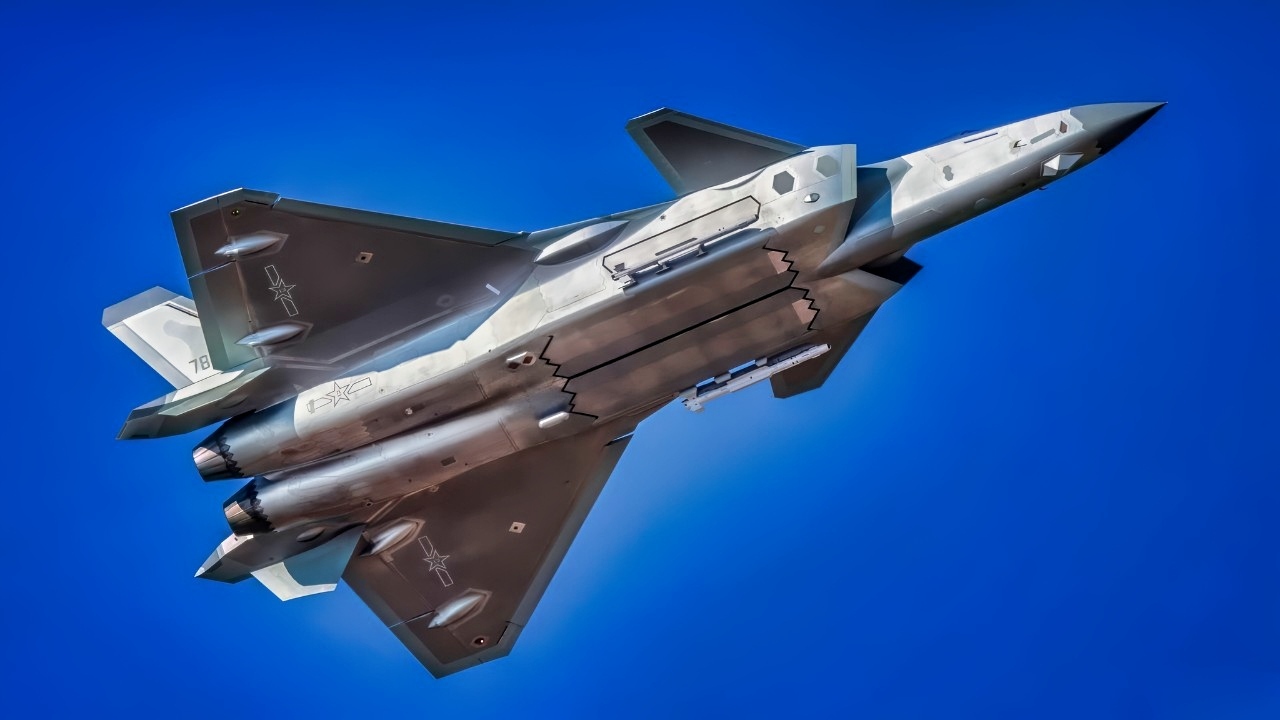
Key Points and Summary – Images of China’s new two-seater J-20S stealth fighter have analysts speculating on its intended role, as it has no direct Western equivalent.
-While the second crew member could be used for electronic warfare or airborne command, the most significant theory is that the J-20S will act as a command-and-control platform for “Loyal Wingmen” combat drones.
-This “mothership” capability could provide a significant boost to the PLAAF’s capabilities. As the U.S. develops its own drone programs, China’s J-20S represents a unique and potentially concerning leap forward in air combat technology.
China’s J-20S Stealth Fighter Has Broken Cover
Recently-circulated images of the J-20S, a two-seater version of China’s fifth-generation J-20, raised questions about what makes this variant different than the parent J-20 fighter—and what the jet’s intended role will be.
Though there are several possibilities, as well as the possibility of something else entirely, speculation about the aircraft has run rampant.
Meet the J-20S
Like the J-20 progenitor, the J-20S is a twin-engine, fifth-generation air interceptor and air superiority fighter that, unlike most stealthy aircraft, the variant features a pair of forward canards.
There is no direct analogue to the two-seat J-20S, raising some speculation about what the jet’s purpose is. In the United States Navy, for example, the EA-18G Growler, a two-seat variant of the F/A-18 Super Hornet, utilizes the second cockpit position for conducting electronic warfare from American aircraft carriers.
The J-20, however, irrespective of variant, is not a carrier-certified fighter jet. And as it can neither take off nor land from Chinese aircraft carriers, the comparison is not a one-to-one example.
Another possibility is that a second human in the loop could conduce Airborne Early Warning and Control mission types, which would allow the J-20S to detect a variety of targets, including enemy aircraft, ships, incoming missiles, and other vehicles from far-off distances, relaying the information to other J-20s, other aircraft, and command nodes for near real-time battlespace information dissemination.
However, Loyal Wingmen drones may be another possibility.
Loyal Wingmen Drones
One potentially useful application for a second pilot, if not electronic warfare, could be to direct and operate Loyal Wingmen-type drones. Unmanned, but armed and boasting some stealthy characteristics, Loyal Wingman drones hold great promise to keep pilots out of harm’s way by undertaking direct-action tasks in pilots’ place.
Their potential use as surveillance and reconnaissance tools is also a potential application at which they could excel—and China has made several initial platforms that could fill those roles.
One of China’s initial forays into Loyal Wingman-type aircraft was the Feihong FH-97, a prototype platform designed to fly ahead of manned aircraft as a decoy and to provide early warning capabilities, while also likely possessing some stealth capabilities.
Later iterations of the FH-97 are expected to mature these and other technologies. Other aircraft, like the Dark Sword, appear to explore both stealth and supersonic speeds, whereas the Hongdu GJ-11 Sharp Sword platform seems to bridge the gap between reconnaissance and combat. If other emerging drones are any indication, there is clearly significant progress in the ‘Loyal Wingman’ department of the People’s Liberation Army Air Force.
The United States, on the other hand, is pursuing its Collaborative Combat Aircraft program, or CCA. And while still in the early stages, the program currently seeks to field sensor-only aircraft, that is, unmanned aircraft that lack weaponry.
That being said, many experts agree that it would take anywhere from five to ten years before China is able to put Loyal Wingmen-type aircraft into service with the People’s Liberation Army Air Force at scale. Still, the county has made significant progress in this, and it is an area to watch.
Writing about current trends in electromagnetic warfare in both China and the United States, Justin Bronk, at the Royal United Service Institute, a think tank in London, writes that the current trend indicates a desire to “disrupting and denying cross-domain datalink and network communications capabilities to break these long-range kill-chains.”
Bronk adds that this trend in electronic warfare development “significantly increases the risk of relying entirely on distributed capabilities such as the collaborative combat aircraft (CCA)-type uncrewed systems envisioned by many to replace the capabilities … at lower cost.”
But, he says, “In theory, by distributing the sensors, weapon carriage and EW effectors that would otherwise need to be carried by one large combat aircraft among many smaller uncrewed systems, militaries can achieve the same effects with CCAs that are much smaller and cheaper for a given range,” Bronk wrote.
He adds, “The theory undoubtedly has significant promise and could enhance combat mass when working as intended,” a cause for concern, given the current state of China’s Loyal Wingman prototyping.
J-20S: What Does the Future Hold?
What exactly this latest J-20 variant’s role within the People’s Liberation Army Air Force will be remains to be definitively seen.
But compared to the base model, this variant’s superior engines and airframe design—in fairness, also exemplified by the J-20A—has lead many to believe that the J-20S will offer a significant boost in capabilities, be they electronic warfare, the fusion of reconnaissance and strike or air superiority, or perhaps, in tandem with the PLAAF’s burgeoning flock of CCAs, some combination thereof.
Irrespective of the jet’s true employment, there is no direct fifth-generation analogue in the United States, nor abroad, despite some overlap with other platforms. That alone, while perhaps not enough on its own to be a cause for concern, might become one a little later down the line.
About the Author: Caleb Larson
Caleb Larson is an American multiformat journalist based in Berlin, Germany. His work covers the intersection of conflict and society, focusing on American foreign policy and European security. He has reported from Germany, Russia, and the United States. Most recently, he covered the war in Ukraine, reporting extensively on the war’s shifting battle lines from Donbas and writing on the war’s civilian and humanitarian toll. Previously, he worked as a Defense Reporter for POLITICO Europe. You can follow his latest work on X.
Fighter Jet Fails
Russia’s Su-57 Felon Stealth Fighter Is a Waste of Rubles


