


The last two days have seen another whirlwind of military threats and purported diplomatic action in the Persian Gulf. A day after insisting that the United States was on the verge of launching extensive strikes against Iran, including the seizure of Kharg Island, President Trump canceled those strikes based on the claim that Iran had agreed in principle to an accord that would end the war. As of yet no reaction from the Iranians indicates that such an accord is on the table. The flurry of threats and promises came at the end of several days of tit-for-tat strikes between Israel, the US, and Iran.
Credibility
But the President, to be blunt, suffers from a credibility issue. This has come about for two reasons: first, the President has repeatedly threatened dire military action against Iran, only to back off when markets got shaky, and second, the President has repeatedly promised negotiated settlements that have yet to bear any fruit. The second is mostly a problem for the American people, who have some but not infinite tolerance for Presidential obfuscation.

President Donald Trump hosts a bilateral meeting with President Nayib Bukele of El Salvador, Monday, April 14, 2025, in the Oval Office. (Official White House Photo by Daniel Torok)
The first is a problem for finishing negotiations with Iran, because the Iranians increasingly have little reason to believe that Trump will carry out his threats.
To be sure, the importance of credibility in international politics can be overstated and often is. Reputations for toughness rarely pay off in the ways that lead to good policy outcomes, in part because terrified opponents often react unpredictably.
In this case, the problem is more direct because Trump has repeatedly promised attacks he has failed to carry out. We even have a meme for it: TACO Tuesday, or “Trump Always Chickens Out.”
President Trump values his reputation for unpredictability in foreign policy, but the problem is that he has become extremely predictable; over the course of the conflict, he has repeatedly shied away from escalation despite using escalatory language. At this point, the Iranians would need to see credible evidence that Trump intended to launch the attacks that he promised, and it’s very difficult to provide that evidence without a wide array of strikes.
And of course, American domestic politics are not opaque to Iran. The Iranians understand that the conflict is broadly unpopular and that the President is suffering dissent within his own party. The IRGC can read inflation statistics just like anybody else and can see the midterm elections on the horizon. The Iranians themselves may conclude that, despite their difficulties, Trump is more desperate to make a deal than they.
Operational
The President’s remarks were notable for a return to the idea of seizing Kharg Island, an offshore hub for Iranian oil distribution.
The operational details of an attack on Kharg Island are complex, as the island lies in the far northern reaches of the Gulf, very close to the Iranian coast and, consequently, to Iranian military facilities.
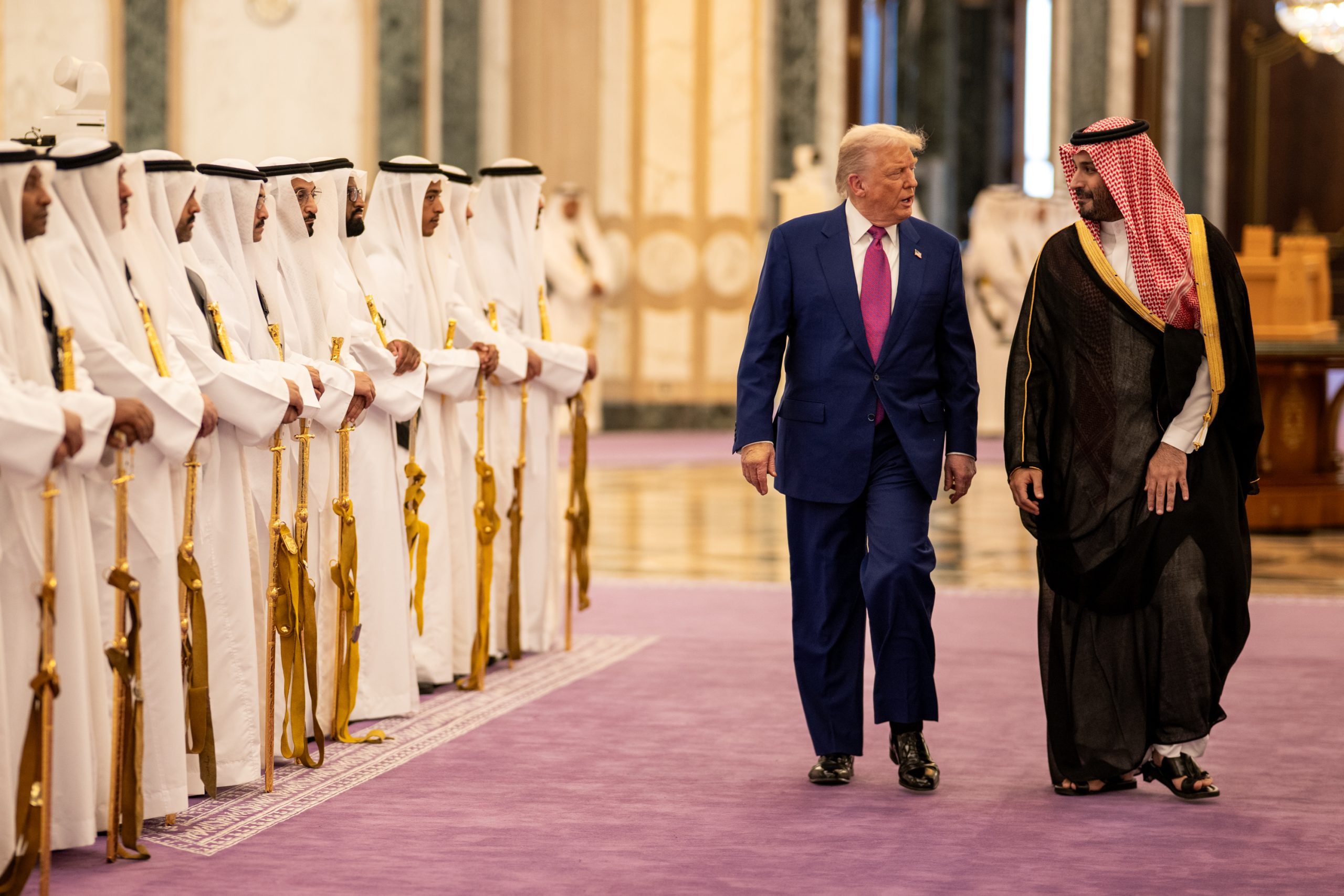
President Donald Trump participates in a welcome ceremony with Saudi Crown Prince Mohammed Bin Salman Al Saud at the Royal Court Palace in Riyadh, Saudi Arabia, Tuesday, May 13, 2025. (Official White House Photo by Daniel Torok)
Given that the US Navy has not moved any large amphibious assault vessels into the Gulf, it is highly likely that any attack would be conducted by transport aircraft and helicopters, potentially supported by small boats launched from installations within the Gulf. The US Navy could also attempt a submarine infiltration, although this would put extremely expensive assets at risk in shallow, drone-infested waters.
An air assault led by helicopters and MV-22 Osprey VSTOL transports, covered by US drones and aircraft, could undoubtedly seize control of the island. However, US forces would then be exposed to Iranian attacks, which could be launched on highly favorable terms.
US forces could take advantage of some of the island’s fortifications and hope that the Iranians would be reticent about damaging their own infrastructure, but this would nevertheless represent a highly risky operation.
Over time, the demands of resupply would become substantial, especially if the island’s garrison was large enough to deter Iranian counterattacks. In a similar situation, Russian units were forced to abandon Snake Island in the first year of the Russia-Ukraine War.
However, as the IRGC would be sorely tempted to turn Kharg Island into America’s Sphacteria, a battle in which Athenians forced Spartan soldiers trapped on a small island to surrender.
Iran War: What Now?
Despite all the confusion, a report from the New York Times indicated that the United States and Iran have made progress on four key nuclear issues, including a timeframe for suspension of enrichment, a dilution of existing stocks, the closure of two production sites, and a schedule for inspections.

(Sept. 16, 2023) – The U.S. Air Force F-22 Raptor Demonstration Team performs during the 2023 NAS Oceana Air Show. The NAS Oceana Air Show is a chance for the Navy to give back to the community, showcasing Naval aviation to visitors from across the country and around the world. (U.S. Navy photo by Mass Communication Specialist 2nd Class Megan Wollam)
While there’s plenty of distance between the parties, all of these issues seem tractable. Relaxation of the dual blockade is similarly a manageable diplomatic issue. This suggests that with patience and hard work, an accord to end the war between Iran and the United States is possible… although Israel remains a potential spoiler if its security interests aren’t addressed.
Negotiations at this point seem unlikely even to touch upon Iran’s missile and drone industries, or its militia allies across the region.
This is to say that even if Tehran and Washington reach a peace deal, Jerusalem might still be inclined to blow things up, an eventuality that President Trump seems not to have yet addressed.
About the Author: Robert Farley, PhD
Dr. Robert Farley has taught security and diplomacy courses at the Patterson School since 2005. He received his BS from the University of Oregon in 1997 and his Ph. D. from the University of Washington in 2004. Dr. Farley is the author of Grounded: The Case for Abolishing the United States Air Force (University Press of Kentucky, 2014), the Battleship Book (Wildside, 2016), Patents for Power: Intellectual Property Law and the Diffusion of Military Technology (University of Chicago, 2020), and most recently Waging War with Gold: National Security and the Finance Domain Across the Ages (Lynne Rienner, 2023). He has contributed extensively to a number of journals and magazines, including the National Interest, the Diplomat: APAC, World Politics Review, and the American Prospect. Dr. Farley is also a founder and senior editor of Lawyers, Guns, and Money.


zhduny
June 12, 2026 at 2:00 am
According to latest news reports, president trump is close to signing a deal with iran this weekend.
The main part of the agreement has been agreed to by both parties, and now, it only needs the president’s signature.
But trump could quickly change his mind, in view of bill gates meeting with the massie oversight committee, and so by evening of monday, 15 june 2026, centcom could be all over kharg island.
A Kharg island seizure could well bring back memories of crimea in the 1850s, when the western powers plus the ottoman empire seized the fortress.
Over half a million died in the fighting and the ‘lady with the lamp’ (florence nightingale) became the sole enduring saga of the great crimea adventure.
Perhaps trump could soon have second thoughts about kharg and thus the media better not press him on the subject.
Pingback: Movement? - Lawyers, Guns & Money
Dr. Hujjathullah M.H.B. Sahib
June 12, 2026 at 9:24 am
What a relief from the often propagandistic narratives ruining mainstream Western media. This is a write-up anchored in solid objectivity. Unfortunately for the world, Trump’s credibility “credential” is all too true and remains pestering. It is good his alleged deal-making track is still on and the outstanding nuclear issues are at the cusp of potential resolution, if he is to be believed ; but then in what significant way are they better than the JCPOA he had arrogantly ditched earlier ? Also, geopolitically, his credibility now appears to have graduated from just TACO to TADA (Trump always ducks away) also, as Iran extends its drone and missile ranges !
Fred Adams
June 13, 2026 at 12:50 pm
While he has done some blustering, President Trump just a day or so ago did execute a damaging air campaign against Iran.
Agree that taking Kharg is not a problem. But neither is holding it. With complete air and naval superiority, the US would control all access to the island. Iranian counterattack is limited to missiles and drones. Iran could never control the island again, absent US agreement.
One need only examine the Berlin airlift to understand the capability of the US to maintain supplies in an enclave. Kharg would be nowhere near as isolated as Berlin was.
I suspect that President Trump’s negotiations with Iran are being conducted in the same tenor as Iran’s negotiations are. I think things are getting worse for the enemy in Iran and that will continue to weaken them.