

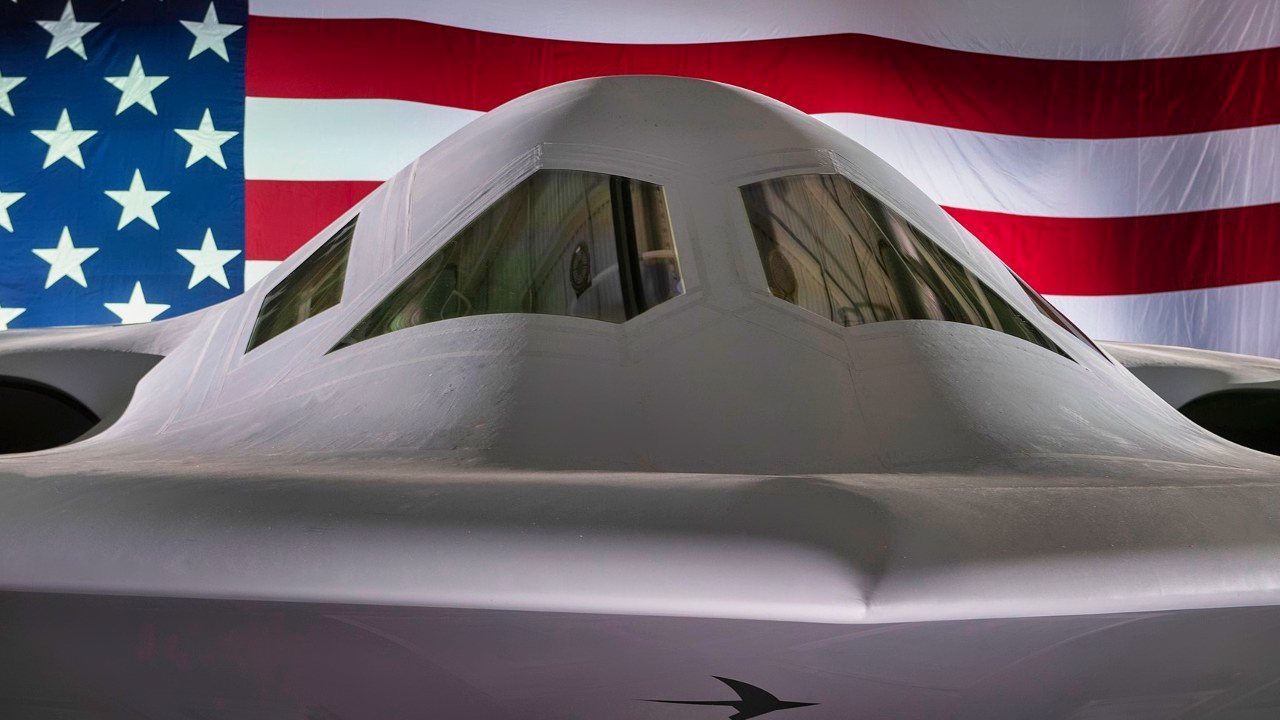
Chinese aerospace researchers say they have identified potential aerodynamic and stability weaknesses in the US Air Force’s next-generation stealth bomber, the B-21 Raider.
The claim comes from a study conducted at the China Aerodynamics Research and Development Center, one of China’s major military aviation research institutions.

B-21 Raider Up Close. Image Credit: U.S. Air Force.

A second B-21 Raider test aircraft takes off, Sept. 11, from Palmdale, Calif., to join the Air Force’s flight test campaign at Edwards Air Force Base, Calif. The addition of the second test aircraft expands mission systems and weapons integration testing, advancing the program toward operational readiness. (Courtesy photo)
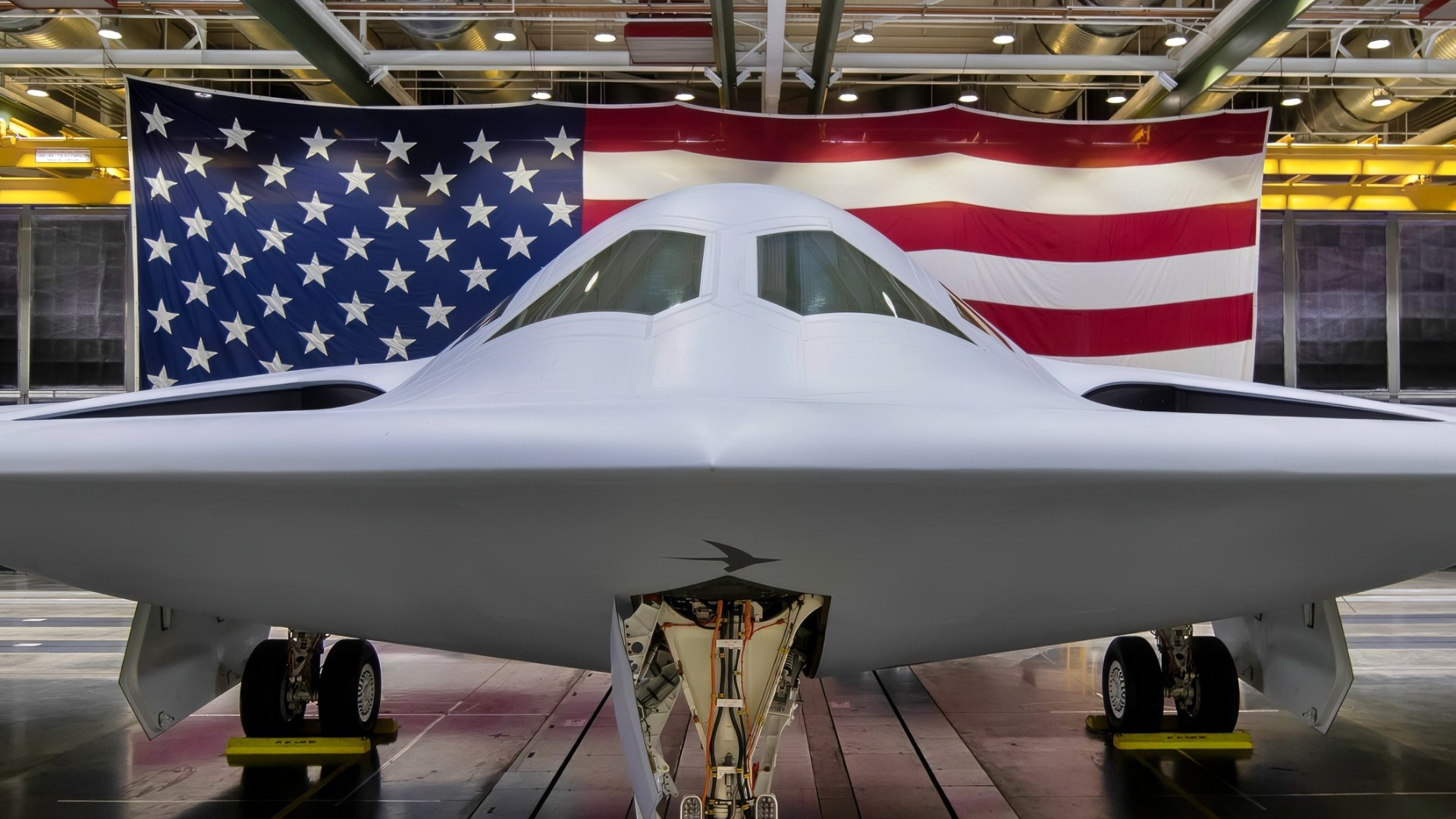
The B-21 Raider was unveiled to the public at a ceremony December 2, 2022 in
Palmdale, Calif. Designed to operate in tomorrow’s high-end threat environment, the B-21 will play a critical role in ensuring America’s enduring airpower capability. (U.S. Air Force photo)
Using a newly developed simulation software, PADJ-X, Chinese researchers modeled the bomber’s likely flight characteristics based on publicly available design information.
The study reportedly identified possible improvements to the B-21’s aerodynamic configuration—suggesting that the PADJ-X software can analyze complex military aircraft designs.
The findings, of course, are still theoretical, but the research highlights the growing role of advanced computational modeling in modern military competition.
What the B-21 Raider Is
The B-21 Raider is the US’s next-generation strategic stealth bomber. Currently under development by Northrop Grumman, the B-21 can be considered a replacement for the company’s last stealth bomber project, the B-2 Spirit.
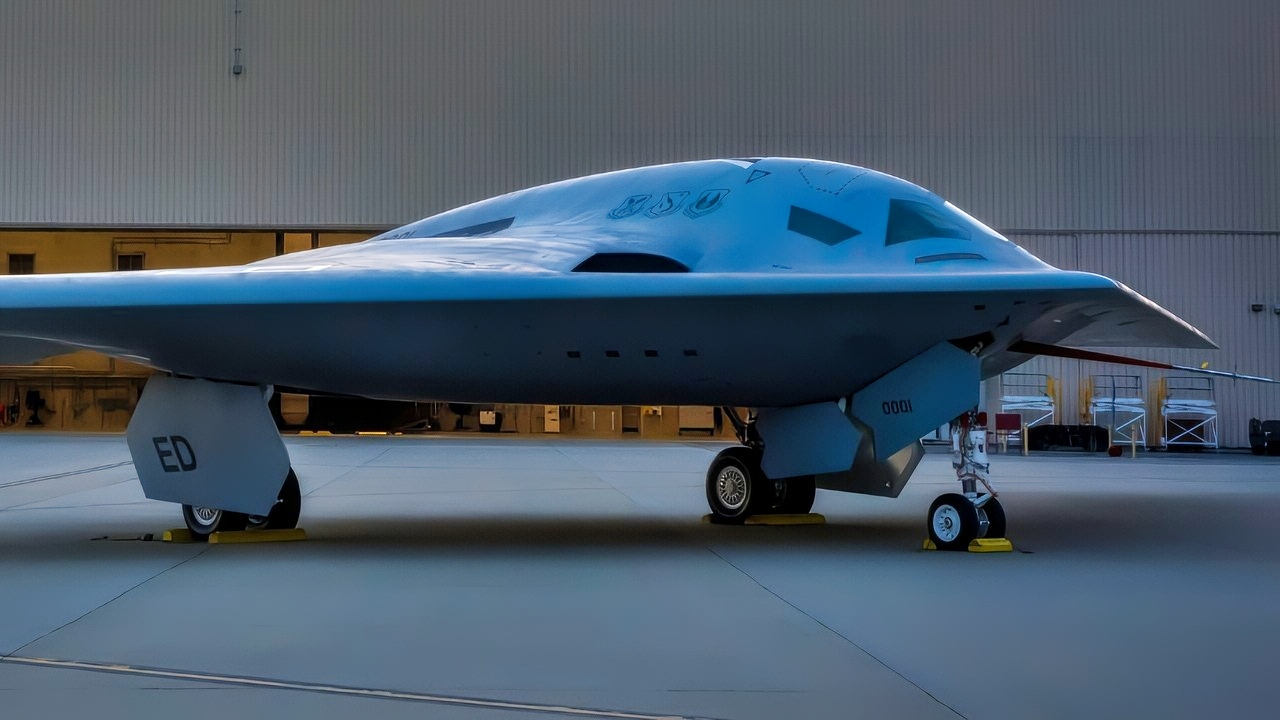
The B-21 Raider is designed with an open systems architecture, enabling rapid insertion of mature technologies and allowing the aircraft to be effective as threats evolve. The bomber was designed up front for supportability and maintainability-based upon decades of lessons learned and best practices from prior aircraft programs-to improve long-term affordability and outcomes in operations and sustainment. The B-21 first flight is anticipated to take place in calendar year 2023. (U.S. Air Force photo)
Appropriately, once the B-21 is available, it will replace both the B-2 and the B-1B Lancer, marking the most dramatic change to the Air Force’s bomber corps in a generation.
B-21’s Key Characteristics
The B-21’s (publicly known) key characteristics include a stealth-focused flying wing design that is outwardly very similar to the B-2’s.
The B-21 is being designed for long-range penetrating strike capability, which the flying wing design facilitates through improved fuel economy (thanks to low drag) and reduced radar cross-section/improved stealth performance (thanks to limited control surfaces).
The B-21 will carry both conventional and nuclear weapons, as well as advanced sensors and network connectivity.
The aircraft is intended to operate in heavily defended airspace, penetrating advanced air defense networks in potential conflicts with near-peer powers such as China or Russia.
And although many of the B-21’s technical details remain classified, the B-21 is expected to represent a major leap forward in stealth, survivability, and digital integration compared to the B-2.
The Chinese Study
According to the research summary, Chinese scientists used a simulation platform called PADJ-X to model the B-21’s aerodynamic behavior.
The software reportedly enables engineers to analyze aircraft performance through high-fidelity digital simulations rather than expensive wind-tunnel tests.
And, using theoretical modeling based on open-source imagery and assumptions about the bomber’s design, researchers evaluated potential stability and aerodynamic characteristics of the B-21.
Aspects the Chinese examined include: airflow around the bomber’s flying-wing configuration; stability across different flight regimes; aerodynamic efficiency; and potential structural or performance trade-offs.
The research suggested that small changes in the aircraft’s configuration could theoretically improve performance.
Limits of the Analysis
However, the study should be taken with a grain of salt, as the analysis is based entirely on external modeling rather than classified design data. The B-21’s exact aerodynamic configuration, materials, and flight control systems remain highly classified.
This means that Chinese researchers are working from public imagery and educated assumptions—not from detailed engineering data from the actual aircraft.
Also worth noting: modern stealth aircraft are often inherently unstable and rely on advanced flight-control computers that can compensate for aerodynamic instabilities that might appear problematic in purely theoretical models, thereby allowing the aircraft to maintain controlled flight.
Which is to say that any Chinese claims about “flaws” in a forthcoming US aircraft, the development of which has been a closely guarded secret, should be treated with skepticism.
Common Practice
Despite the limitations of the Chinese study, the research highlights a common practice in military aerospace competition: countries routinely analyze the visible design characteristics of rival aircraft to estimate performance and identify potential weaknesses.
Not engaging in such behavior and critique would be negligent from a security perspective.
And the use of tools like PADJ-X reflects a broader shift toward digital engineering and advanced simulation in aerospace design. High-performance computing enables engineers to test aircraft designs virtually before building physical prototypes, accelerating design cycles, reducing development costs, and enabling the safe testing of extreme flight scenarios.
China’s interest in the Raider is no surprise, either; it reflects the broader strategic competition between the US and China.
Long-range stealth bombers remain one of the most important tools for projecting military power.
China, too, is currently believed to be developing its own next-generation stealth bomber, the Xi’an H-20, any development of which the Americans will watch closely, waiting to feed data into their own performance modeling software.
About the Author: Harrison Kass
Harrison Kass is an attorney and journalist covering national security, technology, and politics. Previously, he was a political staffer and candidate, and a US Air Force pilot selectee. He holds a JD from the University of Oregon and a master’s in global journalism and international relations from NYU.


Joe
April 26, 2026 at 5:57 pm
Just like how China has caught up to the f-35, it’s all speculation until real world data shows the truth. Countries are psyched when then can track and take out a F-22, which is 20+ years old. That’s how far of an advantage the U.S. has, while being safe about the process. The next 6th Gen aircraft will set the U.S 2 decades ahead, while not putting training pilots in dangerous situations every time.
Michael Jay Sesto
April 26, 2026 at 5:59 pm
Perhaps they are well aware of China’s love to copy, and intentionally don’t show the ACTUAL version, like the post suggests. This made me smile, thank you.
Omega13
April 26, 2026 at 6:29 pm
What a pantload of ChiCom propaganda.
Do better.
God Bless America
April 26, 2026 at 10:51 pm
This author is sucking up to pro-China constituents. The US will lay waste to China’s so-called “advanced military’ (i.e. Temu copycat military) the moment they decide to invade Taiwan.
Scott
April 26, 2026 at 11:49 pm
Really. Bring real details. I have to agree with all the above comments.
bernardito
April 27, 2026 at 1:22 am
so what china? by the way did any Rich Gulf countries have your Jet Fighters?
i will not buy it even if it is Buy One Take Two!!!!
Glenn
April 27, 2026 at 1:58 am
Wow they’re only twenty five years late, unlike Communist countries like China, the United States doesn’t parade their latest technology down the streets.We don’t even know what the hell we’re using these days anyway, when it comes to the united states military, the only stuff you know about is the stuff that they want you to know about. Trust me the b twenty one was probably completed shortly before or after 9/11 as a concept for much more deadly bomber fighter aircraft, this was basically the prototype\ which is the only reason it has flaws. Just like darpa , releases information about certain weapons and vehicles it’s created at the behest of the united states gov, we are basically telling China here.You can see what we were doing with these obsolete aircraft, vehicles and weaponry we have things that are thirty years ahead of that already, the reason why you haven’t heard of them is because the united states is actually very secretive of their military technology, when you look at the blueprints for the Gerald.S Ford our newest aircraft carrier, half of the blueprints are redacted. And any satellite that’s ever taken a photo of it is blurred out when there’s aircraft on the deck that aren’t F15s, F16s, and F35s, when I say trust me , I want you to trust me that these are our last generation aircraft and weaponry. We have drones that are the equivalent of F22s, hell the F15 is probably still more advanced than all other modern aircraft of any nation still to this date, especially when it comes to naval aircraft, and i’m pretty sure, hell i’m almost positive that the first training/testing operations of the F15 happened in secret in the 1980’s 45 years ago. Trust me at the time, the F22 was already in development being tested in colorado and nevada. I mean just look at a MIG, they’ve basically just been tweaking the same plane since the 70’s with no real technological or mechanical? Advancements nor improvements besides the newer ballistics, communications and HUD i mean we have generation 5-6 aircraft that could land and take off vertically on an aircraft carrier. The rea\nSon, why we have gunships and ground attack.Planes is because the united states has air superiority before a battle is even begun. You Don’.\nT see other nations putting 155mm howitzers in their transport aircraft to shoot people on the ground with like the AC130 Hercules, because in order to deploy a aircraft for ground attack support , you need to be positive that air superiority will be achieved, there is no competition when it comes to the United States, military and every other nation in the world.Trust me, I’m not just America fanboy.But the united states can possibly challenge the entire globe in a conflict and come out on top by a long shot. If we’re talking conventional warfare not nuclear.
China’s not even gonna have enough water, food, or work for its own citizens in the next 10 years. Nevermind catching up to the united states and military advancement in technology , it’s not even something to worry about. One aircraft carrier in the Pacific is completely stopping China from invading Taiwan.\nEvery other nation on earth might as well be the same as north korea on a threatening scale. Because no matter how advanced other nations militaries are, there still a good 40? Maybe 50 years behind the united states in military might(tech) in most things… and abouf 20? Or 25 with tech others more common like guns and ballistics.
Just think about this or put it this way, china landed a rover on the moon not long ago if i’m not mistaken. Meanwhile the united states NASA landed a crew of humans on the 60-65 years ago. This is technology that countries like china couldn’t even fathom , even russia could not keep up after the launch of sputnik and sending gregor into space. After that happened well everybody else was running the marathon at a steady pace with their legs, we were competing in the same marathon with a Ferrari, they could see the outside, and they know it’s better than their legs, but they can’t even see the inside of that ferrari, which is where all the true power lies. Hour enemies are aware, which is why they must publish propaganda on a daily basis.It’s the only way to boost the morale of their nationalistic citizenry. The b twenty one is just a decorative piece, we have much cheaper and older planes that can do the same job. We average about one(1) as in a single lost aircraft due to combat, every 29.6 years. Russia’s lost more, then I mean, a lot more the ratio is about 310:1 aircraft due to our stinger missiles in the last five years than we’ve lost since 1946-2026, there’s a reason why we don’t intervene in Ukraine.It’s because every time we have a new weapon to test out, we give it to the Ukrainian ground forces.Our weapons are specifically designed to destroy russian chinese iranian etc. equipment machinery vehicles aircraft etc.
Meanwhile , they have no way of testing any of their weaponry on their enemy , which is us. None of their equipment is battle tested or proven to do anything. And it seems like when their military gets shoved into war, it doesn’t end well, all it takes is a handful of ragtag.\nCombinations of mixed soldiers , ranging from mercenaries to the national guard of ukraine , to just straight up volunteers who have never shot a gun in their life to completely annihilate russia’s cold war surplus, then they started rolling in the T90s and T92-95s, 13(T90) of which were taken out by a singular Leopard 2A, which isnt even germany’s newest version of the leopard, there’s a reason why we’ve been using the abrams since the late 70s early 80s. Because it’s a battle tested superior MBT, we don’t even have rifling on our smoothbore 155mm cannons like many other nations tanks, because we know it’s fucking useless to put rifling on a tank barrel , because if you had to engage another tank where you needed rifling for an accurate shot , there are other weapons that are superior at taking out of enemy tank at that range, or they’ll just fire a disposable javelin missle from some Marines gym bag. Or some seven mile range TOW missle. And this is all speculation, because our air superiority will not allow any of their armored or mechanized divisions or units even come close to putting any of our armored columns in even the most minuscule danger.
I mean we have 1000mi range, baby tomahawks.\nSitting on our destroyers.\nWay off shore, pretty sure our Aegis class cruisers which are actually specifically designed for anti air and missile defense of an aircraft carrier , carries about a hundred and forty of these tomahawks , whichever yield equivalent of a 1000 1500 or even 2000lb MOAB, which can turn an entire city block into dust were only bacteria would survive.
The United States is the people who run this planet’s base of operations.Trust me.They know what the fuck they’re doing.When it comes to making sure when they compare dick sizes, they’ll come out on top.
Edward John Glentz
April 27, 2026 at 4:11 am
PADJ-X software can analyze complex military aircraft designs.
☆PADJ-X is a Chinese-developed software platform designed to analyze and optimize the design of complex military aircraft. Unveiled in a peer-reviewed paper in *Acta Aeronautica et Astronautica Sinica* around late 2025, the tool is described as an “all-in-one” multidisciplinary system that integrates five key engineering fields: aerodynamics, propulsion, electromagnetics, infrared signature,and sonic boom.
☆Technology and Capabilities☆
The software utilizes adjoint optimization technology, an algorithmic approach that allows engineers to adjust thousands of design parameters simultaneously rather than relying on the traditional, time-consuming trial-and-error method. By consolidating multiple disciplines into a single framework, PADJ-X aims to reconcile conflicting design requirements, such as balancing the need for a stealthy shape against the necessity of aerodynamic efficiency and structural integrity.
☆Research Applications☆
Researchers from the China Aerodynamics Research and Development Centre, led by Huang Jiangtao, have used the software to conduct theoretical simulations of high-profile US aircraft based on publicly available data.
☆B-21 Raider: The team performed simulations on configuration models resembling the B-21 stealth bomber, claiming to identify potential aerodynamic and stability shortcomings.
☆X-47B Stealth Drone: In simulations for this discontinued US Navy project, the software reportedly optimized performance, reducing drag by approximately 10% and decreasing the forward radar cross-section significantly.
☆While these findings suggest that PADJ-X can effectively analyze complex military configurations, the researchers emphasized that their results are based on theoretical modeling and open-source imagery rather than classified design specifications.
Christopher Smith
April 27, 2026 at 9:00 am
First even B-21 technology is a bit dated.
Second I’m not sure how much can be cleaned from a mock up model without having had any access to the original
Third I’m sure we’ve identified items that could be improved as well
Fourth none of that necessarily means the Chinese can can gain anything of a material advantage currently
Osvaldo Mateo
April 27, 2026 at 10:19 am
The high Price
John Grabski
April 27, 2026 at 10:28 am
Another WWII copy of the original German Flying wing and only 80 years later. They should have it about perfected by now….lol
Leonard Hermary
April 27, 2026 at 3:29 pm
if anything its just more realization of something else never ever done. Now or before fir what comes next. BS article here
Gumal
April 27, 2026 at 11:57 pm
Blah, blah. I remember when Russia was parading thier latest warfare technology/arms , it was a prop! Same as China they stole technology, did reverse engineering and lyed about thier arms and capabilites Thier arms are inferior, period! Besides the usa has the greatest weapon of all…. financial thier economy will collapse if they can’t trade with the US.
Mark
April 28, 2026 at 12:21 am
China has the American blue prints on the B 2 but still can’t copy it because there is a special coat of paint it takes for stealth that isn’t online and the amount has to be perfect to work . This is old tech to be honest . America has spaceships and rest of the world are still trying to copy a jet. Good Luck China militarily will always be behind because you have to innovate and not copy. Also China does not like naval warfare so America has nothing to worry about.
Hung
April 28, 2026 at 12:57 am
What a study from the country that struggles to sale its Comac C919 domestically!
Travis
April 29, 2026 at 12:22 pm
Sensitive dependence on initial conditions is the hallmark of chaos…(is a quote I remember from the past). When doing any simulation, the variables used will eventually throw off the results as the simulation goes on. For example a digit .001 off can compound simulation calculations more and more as the duration goes on.
In this case, the Chinese scientists would have to make assumptions of all sorts due to the fact that they simply do not know everything about our new stealth bomber. Yeah they probably ran multiple simulations based on ranges of data to accommodate estimated figures. But no matter what there are too many unknowns to precise figures. The initial data they plugged into the simulation is inaccurate to some degree, thus bringing about the hallmark of chaos.