
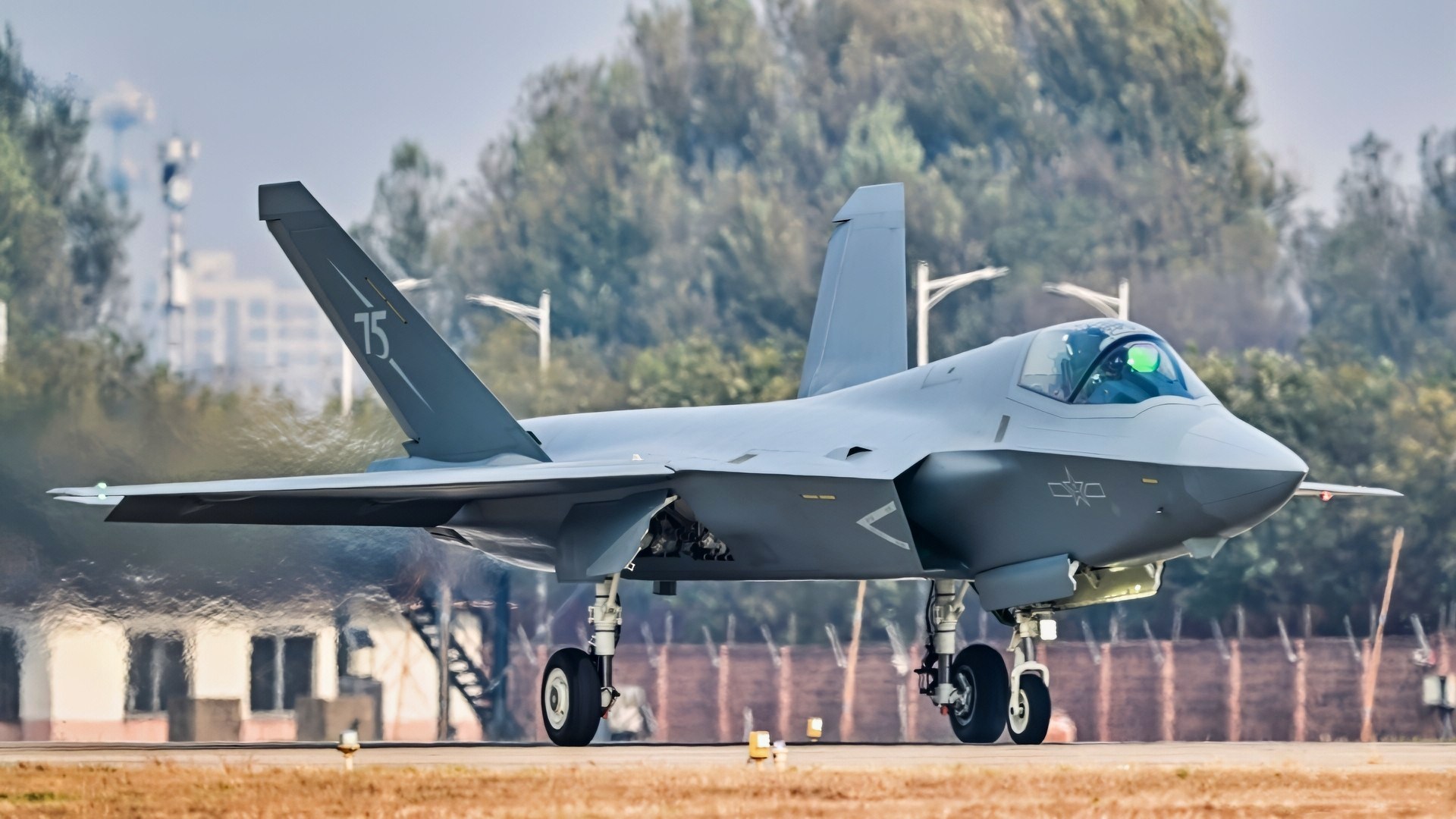
The Problem: Will Anyone Buy China’s New J-35A Fighter? Summary and Key Points
-As the land-based counterpart to the PLAN’s carrier-borne J-35, the aircraft is positioned as a low-cost, 5th-generation alternative to the Lockheed Martin F-35.
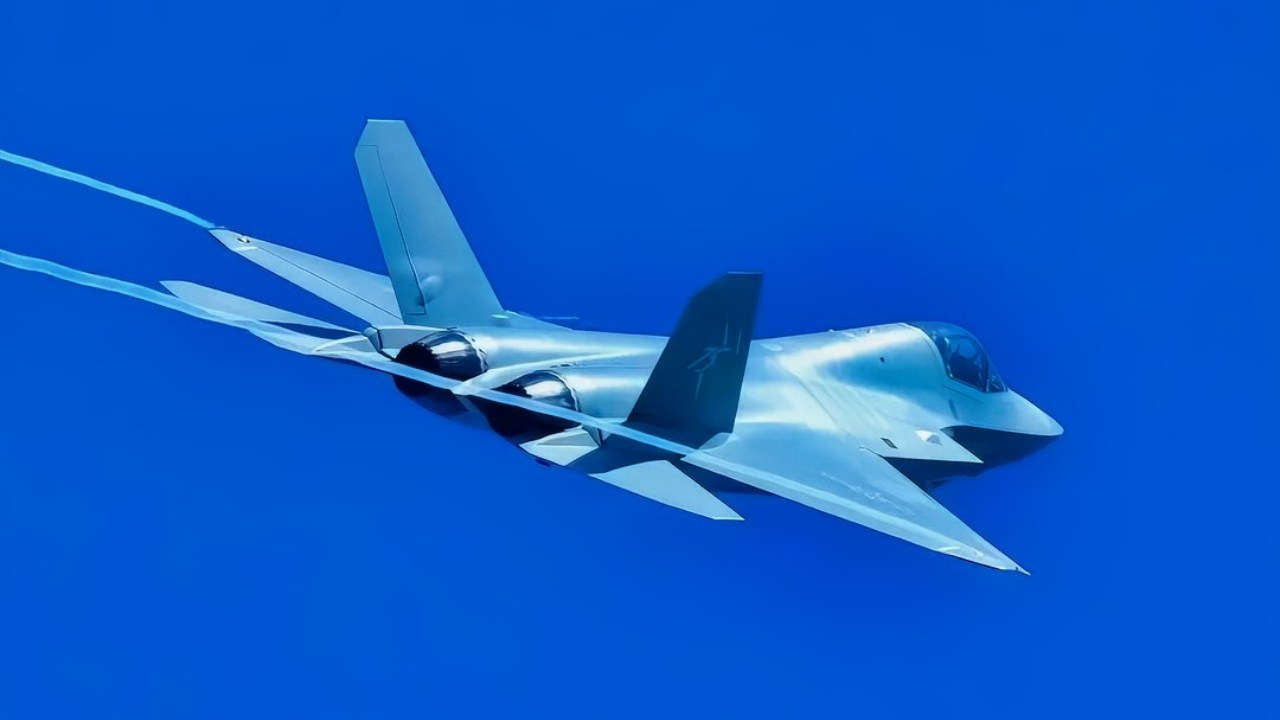
J-35A Fighter from China. Image Credit: PLAAF
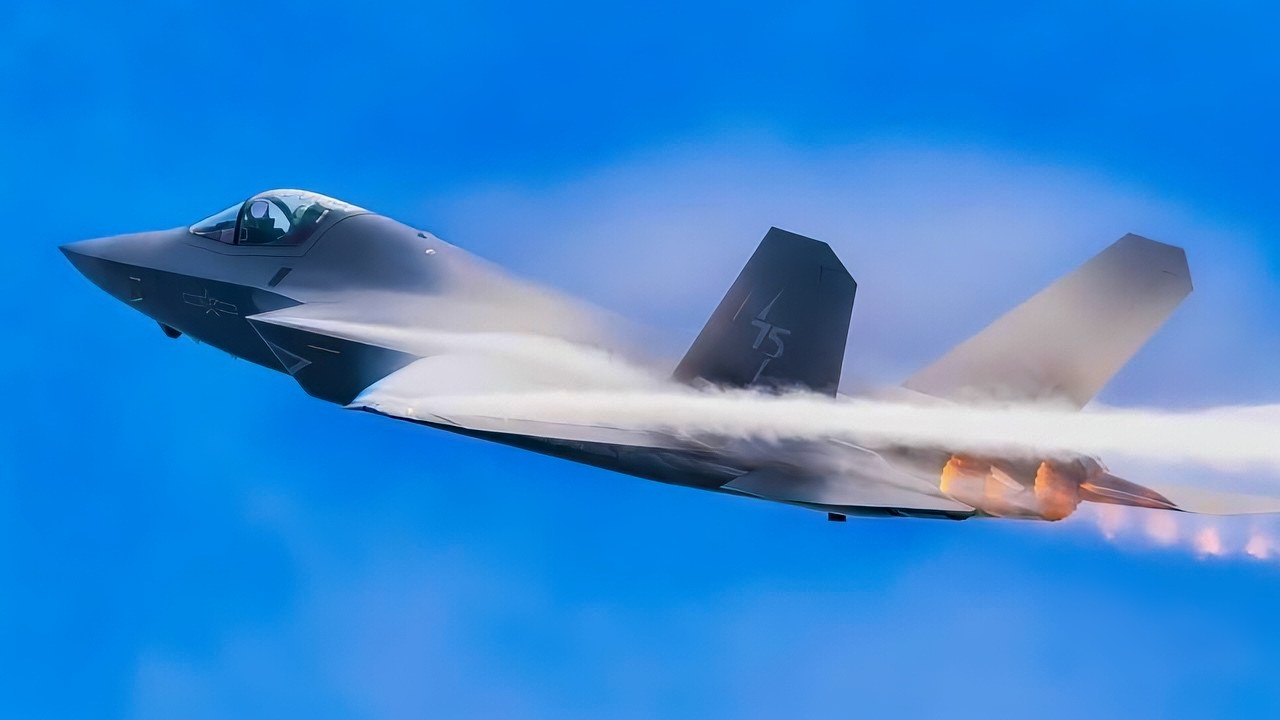
J-35A Fighter in the Clouds. Image Credit: Chinese Weibo.
-This report analyzes CATIC’s marketing strategy at the World Defence Show in Saudi Arabia and Southeast Asia, examining the trade-offs between Chinese logistics and the U.S. F-35 sustainment ecosystem, and evaluating the aircraft’s role in China’s broader A2/AD and global influence goals.
Will Any Air Force Buy China’s New J-35A Fighter?
China is no longer content to be a fifth-generation fighter builder for itself; it wants to be a fifth-generation fighter seller abroad. That ambition was made abundantly clear in February 2026, when China’s state aviation export booth at the Singapore Airshow featured a half-size model of the J-35A, the land-based version of the J-35 stealth fighter family.
The aircraft is China’s answer to the American Lockheed Martin F-35, and the program behind it aims to offer F-35-like stealth and modern sensors to countries locked out of the Western market or unwilling to pay Western prices.
But export success is not guaranteed, because while the performance may be solid, there’s still the question of who would be willing to purchase the aircraft, and the political baggage, training requirements, and long-term dependence that come with it.
What the J-35 Is – and Why It’s Not Just Another Chinese Fighter
The J-35 is part of the Shenyang Aircraft Corporation’s J-35 program, producing a family of fifth-generation aircraft, including the J-35A land-based variant and the carrier-oriented J-35 naval version. The carrier angle is particularly important for China as the country is presently expanding its carrier capabilities, fielding the new Type 003 Fujian carrier recently, and preparing to launch the next Type 004 supercarrier.
The aircraft is a major capability step beyond the fourth-generation carrier aircraft it already fields.
Publicly, China remains tight-lipped on hard specifications. Even so, Beijing has deliberately moved the aircraft beyond prototyping and has begun showing it off at major exhibitions, with reports from 2024 revealing additional details about the aircraft after it appeared at the Zhuhai Air Show.

J-35A Fighter at Le Bourget Air Show. Image Credit: Author/National Security Journal.
That presence at recent airshows is important because it signals that China is clearly looking at marketing the aircraft to foreign buyers.
Why It’s Internationally Interesting
To understand China’s J-35 export pitch, you must understand what America’s F-35 pitch represents. The F-35 is a fifth-generation stealth fighter, yes, but it is also a long-term alliance ecosystem built around U.S. support and software upgrades, and shared training pipelines and spares. It is designed around interoperability, ensuring that U.S. allies can more easily operate together globally.
That ecosystem is explicitly political, too. The United States removed Turkey from the F-35 program after Ankara acquired Russia’s S-400 air defense system, for example, with the WHite House stating that the decision made Turkey’s continued involvement impossible.
Cost and sustainment are the other half of the story. The U.S. Government Accountability Office has reported that F-35 sustainment cost estimates increased from about $1.1 trillion (2018) to $1.58 trillion (2023) and that availability has trended downward, with variants not meeting availability goals. The Congressional Budget Office has also detailed large operating and support cost burdens associated with the fleet. Those realities have created an opening for an exporter like China to argue that they can offer something stealthy, modern, and much cheaper than what the Americans have to offer.

China’s New J-35 Stealth Fighter

China New J-35 Fighter on Aircraft Carrier. Image Credit: Chinese Weibo.

J-35 Fighter on Chinese Aircraft Carrier. Image Credit: X Screenshot.
But the comparison is not just stealth versus stealth. The J-35 is China’s second stealth fighter line after the J-20, and part of a broader effort to rival U.S. air dominance while also helping smaller nations arm themselves with hardware and assets that are nearly on par with those used by the U.S. and its allies.
Out of the two platforms, the F-35 is superior in most ways, but there is one that truly stands out: the F-35 and its ecosystem come with years of real-world integration experience
What We Know Now
According to the South China Morning Post, China’s aviation booth in Singapore was operated by China National Aero-Technology Import & Export Corporation (CATIC), representing AVIC, and the J-35A model was part of the display
. CATIC itself describes its role as a primary channel for presenting Chinese aviation products and technology internationally, explicitly tying its mission to AVIC global outreach. This was a clear, official effort to market the J-35 to new customers – and the aircraft’s show circuit has not been subtle at all.
In February 2026, SCMP also reported that China exhibited models of the J-35A at the World Defence Show in Saudi Arabia – another signal that Beijing is actively marketing the J-35A to new markets.
The Problem: Who Are the Customers and What Are the Limits of the J-35A?
The J-35’s customer pool will not primarily be countries that can easily buy the F-35. It will be countries that are excluded or strategically unwilling to tie themselves to an American ecosystem. For states under Western sanctions pressure, or those that do not consider themselves strong allies of the United States, the appeal of a Chinese fifth-generation export option is obvious in theory.
But good in theory does not mean good in practice. First of all, buyers must assume that buying into the J-35 platform means long-term dependence on Chinese logistics, spares, upgrades, and training. They won’t be buying into an American ecosystem, but they will be buying into a Chinese one. Buyers need to consider that, by buying the aircraft, they are effectively tying themselves politically to China.
Additionally, the J-35 won’t be the only F-35 alternative for many of these buyers. There are other “good enough”, cheaper aircraft out there that may be even more competitive on price or that may not require the same level of commitment to a wider ecosystem. Beyond true fifth-generation stealth jets like the F-35 or J-35, there are fourth-generation and 4.5-generation options, including Sweden’s Saab JAS 39 Gripen, France’s Dassault Rafale, and the European Eurofighter. However, given that those platforms are still produced by Western European countries, the Chinese offering may still be the best bet.
About the Author: Jack Buckby
Jack Buckby is a British researcher and analyst specialising in defence and national security, based in New York. His work focuses on military capability, procurement, and strategic competition, producing and editing analysis for policy and defence audiences. He brings extensive editorial experience, with a career output spanning over 1,000 articles at 19FortyFive and National Security Journal, and has previously authored books and papers on extremism and deradicalisation.


