

Summary and Key Points: Vladimir Putin still tells his country that victory in Ukraine is coming. But the war has now lasted longer than World War II did for Russia, and the people best positioned to know — including one of Russia’s own top academics — have quietly reached the opposite conclusion: this war cannot be won, not without an occupation that is simply impossible.
The Ukraine War and a Look to History

U.S. Army Pvt. 1st Class Ian Wojick, assigned to 552nd Military Police Company, 25th Infantry, aims a DroneBuster, an anti-drone weapon, toward the sky during the Joint Pacific Multinational Readiness Center Exportable (JPMRC-X) exercise at Fort Magsaysay, Philippines, June 1, 2025. This iteration of the JPMRC-X marks the second Combat Training Center (CTC) rotation conducted in the Philippines. As part of the Army’s premier regional CTC, JPMRC-X enables the U.S. Army, joint force, allies, and partners to develop skills in realistic environments and conditions. Through exportable capabilities, JPMRC-X strengthens war-fighting readiness, enhances multilateral relationships, and contributes to regional security and stability in the Indo-Pacific. (U.S. Army photo by Staff Sgt. Keith Thornburgh)
The current war in Ukraine has lasted longer than World War II did for Russia, but they have not yet achieved one of their primary goals of the war. The Ukrainians have been turning the tide of the war, but may not have the military forces to drive Russia out of its territory.
Like the Korean War before it, this nearly four-and-a-half-year war may end up in a negotiated settlement, with a country divided by a heavily militarized line of control between the two warring factions.
In a bizarre twist of fate, thousands of North Korean “volunteers” are fighting for Russia in the same brutal, bloody, meatgrinder that their forefathers fought in the 1950s.
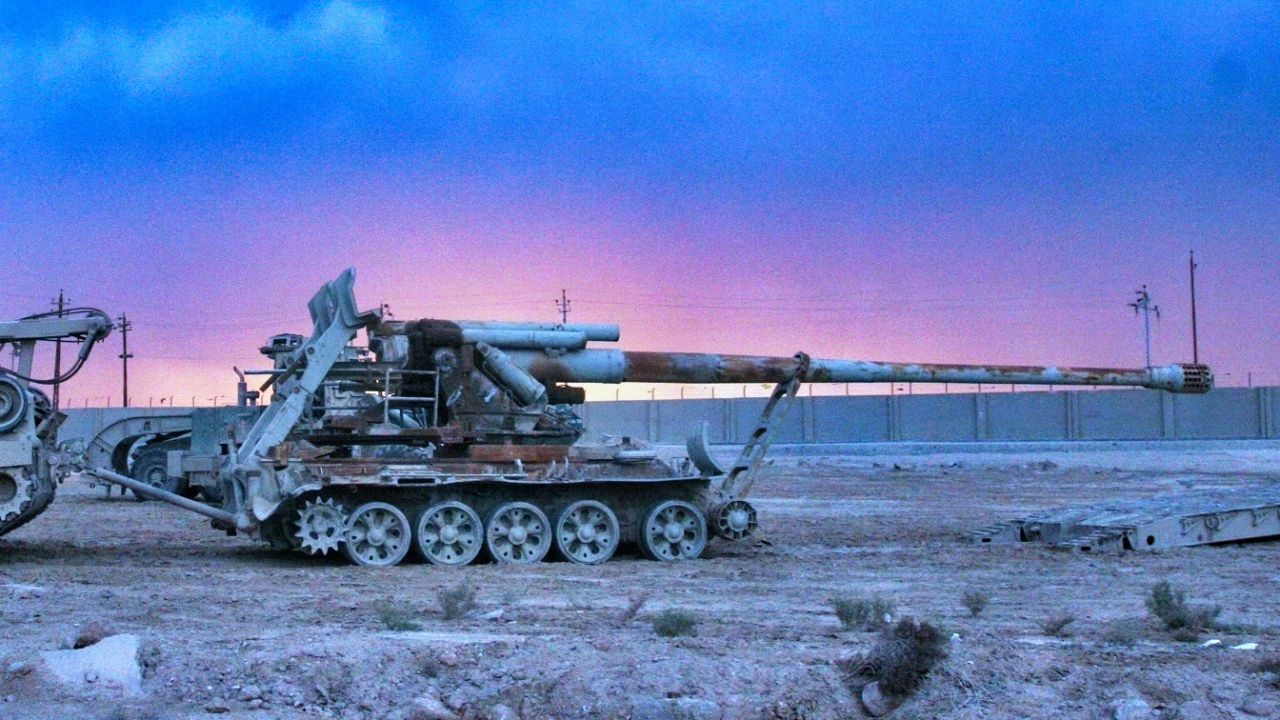
North Korea Artillery. Image Credit: Creative Commons.

North Korea Soldiers. Image Credit: KCNA/North Korean State Media.
Many of the Same Factors Face Each Side in Ukraine
Russian dictator Vladimir Putin is facing increasing pressure both at the front and within the country. The Russian army’s offensive is slowing down, resources are being depleted, and Ukrainian drone strikes are hitting the logistics and economy of the Russian Federation increasingly hard.
Military analysts are increasingly coming to the conclusion that Putin’s war aims, despite his insistence, are becoming increasingly unattainable.
Putin’s growing frustration has led many analysts to believe that Putin will once again resort to nuclear blackmail in an attempt to win strategic concessions from the West.
There were the same threats that both sides used in Korea.
Other Similarities To The Korean War
Neither side is able to gain much territory. Just as the Korean War transitioned from rapid territorial swings to a grueling war of attrition along a static front, the conflict in Ukraine has frequently settled into a defensive deadlock.
A reluctant armistice could freeze the front lines with a heavily fortified Demilitarized Zone (DMZ) stretching across ruined territories.
CIRSD wrote that “just as the Korean War came as a consequence of the division of Korea, the war in Ukraine came as a consequence of the breakup of the Soviet Union. Modern world history shows that, when a unitary state splits or disintegrates, violent conflicts can ensue.”
Also, like the Korean War, the war of attrition has been dragging on, with an appalling number of casualties on both sides, but mainly suffered by Russia.
According to the Center for Strategic and International Studies (CSIS), as of late May 2026, Russia has suffered more than 1.3 million casualties (killed and wounded) in Ukraine since the February 2022 invasion. More than 352,000 of these are believed to be fatalities.

Russian President Vladimir Putin (R) meets with North Korea’s leader Kim Jong Un in Vladivostok, Russia April 25, 2019.
Despite very positive combat assessments by his generals, Putin’s forces are making very minimal gains (15 to 70 meters per day) but at casualty rates of up to 1,000 troops per day.
Ukraine Was Offered The “Korean Option” In 2023
In January 2023, Oleksii Danilov, the Secretary of Ukraine’s National Security Council, warned that the stalemate may result in the same armistice. “We are being offered the Korean option. ‘Here there will be some Ukrainians, here there will be other Ukrainians, and here there shall be no Ukrainians.’ I’m convinced that one of the options they will offer us is this 38th parallel.”
Oleksii Arestovich, a well-known Ukrainian political commentator and former advisor to President Volodymyr Zelenskyy, stated that the situation was similar to Korea as well, saying the country could end up “in a two-Koreas scenario.” “The worst thing of all,” Arestovich added, “is that the West thinks that this is possible… and we’re totally dependent on them.”
Other Ukrainians believe that if the country joins the European Union (EU), it could establish a new security framework within NATO’s self-defense framework, similar to South Korea’s with Washington.
Ukraine’s Situation Is Different Than South Korea’s
The Russian invasion of Ukraine has dragged on for more than four years, and Putin continues to believe that he will eventually prevail, even though many of his own advisors believe that his goals are unattainable.
Russian academic Vasily Kashin, the Director of the prestigious Higher School of Economics’ Center for Comprehensive European and International Studies, wrote a scathing article on the site “Russia in Global Affairs,” in which he stated that Russia cannot win the war.
“The elimination of the anti-Russian regime is fundamentally unattainable without a full military occupation of the entire country for a long period. For Russia, this is technically impossible.”
The 1953 Korean Armistice established a clear Military Demarcation Line. In Ukraine, Russia continues to claim the annexation of territories (such as the Donetsk, Luhansk, Kherson, and Zaporizhzhia oblasts) that it does not fully control, complicating where a theoretical ceasefire line would be drawn.
Ukraine’s Terrain Will Make A DMZ Type Of Line Difficult
The mountainous, narrow terrain of the Korean Peninsula lent itself to being highly defensible.
Ukraine, however, features vast, open terrain spanning hundreds of kilometers, making it significantly harder to permanently secure and patrol against future incursions without massive ongoing military commitments.
Lack of a Buffer Zone consensus will be a major sticking point. Some proposed models for ending the Ukraine war mimic the Korean model by implementing demilitarized buffer zones within Ukrainian sovereign territory.
However, there is no international consensus on how these zones would be enforced or whether international peacekeepers would be utilized. And Russia has been strongly opposed to any NATO or Western peacekeepers in the region.
However, it is too soon to expect any kind of armistice in the Russian war in Ukraine. Neither side is yet willing to stop fighting.
About the Author: Steve Balestrieri
Steve Balestrieri is a National Security Columnist. He served as a US Army Special Forces NCO and Warrant Officer. In addition to writing on defense, he covers the NFL for PatsFans.com and is a member of the Pro Football Writers of America (PFWA). His work was regularly featured in many military publications.


