


Key Points and Summary: Following a major $10 million dry dock refurbishment, the battleship USS New Jersey (BB-62)—the most decorated warship in U.S. Navy history—is back at its museum berth in Camden.
-This article combines a first-hand tour of the historic vessel with an exclusive interview with the museum’s CEO, who details the painstaking external hull restoration.

USS New Jersey July 2025. Image Credit: National Security Journal.
-The complex work included replacing the cathodic protection system and even tracking down a mysterious 40-year-old sealant.
-The project, funded entirely by state and private sources, has given the legendary battleship a new lease on life for future generations.
National Security Journal Toured the Refurbished Battleship USS New Jersey
Camden, N.J. – The USS New Jersey (BB-62) was an Iowa-class battleship that had four major deployments in its long life: in World War II, the Korean War, the Vietnam War, and in its recommissioning in the 1980s, including in the Lebanon campaign.
Following its retirement in 1991, the New Jersey moved to its new home in Camden, N.J., across the Delaware River from Philadelphia—and the USS Olympia museum ship—the home of the Battleship New Jersey Museum and Memorial. The museum is now under the auspices of a nonprofit corporation and not governed by the Pentagon or any other arm of the federal government.
Last summer, the 45,000-ton battleship underwent a 12-week, $10 million dry dock repair in the Philadelphia Navy Yard just across the river. The ship was built in Philadelphia in the 1940s and launched on December 7, 1942, on the first anniversary of Pearl Harbor. That launch was from Dry Dock #3 at the Navy Yard, the same place where the 2024 repairs took place.
We recently had the opportunity to tour the battleship. Then we spoke with Marshall Spevak, the CEO of the Battleship, about the recent refurbishment, how it was carried out, and what’s coming up next for the Battleship New Jersey.

USS New Jersey 16-Inch Guns. Image Credit: National Security Journal.
On Deck
While most of the recent repairs and improvements were not what one can expect to see on the tour, we can say that the ship is looking in tip-top shape and looked fantastic on a beautiful summer day.
The tour covered all four storys of the ship, from the radar room to the captain’s quarters to the radar rooms. There was even a dentist’s chair, which was used for maritime dental work.
When our guide showed the various gun positions on the ship, he joked about which rival NFL stadiums they could potentially reach.
The New Jersey, as our tour guide explained, was the most decorated Naval ship in US history and, at 887 feet, is also the longest. It’s so long that getting the entire length in one photograph was not an easy task.
The battleship also played a key role in most of the nation’s wars in the 20th century. Its deck was a “frontrunner” to serve as the site of Japan’s formal surrender in World War II, but after FDR died and was succeeded by President Harry Truman, the ceremony instead took place on the USS Missouri, the ship named for the new president’s home state.
Participating in the tour as part of our group was everyone from war veterans to an eight-year-old boy who seemed to know just about everything there is to know about naval history, and was even able to point out the Soviet Union—a country dissolved long before he was born—on a map in the radar room.
There is currently a USS New Jersey, a Navy attack submarine, although its current whereabouts are “classified,” the tour guide said.

USS New Jersey National Security Journal Photo by Stephen Silver.
What Was Repaired
“It was all external, it was all work on the ship’s hull, pretty much all of the work,” Marshall Spevak, Battleship New Jersey’s CEO, told National Security Journal in an interview, of the refurbishment.
“We did not do any internal work as part of the dry dock project. It was all external, under the water line, and places that we cannot see from our berth,” he said.
“We spent just about 10 million dollars. And it was the first time that this battleship has ever been dry docked as a museum. And the first time she’s been dry docked since her activation for recommissioning in 1982,” the CEO said. “As a museum and even for the people who have served on board in the 80s for many, and for most of us, this was the first time anyone’s seen underneath the ship. So it was an incredible project and highly successful.”
Spevak added that “the great majority” of the dry dock work went into a couple of specific projects, including applying a new system of coatings to the hull and also replacing the ship’s cathodic protection system.
“The ship had 1204 zinc anodes to the cathodic protection system,” Spevak said. “We replaced them with aluminum anodes. We did half as many as there before, but double as thick. So the zinc is made for saltwater here in the Delaware [River]. We’re sort of in a fresh brackish type of water. So the aluminum is meant for that type of setting. So we replaced the zincs with aluminums.”
The project also involved pressure-testing the through-hole openings under the ship to make sure none were leaking through.
“We went and individually tested all of those blanks, and in cases where it needed repairs, we welded over and replaced them,” he said.
They also “boxed in the propeller shaft to make sure that there was no water leaking through.”
That’s a Lot of Sealant
One particular repair was something of a surprise.
“When we got underneath the hull, we noticed that there was, across basically the entirety of the hull along all the riveted seams, this almost caulk-like epoxy material that we had no idea even existed. We had no idea it was there. After searching for a couple of weeks through our archives, our blueprints, and paperwork, we actually found a reference to it. It’s a sealant that was placed over the riveted seams in the last dry dock in the ship in the ‘80s.”
Spevak credited the battleship’s “incredible curatorial team” for finding a reference in an old Naval report to the sealant that was used—and luckily, it remains available, and they were able to order more of it. It required “several thousand feet of linear feet of this sealant,” which was applied throughout the ship.

USS New Jersey Broadside Battleship. Image Credit: Creative Commons.

USS New Jersey Firing Iowa-Class Battleship. Image Credit: Creative Commons.
Another test, he said, entailed “over a thousand ultrasonic shocks of the hull, testing the thickness of the steel and various parts of the hull.” And additional steel plates were added in some cases, mainly towards the bow of the ship.
“Those were the major projects that we undertook,” Spevak said. “Three of them that we had planned for, three of them that we ended up doing based on our assessment when we got to the dry dock.”
Spevak has been CEO since 2023, after serving for seven years on the museum’s Board of Trustees. Before that, he worked in politics, including as a lobbyist, in the legislature, and for New Jersey’s governor. He’s been coming to the Battleship since he was a kid, he said.
USS New Jersey Refit: How It Was Funded
The Battleship New Jersey was a naval ship, but now that it’s a museum, it is no longer controlled by the Navy or any other part of the federal government. It operates as a private 501 (c) (3) nonprofit organization that owns and operates the battleship. So the $10 million price tag for the renovation came not from the Pentagon or federal budget, but from other sources.
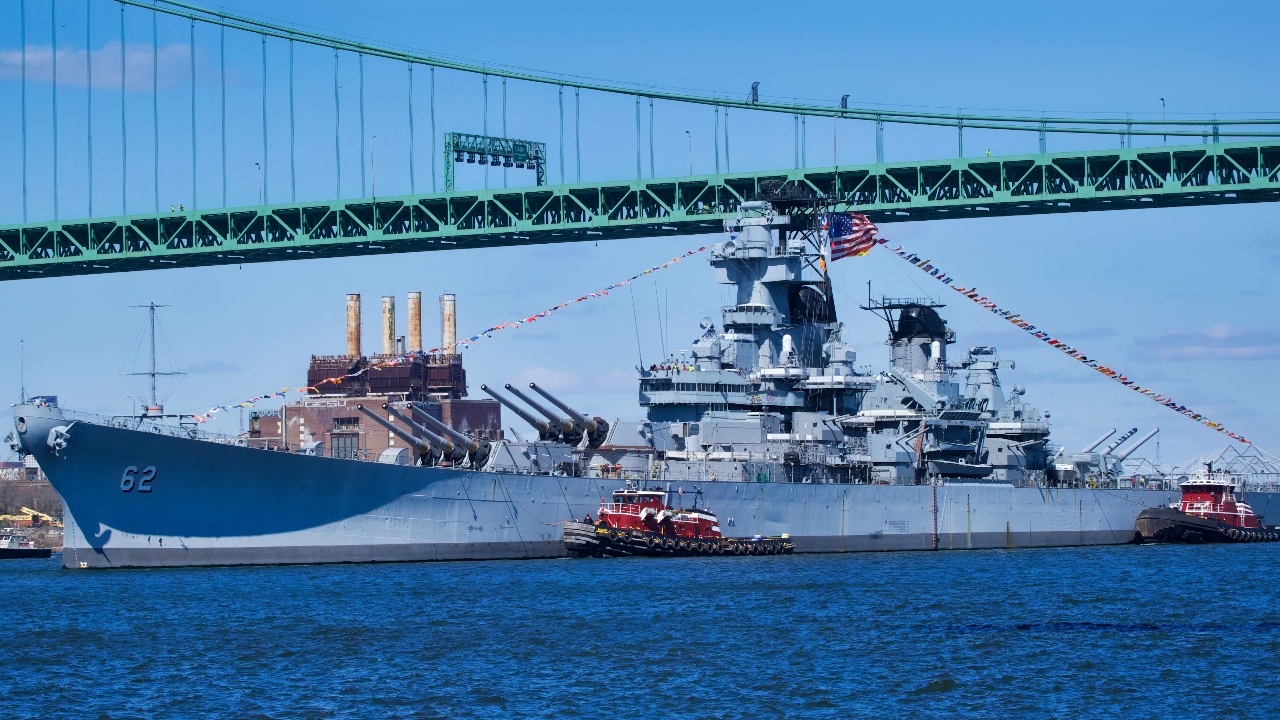
USS New Jersey Iowa-Class Battleship. Image Credit: Creative Commons.
The project, Spevak said, received a one-time $5 million grant from the state of New Jersey, while Camden County, where the ship is located, guaranteed a bond on the organization’s behalf, which they bonded for $3.25 million. The rest of the money came from private fundraising, as well as money from tours and other income.
“We received zero funding from the federal government, we received zero funding from the US Navy, we have never received funding from the Navy in our 25-year history,” the CEO said. “And so everything that we do is privately fundraised or through grants and appropriations from the state and the county, and other places.”
The Battleship has sought federal funding in the past—“we ask all the time,” Spevak said—although the Navy does not fund museum ships anymore. Rep. Donald Norcross (D-NJ), long a supporter of the Battleship, has introduced legislation to make a pool of funding available to such ships.
“We are trying to work to open up further opportunities, but unfortunately, the Navy does not have any budget line items for museum historic ships,” Spevak said.
“We get by on visitation and guests” on a day-to-day basis, he added.
The Navy Reserves the Right to Recall the USS New Jersey
The battleship’s contract with the Navy, Spevak said, says two things: They are “not allowed to touch the engine systems,’ which is one reason why tug boats were used to move it from the dry dock.
And the other is that “the Navy reserves the right to recall the ship back into service in the event of a national emergency.” However, Spevak stated “we have no feeling that that will ever happen again,” and that none of the refurbishments were done with the idea that the ship would ever return to service. The Navy does, however, issue guidelines about how often a museum ship should return to dry dock.
What’s Next?
The Navy will celebrate its 250th birthday in October, with the Marine Corps celebrating the same milestone the following month.
“The Navy is hosting the celebration for the 250th anniversary in Philadelphia and in New Jersey, and the Battleship is going to be a key part of those celebrations,” Spevak said. The celebrations are called Homecoming 250.
“There are several hundred thousand people who are expected to come into town from October 9th to the 16th. The Navy is bringing several active duty ships to Philly, South Jersey, to Camden, for display and tours.”
The CEO looks back fondly on the dry dock project.
“The ship was on the blocks for 78 days, and it was an incredible 78 days,” he said. “And it was a real thrill to be a part of this project to get the battleship underway again… it was really an incredible day, and watching the ship move down river and being on the ship when it was moving down river was just a career and life highlight for me.”
About the Author: Stephen Silver
Stephen Silver is an award-winning journalist, essayist, and film critic, and contributor to the Philadelphia Inquirer, the Jewish Telegraphic Agency, Broad Street Review, and Splice Today. The co-founder of the Philadelphia Film Critics Circle, Stephen lives in suburban Philadelphia with his wife and two sons. For over a decade, Stephen has authored thousands of articles that focus on politics, national security, technology, and the economy. Follow him on X (formerly Twitter) at @StephenSilver, and subscribe to his Substack newsletter.
Military Affairs
China’s Stealth Air Force Has 1 Mission


John Dilatush
August 23, 2025 at 3:33 pm
Let’s be perfectly clear… there may be three or four guys left that could explain how to steam her but in this day and age we don’t have any kids that could stand six and six at the checks and not whine about the heat… they won’t get a Covid shot so how are they gonna lite fires or start a feed pump or god forbid clean the bilges after doing a bottom blow.
megiddo
August 23, 2025 at 7:37 pm
President donald trump will reactivate this super duper stupendous powerful warship and send it to the pacific once putin blasts Taipei with a nuke ICBM.
Why putin would do that.
It’s because trump is again doing his flippy floppy routine, due largely to the ongoing maxwell hearings.
We cannot discount a surprise blooper or two from Maxwell.
Thus the flipping flipping is urgrntly NEEDED to take the pressure off from THAT.
But it means putin will get very mightily squeezed through no fault of his own.
To escape from that STUPID really stupid situation, a big big boom at Taipei will resolve it fully.
securocrat
August 24, 2025 at 7:45 am
Trump is waitin’ & waitin’ in great big trepidation at What Maxwell could reveal next.
Maxwell said bill Clinton flew dozens of times on ep’s jet but never once got a free massage.
Strange, like saying a bear walked 20 to 40 times past a honey jug but never bothered to overturn it a single time.
Over to ukraine.
In 2014, when western operatives had fully upended ukraine, hussein obama wasn’t keen at all to worsen the situation.
There were lots of fighting and clashing then, but ‘o’ refused to send any big US military weapons there.
Others were of very different views, particularly general breedlove then the chief NATO military boss in euripe.
Breedlove got into a scheme with several other bigshots, especially one phillip kerber.
Breedlove’s aim was to put an end to ‘o’ wishes for ukraine, and to send heavy weapins there and let them all fight like it’s hell on Earth.
Kerber arranged for a third party to supply heavy TOW missiles to the neo-nazi battalions in ukraine, then deeply involved in the so-called ATO, or campaign to wipe out the russian-speaking inhabitants who greatly opposed the nazis.
Fortunately, the plan never worked out, and by february 2015, the ATO had largely fizzled out, replaced by the CIA-taught attritional warfare mounted against the ethnic russians.
Until grnocide joe biden became president and the SMO was unleashed.
Blake Beyers
August 24, 2025 at 2:15 pm
Actually the ‘ultrasonic shocks’ mentioned in the article aren’t really ‘shocks’ at all. All they did is a comprehensive thickness survey on the for information and possibly add extra plates if an area was corroded or thinned out from age. All it takes is some gel on the surface put probe on and you have a digital reading right away.
Laurian M Weisser
August 24, 2025 at 2:24 pm
There is a wonderful You Tube channel hosted by the lead Curator of the New Jersey. There are close to one hundred videos documenting some aspect of the ship. The dry docking was extensively covered. Well worth spending some time there.
Martin Goodkind
August 25, 2025 at 5:44 pm
We need ships so badly, I believe that a one billion $ conversion should and would get this warship back at sea..
tony woods
March 9, 2026 at 5:40 pm
she is a marvel that has to be seen. I took my wife aboard her several years ago and she was completely speechless. i was fortunate enough to see her fire her guns back in the 60s and what a marvel it was to see.I look forward to visit her this year with the rest of my family. Im in my late 70s but I would sign up again if I was assigned to serve aboard her.