

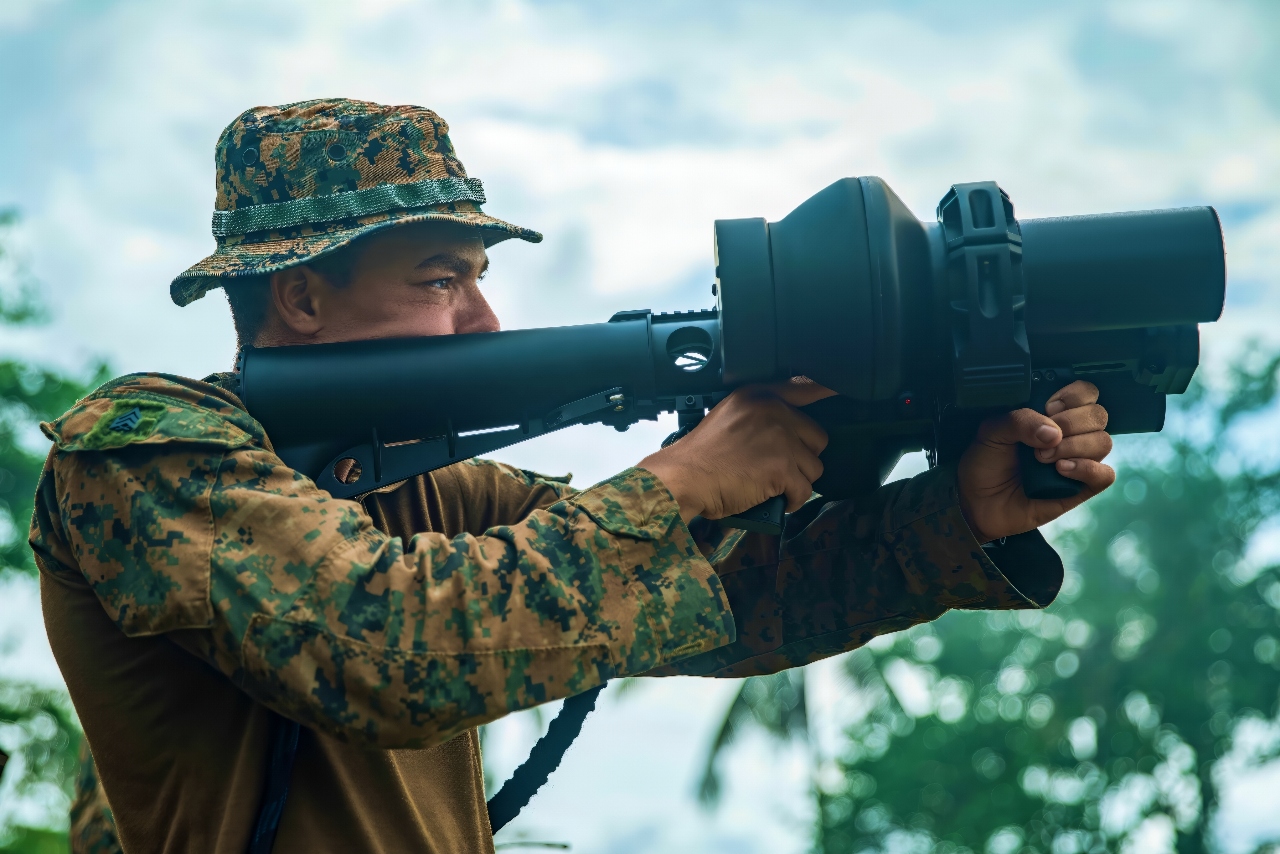
Key Points and Summary – This article, written by an Army veteran, explains the origin of the “crayon-eating Marine” joke as an inter-service “smack talk” stereotype that portrays Marines as “more brawn than brain.”
-The joke became mainstream with the rise of social media.
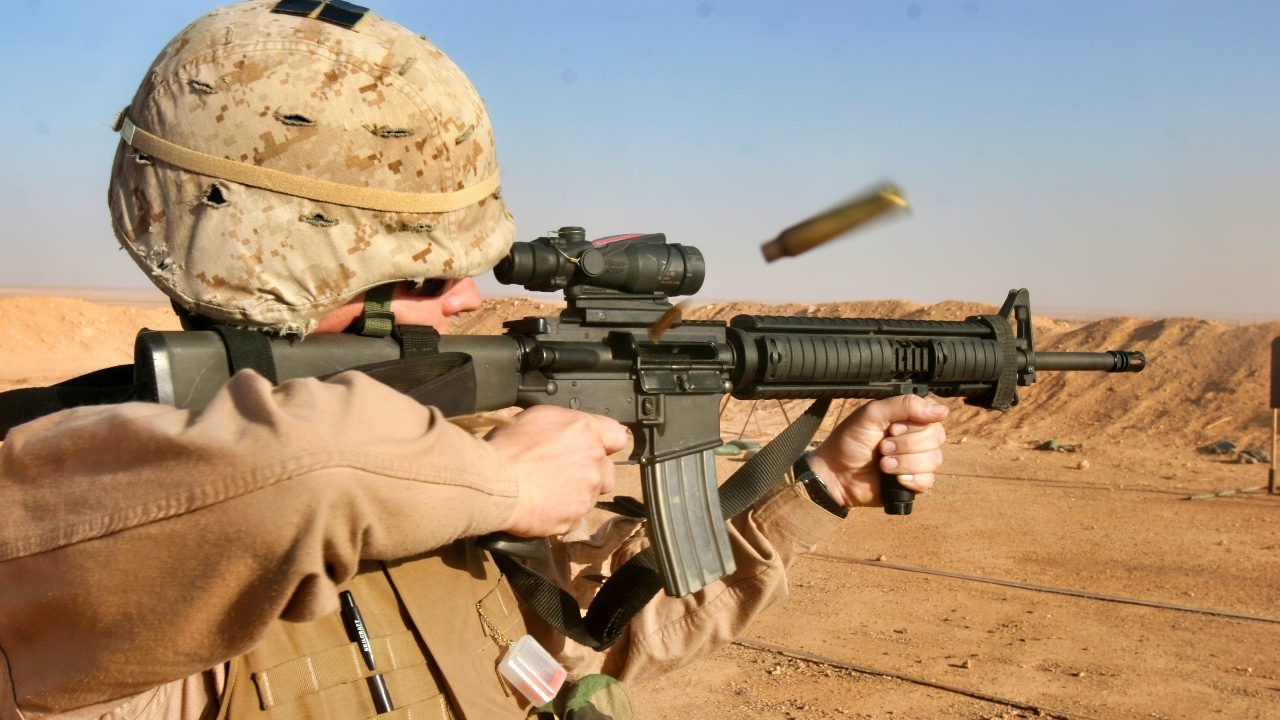
CAMP KOREAN VILLAGE, Iraq (May 15, 2007) – Sergeant Christopher L. McCabe fires his rifle during monthly range training here May 15. The Marines and sailors of Detachment 1, Combat Logistics Battalion 2, 2nd Marine Logistics Group (Forward), provide necessities and services to coalition forces throughout the area of operations. McCabe, a Bellaire, Ohio, native, is the staff noncommissioned officer-in-charge of the maintenance section, Det 1, CLB-2, 2nd MLG
-However, the article highlights how Marines have “fully embraced” the insult, turning it into a point of self-deprecating humor.
-The author cites examples, including a Marine veteran who sells edible crayons and his friend, writer Alex Hollings, who once “ate the thing” when presented with crayons at a formal event, winning over the crowd.
Where Did The Myth Of The “Crayon-Eating Marines” Come From?
If you have never been in the military, then you have never experienced the amount of trash talk that goes on within the services.
But as pointed as the ribbing can get between teammates—you need really thick skin to be in a Special Operations unit—that’s nothing compared to how service members talk about the other services.
Some of those smack-talk sessions could fill volumes. But here is one of the tame ones: “What is the difference between Special Forces and the Girl Scouts? The Girl Scouts have adult supervision.” We will limit ourselves to that level of tameness, since this is a family-oriented post.
But perhaps no story on intraservice ribaldry is complete without mention of the enduring saga of the “crayon-eating Marines.”
Where Did the Crayon-Eating Marine Story Come From:
Being an Army guy, I’ll admit, I absolutely loved the crayon-eating story.
The “crayon-eating Marine” joke didn’t just appear out of nowhere— someone with too much time on his/her hands thought it up (and deserved an impact award). It was probably a Marine looking to indulge in a bit of self-deprecating humor.
Wherever it originated, the story obviously evolved from some common perceptions, and perhaps misconceptions, about the Marine Corps itself.

U.S. Marine from the 24th Marine Expeditionary Unit (MEU) Special Operations Capable (SOC) Maritime Special Purpose Force (MSPF) wears a camouflaging cobra hood during Baltic Operations 2024 (BALTOPS 24) in Ustka, Poland June 14, 2024. BALTOPS 24 is the premier maritime-focused military exercise in the Baltic Region. The exercise, led by U.S. Naval Forces Europe-Africa, and executed by Naval Striking and Support Forces NATO, provides a unique training opportunity to strengthen combined response capabilities critical to preserving freedom of navigation and security in the Baltic Sea. (U.S. Navy photo by Mass Communication Specialist 3rd Class Sisi Lopez Barahona)
The Marine Corps’ emphasis on physical toughness has led to a stereotypical portrayal of Marines as being more brawn than brain. While the joke has been around for a long time, it really didn’t reach the mainstream population until the social media explosion in the 2000s and 2010s. That’s when GIFs and memes began to make their way into everyday life.
The irony is that the joke was shared by plenty of walking, talking examples of a crayon-eater who lacked the gumption to become a Marine. But, that is social media.
I will admit that at the USAMM Super Store’s website, if you type in crayon eater, it takes you to a Special Forces unit flash. Wait, What?!?
The idea behind the joke that Marines might enjoy eating something like crayons—an object associated with children—is that it was a humorous way to highlight their gritty, no-nonsense nature.
But a funny thing happened amid the smack talk. The Marines didn’t fight back against this silly stuff; no, they embraced it, turning the joke back on its purveyors.
Tashina Coronel, a Marine veteran and the owner of Okashi Sweets, decided to start selling edible crayons to Marines. She threw in edible glue for good measure.
“The crayons started as an inside joke between services,” Coronel said in an interview with Military Times. “It was actually a jab at Marines from other services, trying to make fun of us. But as Marines, we can laugh along with them and own it as our own.”
The memes will undoubtedly continue.
Alex Hollings is a good friend who has always been there whenever called. He’s a Marine to his core, and he’s the polar opposite of a “Jarhead” (due to haircuts) and a crayon-eater.
Indeed, he’s one of the most talented aviation writers anywhere. Need proof? He was invited to speak at NATO Joint Air and Space Power Conference. Yet he has fully embraced the crayon-eating Marine joke.
Alex tells the story of being at the SHOT Show a few years ago: “Someone paid a waiter to carry out a fancy tray full of large crayons for the two of us Marines attending the event as guests.
“The joke played well in a room full of veterans, service members, and defense media types — and as the tray made its way up to us, I made a command decision.
“I stood up and waved to our audience, politely picked up a red crayon from the tray, and I ate the —- thing.
“The decision prompted cheers from the crowd and the nod of approval from the other guys I spotted in the audience with the tell-tale high and tight haircut. Sometimes the best way to take a joke is to lean in and to remember that we’re all really on the same team here.
“Besides, red crayons taste the best.”
That is why Alex is my friend.
About the Author: Steve Balestrieri
Steve Balestrieri is a National Security Columnist. He served as a US Army Special Forces NCO and Warrant Officer. In addition to writing on defense, he covers the NFL for PatsFans.com and is a member of the Pro Football Writers of America (PFWA). His work was regularly featured in many military publications.
More Military
Europe and Canada Are Finally Saying No to the F-35 Stealth Fighter
The Exact Day Navy Battleships Became Obsolete Is Clear
The X-44 Manta Has a Message for Every Air Force on Earth


