

The U.S. is hoping to mediate talks between Ukraine and Russia as Washington ramps up its efforts to end the war in Ukraine.
According to Special Envoy Steve Witkoff, the U.S. will mediate talks between Moscow and Kyiv in Abu Dhabi on November 10 and 11.

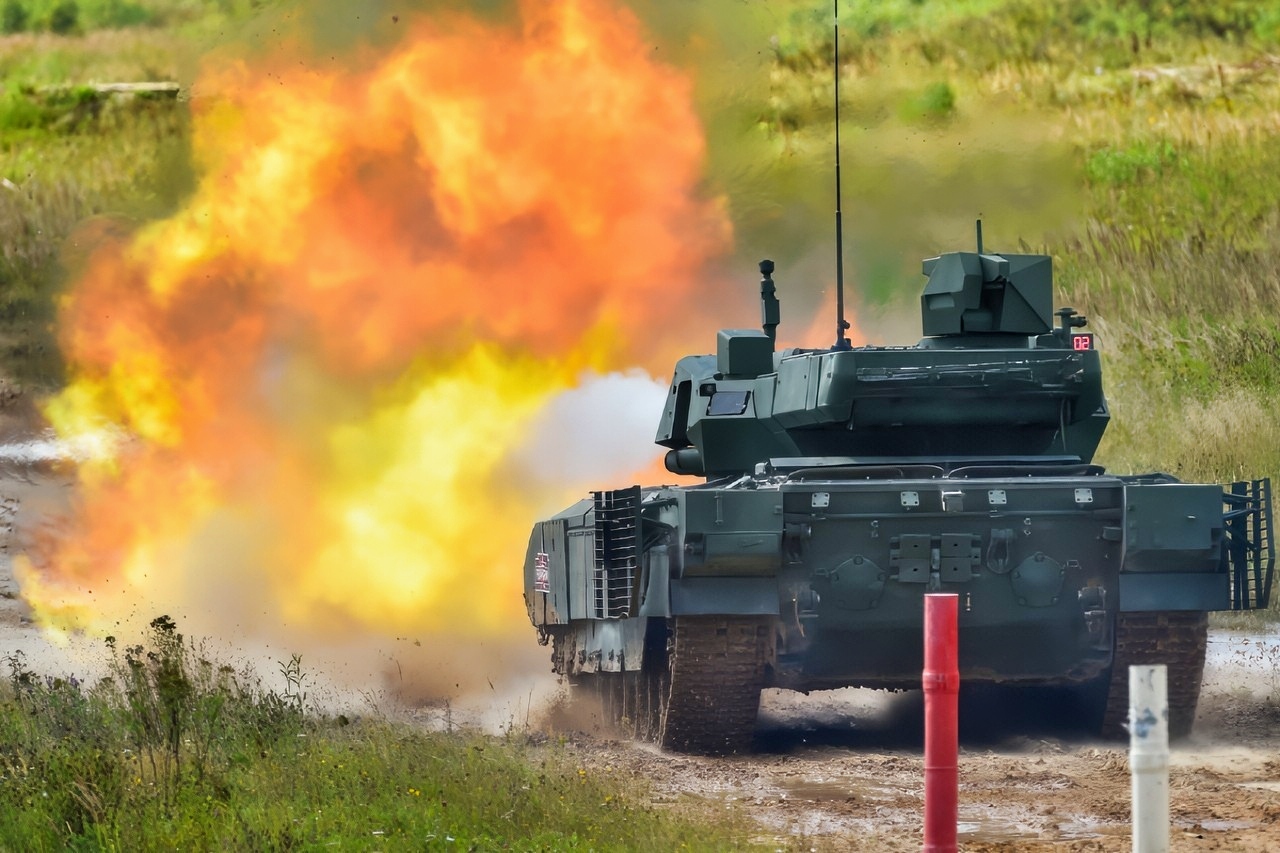
T-80 Tank from Russian Army. Image Credit: Creative Commons.

T-80 Tank Russian Army. Image Credit: Creative Commons.
As previously reported, President Trump likely hopes to present a comprehensive peace plan and host a direct meeting between Presidents Putin and Zelenskyy.
Negotiations between Russia and Ukraine have been gridlocked for the last few years, as neither side is willing to compromise on its ambitious war goals.
Moscow remains committed to annexing the Donbas, while Kyiv wants to return to its pre-2014 borders, including Crimea.
Looking for a Diplomatic Breakthrough
On Monday, Steve Witkoff announced on social media that the U.S. will mediate working-level talks between Ukraine and Russia on November 10 and 11 in Abu Dhabi.
He also stated that American negotiators will meet with representatives from the UK, France, Germany, and other EU countries to discuss security guarantees for Ukraine and opportunities to support its reconstruction. Security guarantees have been a major concern for Zelenskyy since the war began.
Last month, U.S. envoys discussed possible peace settlements with the Ukrainian president, including security agreements modeled on NATO’s Article 5 clause. “We look forward to building on the progress made in Kyiv, Oslo, and St. Petersburg toward a comprehensive, durable peace agreement that delivers lasting security for generations to come,” he concluded in his post on X.
The latest announcement of “working-level” negotiations indicated that discussions will likely be held among technocrats rather than at the senior diplomatic or national leadership level.
Low-level talks between Russia and Ukraine occur fairly often.
However, a few weeks ago, Russia’s Human Rights Commissioner, Yana Lantratova, met with her Ukrainian counterpart, Dmytro Lubinets, in Belarus to discuss humanitarian matters, particularly the treatment of POWs.
Low-level talks like these usually result in POW transfers or the repatriation of fallen soldiers.
More significantly, however, Ukraine and Russia implemented a local ceasefire in the Russian-occupied frontline town of Oleshky in the Kharkiv region.
Moscow and Kyiv acknowledge that the ceasefire was due to the efforts of Melania Trump and Pope Leo.
The brief ceasefire allowed humanitarian aid to reach the battered town and enabled an undisclosed number of civilians to be evacuated.
Brief as it was, the agreement sparked hope that Kyiv and Moscow could reach a broader agreement.
Why Diplomacy Has Failed So Far
While Ukraine and Russia can set aside their differences on certain smaller matters, the main issues behind the conflict are much harder to resolve.
Kyiv refuses to acknowledge any of Russia’s annexed territories and insists that Russia withdraw from all occupied territory, including Crimea.
Ukraine has also requested security guarantees from NATO or an agreement from other European nations to deter any future Russian invasion.
Kyiv maintains, and several European states agree, that legitimizing Putin’s gains in Ukraine would set a dangerous precedent and embolden Russia.
While Zelenskyy has proposed several ceasefires to freeze the conflict along the current line of contact, Kyiv still maintains that territorial concessions are unacceptable.
Meanwhile, Russia is unwilling to compromise on any of its territorial claims.
In fact, Russia refuses to drop its claims to Novorossiya, which includes the Kharkiv, Mykolaiv, and Odesa regions, where Russian troops currently have little to no presence.
Furthermore, the Kremlin maintains that the current government in Kyiv is illegitimate and not worth negotiating with.
At a recent conference, Russia’s Foreign Minister, Sergei Lavrov, dismissed the idea of negotiating with Kyiv, calling Zelenskyy’s government an “openly Nazi” regime. “They [the West] say, ‘Let’s stop where the line of contact is now, and then we will rebuild Ukraine and deploy international stabilization forces in the remaining part of Ukraine,’” he said. “International stabilization forces. To stabilize what? This is the idea of London and Paris. What are they going to stabilize? An openly Nazi regime.”
Can Trump End the War?
Against this backdrop, the Trump administration faces an uphill battle in its push to end the war in Ukraine.
The U.S. has previously mediated talks between Ukrainian and Russian officials with little success.
American envoys Steve Witkoff and Jared Kushner met with Russian and Ukrainian officials in October, hoping to lay the groundwork for more substantive talks.
Later this month, Trump is hoping to meet with Vladimir Putin and Xi Jinping in China on the sidelines of the Asia-Pacific Economic Cooperation summit in Shenzhen.
According to some reports, Trump’s ultimate goal is to present a comprehensive peace plan at the upcoming G20 summit in December, to which both Zelenskyy and Putin have been invited.
The Kremlin has yet to confirm the Russian president’s attendance.
While the U.S. struggles to achieve a diplomatic breakthrough, Russia and Ukraine continue their long-range attacks against each other.
Over the last few days, Russia has launched multiple large-scale combined drone and missile attacks against Ukraine.
According to some reports, the Russians have used several hundred attack UAVs in the last two nights alone, along with multiple ballistic and cruise missiles.
According to the Ukrainian energy company DTEK, three power plants in the Kryvyi Rih, Dnipropetrovsk, and Vinnytsia oblasts stopped generating electricity after suffering “extensive damage” from Russian ballistic missiles.
About the Author: Isaac Seitz
Isaac Seitz, a Defense Columnist, graduated from Patrick Henry College’s Strategic Intelligence and National Security program. He has also studied Russian at Middlebury Language Schools and has worked as an intelligence Analyst in the private sector.


