

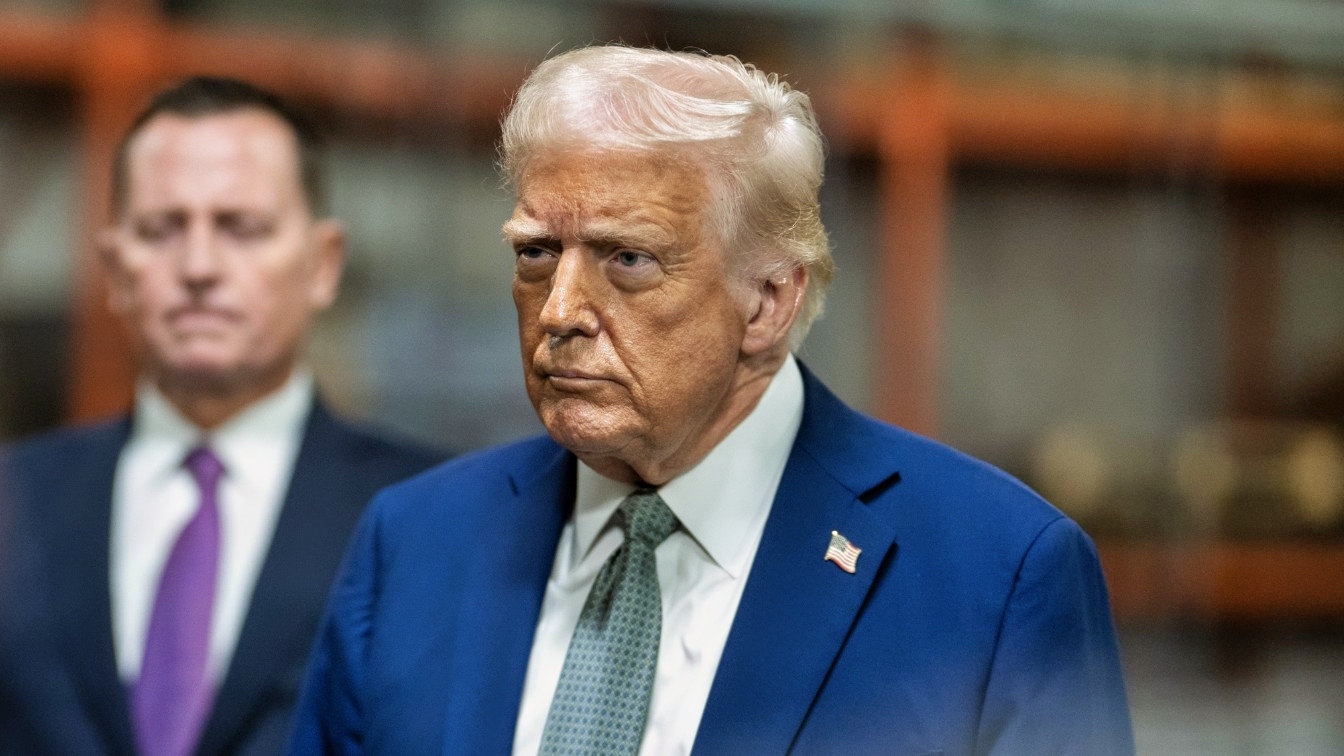
President Donald J. Trump is a self-described tariff man. In fact, protectionism is one of the defining hallmarks of his public career–having called for protectionism going back to the 1980s, back when Japan was the economic challenger to the United States.
And there are real reasons why the United States might have benefited from specific protectionist policies.

Donald Trump Speaking at CPAC. Image Credit: Creative Commons.

Donald Trump Giving a Speech. Image Credit: Gage Skidmore.
Since entering his second term, though, the president has enacted protectionist policies so sweeping and haphazard that they have compromised both the validity of protectionism as a strategic policy and the American economy itself.
A recent Fortune article highlights how the Trump administration has changed its tariffs more than 50 times since enacting them over the last two years.
In business, uncertainty is one of the worst things for keeping prices stable.
When businesses face uncertainty, it harms international supply chains, undermines investment decisions, and raises consumer prices.
The Trade War Erupts
Two years into the trade war, the Trump administration today faces massive pressure not only from uncertain business leaders but also from foreign governments demanding relief from US tariffs.
Meanwhile, in the wake of the massive Democratic Party victory in the Midterms earlier this month, there is simply no way that the Democratic Party will abide by Trump having such free rein when it comes to trade policy.
One of the most contentious domestic policy concerns has been the financial burden Trump’s tariffs have imposed on American households.
One study found that the tariffs have forced Americans to pay another $1,000 per year that they otherwise would not have paid. New duties could add another $900 in household costs this year.
Trump claimed that his tariffs were taxes on other countries.
This was always an economically illiterate position.
They are taxes on American importers, who then pass the increased cost of doing business on to the American people.
The argument was always that these were prices needed to pay for national security and to shore up American industry being eviscerated by cheaper foreign competition.
But Trump’s tariffs were too widespread and not aimed at specific sensitive industries. As a result, the government imposed a new burden on all Americans.
Trump’s tariffs were so vast that they forced a Supreme Court ruling that essentially invalidated the tariffs that Trump imposed under the International Emergency Economic Powers Act.
In effect, Trump must now oversee $166 billion in corporate refunds to companies harmed by his tariffs.
Remember, Trump had vowed that the money generated off his tariffs would be dispersed to the American people.
Instead, according to the Supreme Court, it will be given back to the corporations.
Only Wall Street Benefits
So, the American people are again left paying for a policy that benefits only Wall Street and the C-Suites of massive conglomerates. Americans see this.
They understand what they’re seeing, too.
It is one of many reasons why the people voted so decisively against President Trump.
Because of the severity, suddenness, and apparent capriciousness of the tariffs Trump imposed on the American people, longtime partners such as Canada have been driven out of America’s geopolitical and geoeconomic orbit, to some degree.
Canadian Prime Minister Mark Carney owes his entire political fortune to Trump starting an unpopular and dangerous trade war with Canada in the middle of Canada’s election, when it appeared the conservative candidate was set to win.
Once the tariffs were imposed and Trump began his verbal tirades on Canada, the Canadian voters sided with Mark Carney, who is now expanding commercial relations with China, Europe, and India–all at the expense of relations with the United States.
Chinese President Xi Jinping has seized the opportunity that Trump’s self-inflicted wounds created.
Beijing is masterfully exploiting the dissatisfaction with American protectionism by presenting China as the real defender of international commerce.
It makes sense.
More than any other nation, the People’s Republic of China has benefited from the post-Cold War globalized economy.
Its entire economic order rests on the easy, reliable flow of goods worldwide.
Trump threatened that flow from the outset of his presidency in 2016.
Interestingly, Trump’s tariffs were designed to reduce US dependence on China.
But Beijing has successfully countered most of these attempts with its global free trade profile.
These policies have damaged America the most, and Beijing now seems to be rising in stature in the eyes of the rest of the international trade community.
Can Diplomacy Save Us?
The historic trilateral meeting between US President Trump, China’s Xi Jinping, and Russian President Vladimir Putin underscores how economic competition has become integrated with international security.
During the meeting in Shenzhen, the three leaders discussed nuclear stability, energy supplies, and reforms to international institutions.
While the meeting produced no immediate breakthrough, the way the three leaders spoke suggests a chance to turn away from the current global spate of hostilities.
A primary concern, though, is whether the Trump administration can prove its protectionism produces meaningful results in the near and medium term here in the United States before its economic and political costs become unsustainable.
Thus far, they have not.
About the Author: Brandon J. Weichert
Brandon J. Weichert is the Senior National Security Editor. He also manages The Weichert Brief on Substack. Weichert is the co-host of The Mario Nawfal Show on Twitter/X. He is the author of four bestselling national security books, most recently A Disaster of Our Own Making: How the West Lost Ukraine (Encounter Books). His next book, Fortress Americas: A New Monroe Doctrine (Tucker Carlson Books), is due out December 8. Follow him via Twitter/X @WeTheBrandon.


