


Article Summary – The UK has awarded MBDA a £316 million contract to field the DragonFire laser weapon on Royal Navy Type 45 destroyers by 2027, five years ahead of schedule.
-DragonFire has already shot down high-speed drones in trials and can reportedly hit a £1 coin at a kilometer for about £10 per shot—far cheaper than missiles.

U.S. Navy Railgun Test. Image Credit: Creative Commons.
-Developed by a UK consortium including MBDA, QinetiQ, and Leonardo, the high-energy laser is Britain’s first operational directed-energy weapon and one of NATO’s most advanced anti-drone systems.
-Driven by lessons from Ukraine and Red Sea drone attacks, London is betting big on lasers for future air defense.
Why the UK Is Rushing Its DragonFire Laser Onto Type 45 Destroyers
With drone warfare a growing part of modern war, especially in the continuing conflict between Russia and Ukraine, other nations are moving to shore up their own anti-drone capabilities.
Great Britain, in particular, has taken a big step in that direction.
The UK government announced last week that it has awarded a contract of £316 million (about $414 million in US dollars) to MBDA to provide DragonFire anti-drone systems to the Royal Navy, starting in 2027.
The DragonFire, according to a British government announcement, has been shown in recent tests to be able to shoot down high-speed drones with its laser system. The British military’s social media accounts published a video of the successful test.
“The laser system costs just £10 per shot and is accurate enough to hit a £1 coin from a kilometre away,” the government press release said. “It is a more cost-effective method in comparison to traditional missile systems, which cost upwards of hundreds of thousands of pounds per shot. DragonFire will be fitted to a Royal Navy Type 45 destroyer by 2027 – five years faster than originally planned.”

DAHLGREN, Va. (Jan. 31, 2008) Photograph taken from a high-speed video camera during a record-setting firing of an electromagnetic railgun (EMRG) at Naval Surface Warfare Center, Dahlgren, Va., on January 31, 2008, firing at 10.64MJ (megajoules) with a muzzle velocity of 2520 meters per second. The Office of Naval Research’s EMRG program is part of the Department of the Navy’s Science and Technology investments, focused on developing new technologies to support Navy and Marine Corps war fighting needs. This photograph is a frame taken from a high-speed video camera. U.S. Navy Photograph (Released)
The contract, the government promises, will help create and sustain hundreds of jobs throughout the UK. It’s also described by the British government as “the first high-power laser capability entering service from a European nation, representing one of the most advanced directed energy weapons programmes in NATO.”
The Power of Lasers
“This high-power laser will see our Royal Navy at the leading edge of innovation in NATO, delivering a cutting-edge capability to help defend the UK and our allies in this new era of threat,” MP and Minister for Defence Readiness Luke Pollard said in the government announcement.
“We are delivering on our Strategic Defence Review by backing British industry and creating hundreds more jobs, making defence an engine for growth across the UK.”
Scottish Secretary Douglas Alexander, meanwhile, touted Scotland’s role in developing the weapon.
“This new £316 million contract award – and news that DragonFire has successfully taken down high-speed drones in the latest trials at the MoD’s Hebrides range – shows just how vital Scottish expertise is to the UK’s national security and why Scotland is globally recognised as a centre of defence excellence,” Alexander said in the government statement.
That Strategic Defence Review had taken place in 2025, with an aim towards making Britain “secure at home [and] stronger abroad.”
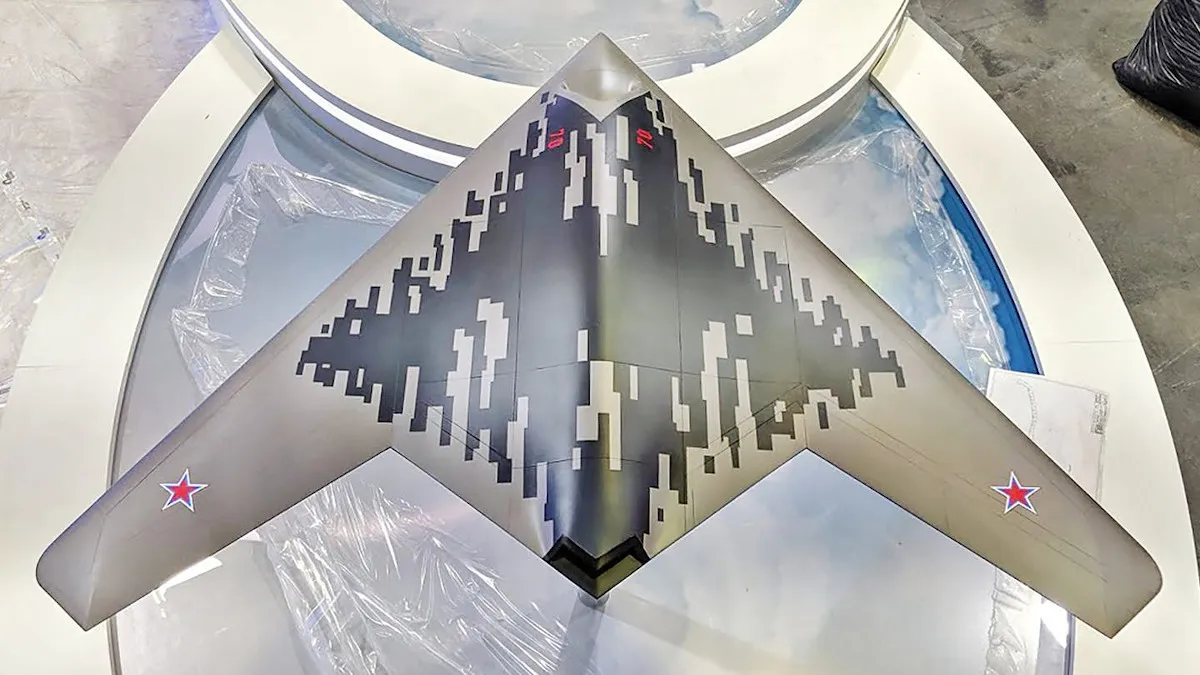
S-70 Drone VIA X Screenshot. Image Credit: X Screenshot.
The DragonFire was mentioned in the review’s announcement, as part of a section listing “Technologies that are redefining warfare,” which also included such things as AI, robotics, hypersonic missiles, space-based capabilities, quantum, and engineering biology.
“Directed energy weapons, such as the UK’s DragonFire, which have the potential to reduce collateral damage and reliance on expensive ammunition,” was the review’s description of the weapons.”
A History of DragonFire
The DragonFire program, or at least its public disclosure, dates back to 2017; DragonFire is also the name of the consortium that produces the weapon.
In January of 2017, the International Business Times reported that Britain had begun work on laser-directed energy weapons, including the awarding of the first contract by the Defence Science and Technology Laboratory (DSTL). That report described the consortium that worked on the weapons as consisting of “MBDA UK, alongside BAE Systems, Qinteq, Arke, and aerospace defence and security firm Leonardo-Finmeccanica.”
A more recent Tom’s Hardware report listed the involved companies as MBDA, QinetiQ, and Leonardo.
Just eight months later, the UK announced that DragonFire would be displaying a prototype of the weapon at that year’s Defence and Security Equipment International (DSEI) conference in London.
Trials and demonstrations were planned for 2018 and 2019, though COVID delays pushed the first back to 2022.
“With the technology focused initially on tracking the target, identifying the aimpoint, and holding the laser precisely on that point, the first trial took place in 2021 and tackled the tracking element using a low-power laser,” Naval News reported of the plans. “A high-power laser was tested in 2022, including in below-the-horizon firings. Above-the-horizon firing was tested in 2023.”
Trials have continued into this year, with the most recent tests, per Naval News, involving “tracking, targeting, and shooting down such drones in above-the-horizon tactical contexts.”
What It Means
Naval News reported on the contract award and what it means for NATO nations’ anti-drone capabilities.
“There are many lessons you can take from Ukraine, but the ones we’re particularly looking at are how do we make sure – in an environment that has such a fast pace of change, with drones needing to be iterated every two to three weeks to remain relevant – that the systems we are fielding can be spiral developed, and don’t take years to procure and when they come online are outpaced by our adversaries,” Pollard told the press, as reported by Naval News.
But at issue, the report said, was not just considerations coming out of the Ukraine war, in which Russian drones have sometimes reached the territory of NATO nations.
“From late 2023 and well into 2024, an international collection of naval ships deployed to the Red Sea to deter and defend against ballistic and cruise missile, and uncrewed aerial vehicle (UAV) and uncrewed surface vessel, attacks against commercial and naval ships sailing in the southern Red Sea/Bab-al-Mandeb/Gulf of Aden corridor,” Naval News said of the threat.
“Several RN surface ships, including the Type 45 destroyer HMS Diamond, contributed extensively to the campaign, often using missiles to defend themselves and other shipping.”
It’s part of the new capabilities the British military has developed, which include changes in the law.
“Following a number of suspected drone incursions over U.S. Air Force bases in the UK last year, the UK Government has now announced plans to implement changes to the law that would give the armed forces more authority to directly engage drones that are perceived to be threatening military bases,” the Aviationist reported over the weekend.
About the Author: Stephen Silver
Stephen Silver is an award-winning journalist, essayist, and film critic, and contributor to the Philadelphia Inquirer, the Jewish Telegraphic Agency, Broad Street Review, and Splice Today. The co-founder of the Philadelphia Film Critics Circle, Stephen lives in suburban Philadelphia with his wife and two sons. For over a decade, Stephen has authored thousands of articles that focus on politics, national security, technology, and the economy. Follow him on X (formerly Twitter) at @StephenSilver, and subscribe to his Substack newsletter.
More Military
Taiwan’s F-16V Fighter Was Built to Fight China’s Air Force
5 Places World War III Could Break Out in 2026
The X-37B Space Plane Is Breaking All the Rules and Makes Chinese Generals Sweat


