

Key Points and Summary – USS Blue Ridge, commissioned in 1970, is the U.S. Navy’s oldest operational warship—but it remains the high-tech flagship of the 7th Fleet in the Indo-Pacific.
-Purpose-built as a floating command center, Blue Ridge hosts the admiral, staff, sensors, and secure networks that tie together carriers, destroyers, subs, and aircraft across the theater.
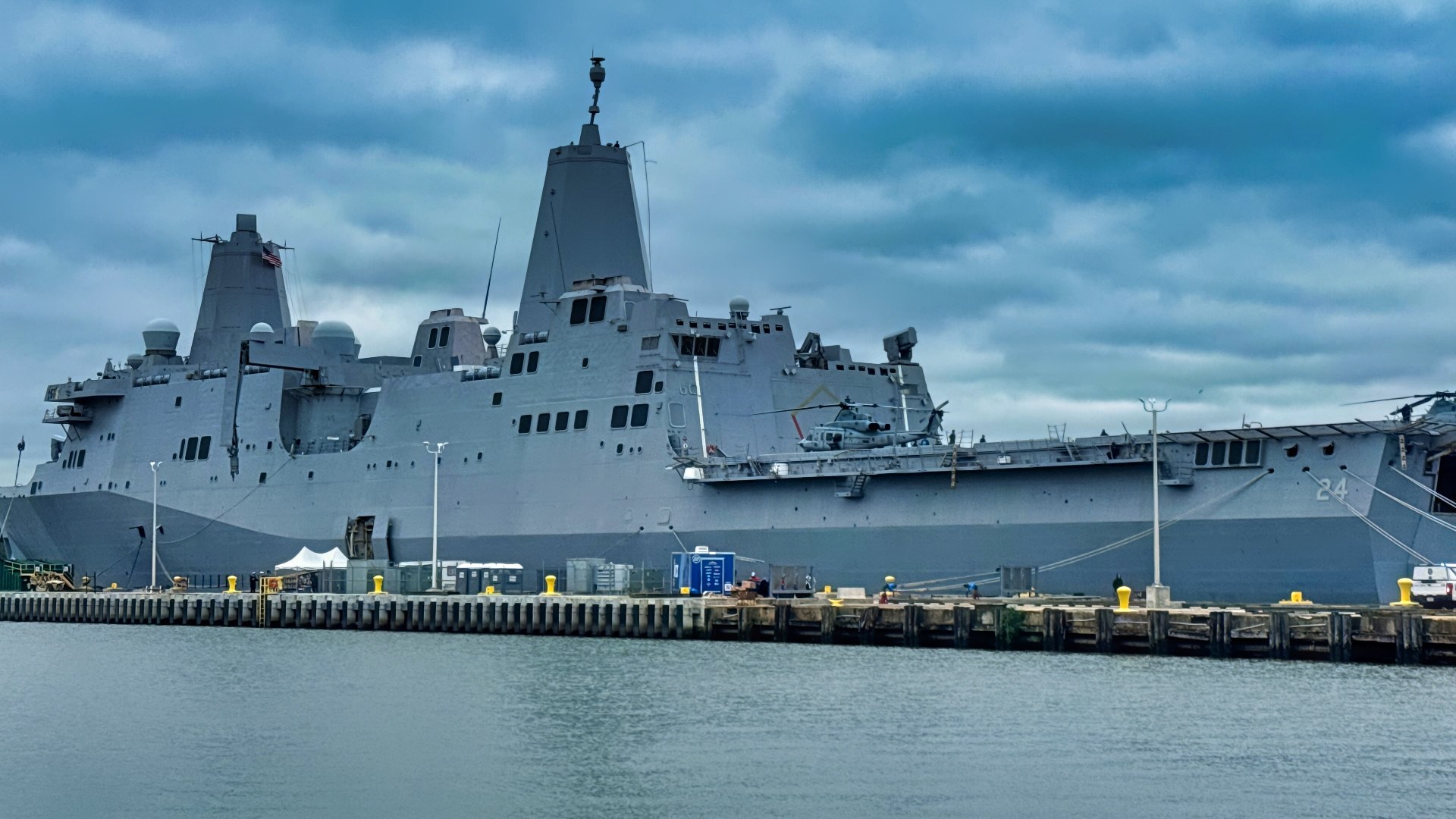
U.S. Navy USS Arlington Warship. Image Credit: Stephen Silver/National Security Journal.
-Repeated upgrades, including the CANES network overhaul and full synthetic joint training integration, have kept its “brain” cutting edge even as the hull ages.
-Port visits from Fiji to Sydney underscore a simple reality: in an era of hypersonics and drone swarms, command-and-control at sea still wins wars.
USS Blue Ridge: The 50-Year-Old Flagship Running America’s Pacific Fleet
On 26 May 2025, the forward-deployed flagship USS Blue Ridge (LCC-19) sailed into Sydney Harbor as part of what the U.S. Navy has described as regular Indo-Pacific patrols intended to “deter aggression, strengthen alliances and partnerships, and advance future warfighting capabilities.”
The ship is the U.S. Navy’s oldest operational warship, and yet it continues to serve as the nerve-center for an entire fleet. And while headlines often focus on aircraft carriers, destroyers, or submarines, this little-known vessel serves a unique and critical role: providing a floating headquarters and command center for an important fleet.
It’s already impressive for a ship that just celebrated its 50th anniversary – but it’s imposing in the age of hypersonic missiles, drone swarms, and advanced automated technologies.
A boat that was commissioned in 1970 still plays a vital role in U.S. naval forces, and is one of the most important assets the U.S. Navy still uses.
An Old Ship Commanding A Modern Fleet
The Blue Ridge-class was designed initially not to launch missiles or aircraft, but to serve as a command station – and it’s a job it has long done so well that it continues to do so. It hosts a fleet commander, staff, and all the command-and-control systems that tie together operational assets at sea.
The two-ship class (USS Mount Whitney, LCC-20, is the other) were purpose-built command-and-control ships. In plain terms, that means it is a floating operations center where radar, satellite feeds, secure communications, and staff planning rooms are located.
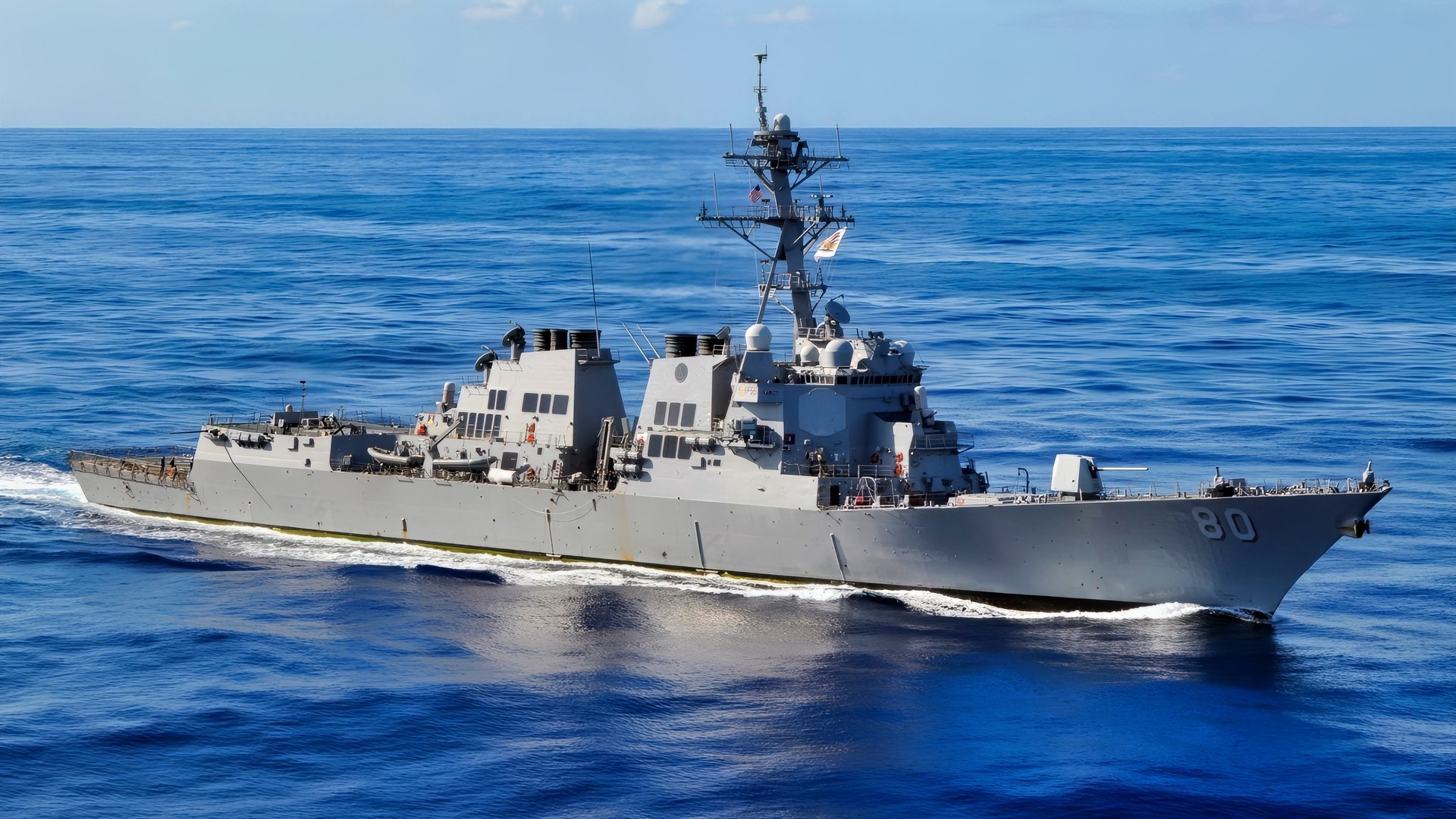
ATLANTIC OCEAN (Sept. 06, 2008) – The guided-missile destroyer USS Roosevelt (DDG 80) steams through the Atlantic Ocean. Roosevelt is deployed as part of the Iwo Jima Expeditionary Strike Group (ESG) in support of maritime security operations in the Navy’s 5th and 6th fleet areas of responsibility. The Iwo Jima ESG is made up of Roosevelt, homeported at Mayport, Fla.; the amphibious assault ship USS Iwo Jima (LHD 7); the amphibious dock landing ship USS San Antonio (LPD 17); the amphibious transport dock ship USS Carter Hall (LSD 50); the guided-missile cruiser USS Vella Gulf (CG 72); the guided-missile destroyer USS Ramage (DDG 61); all homeported at Norfolk, Va.; and the fast attack submarine USS Hartford (SSN 768), homeported at Groton, Conn. U.S. Navy photo by Mass Communication Specialist 2nd Class Jason R. Zalasky (Released)
Here’s a good example: the U.S. Seventh fleet uses the Blue Ridge as its flagship in the Indo-Pacific, meaning the admiral in charge of the fleet uses the ship to see what his destroyers, submarines, and aircraft are doing – while also coordinating with allies and responding to crises or exercises in real time.
Ships like the USS Blue Ridge are crucial to naval operations, providing fleet commanders with flexibility and mobility.
Rather than being fixed on land, a floating operations center enables distributed operations and ensures a fleet commander is tuned into everything that is happening. They also make port visits and forward deployments possible, proving that the ships are active – and, in turn, serving as a deterrent. In 2025, Blue Ridge visited Wellington, New Zealand, Noumea, Suva (Fiji), and participated in Exercise Croix du Sud in the Coral Sea.
And why does it matter?
Because modern naval warfare is less about single big guns these days, and more about networked sensors, fast data links, and coordinated, effective responses.
A carrier strike group may have dozens of ships, but without a capable command platform to integrate all those assets, its effectiveness is significantly degraded.
The Blue Ridge-class, despite its age, provides that kind of capability at sea.How An Old Ship Commands A Modern Fleet
It may seem strange that the Navy’s oldest ship could be the lead of a modern fleet, but it makes perfect sense.
Its service life has been extended to 2039 under a Navy Extended Service Life Program (ESLP) for LCC-type ships.
So, despite the hull being of the Cold War era, the ship’s “brain” is actually much newer and is constantly upgraded with new communications, computers, and satellites.
In fact, while the Blue Ridge is among the oldest in service, its computer systems and other hardware are actually some of the most advanced.
In 2017, the Navy completed installation of the Consolidated Afloat Networks and Enterprise Services (CANES) system aboard the ship.
This overhaul replaced its outdated legacy networks with modern, virtualized computing environments and new cybersecurity protections.
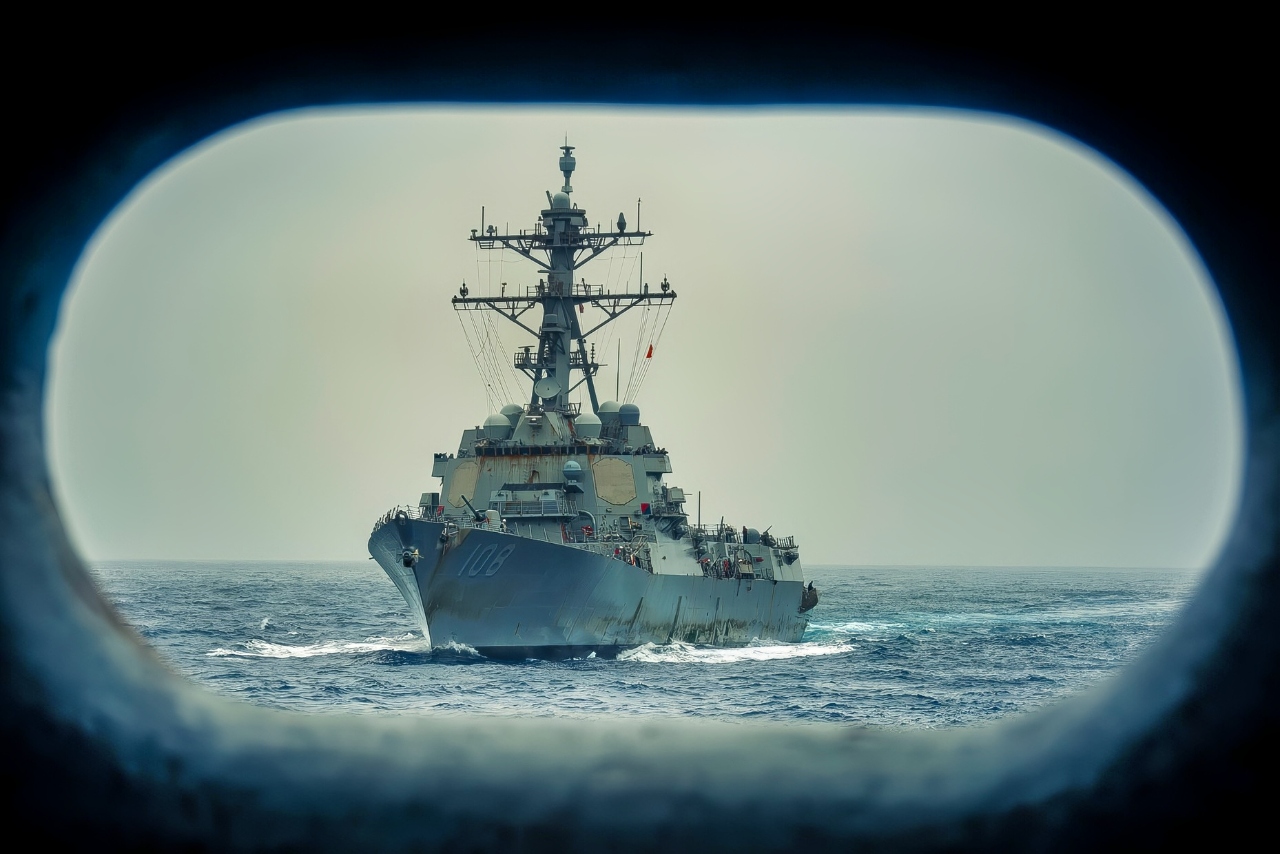
(August 1, 2025) The Arleigh Burke-class guided-missile destroyer USS Wayne E. Meyer (DDG 108) approaches the Nimitz-class aircraft carrier USS Nimitz (CVN 68) for a replenishment-at-sea in the U.S. Central Command area of responsibility. (Official U.S. Navy photo)
The installation, which began earlier that year at Yokosuka, was one of the most extensive network refits ever performed on a command ship.
The Navy stated that CANES would improve operational readiness, maintenance, and cybersecurity by consolidating five older Navy network systems into a single architecture.
The ship has also received repeated enhancements to its command suites and battle-management tools. In 2020, it also became the first Seventh Fleet vessel to complete a Full Synthetic Training – Joint (FST-J) integration.
In simple terms, the upgrade allowed the crew to plug the ship directly into advanced, computer-driven training systems used across the U.S. military. Instead of solely relying on live exercises at sea, the ship’s commanders can now run complex virtual scenarios from onboard consoles.
They can simulate air strikes, submarine hunts, humanitarian missions, and more, all using real data feeds and the ship’s actual command center.
That means the staff can rehearse large-scale missions without needing multiple aircraft, ships, or foreign partners physically present.
And the ship’s arrival in Sydney reflects this point well: the Navy’s oldest ship is still one of its most effective tools for projecting command presence across the Indo-Pacific. And while its retirement is approaching, it’s still an extraordinarily effective and valuable tool for the world’s greatest Navy.
About the Author:
Jack Buckby is a British author, counter-extremism researcher, and journalist based in New York who writes frequently for National Security Journal. Reporting on the U.K., Europe, and the U.S., he works to analyze and understand left-wing and right-wing radicalization, and reports on Western governments’ approaches to the pressing issues of today. His books and research papers explore these themes and propose pragmatic solutions to our increasingly polarized society. His latest book is The Truth Teller: RFK Jr. and the Case for a Post-Partisan Presidency.


Duke Jordan
November 26, 2025 at 10:28 am
Why tell the world about our naval command ship and tell everyone about its’ capabilities? Just painted a target on it…Unless, it’s a decoy. As a Marine Vet, Retired Police Commander, and former Terrorist Scenario Planner for Homeland Response Forces, I think it’s crazy to put out any info like that.
John Pritchard
November 26, 2025 at 10:50 am
Mount Whitney!
Bob
November 26, 2025 at 1:24 pm
Once again the “National Security Journal” paints a target on one of out military ships. Let’s call out exactly what our ships do, and even where they are, so our adversaries know what and where to cripple us.
The most Un-American media outlet around, congratulations 🏆
GhostTomahawk
November 26, 2025 at 1:25 pm
The world is changing. Reliance on networking and data is going to be the first thing that gets taken out. Fighting a near peer the first thing I would do is EMP. Make my enemy unable to do communicate. In order to fight effectively you need to be able to shoot move and communicate. Take out 1 of those 3 and you win.
The US Navy is not capable of fighting a protracted war that lasts longer than a couple weeks. Hubris is a killer
Mark D Elias
November 27, 2025 at 12:31 pm
Why would the Navy put out a ship like that that requires protection and cannot defend itself. If the enemy strikes that ship with all
Command personnel on board and sinks it. Game lost.
Christopher Nicholson
November 28, 2025 at 1:01 am
I was stationed on mount whitney lcc 20 for 4 years so awsome
Dave
November 28, 2025 at 12:00 pm
2 year tour in the 90’s and we knew back then we were a massive floating target.
Grne
November 28, 2025 at 9:49 pm
Building19 was mored next to our real combatant ship CV 62
SDV1
November 30, 2025 at 11:07 am
Another article written by a moron.
K Mcmaugh
December 1, 2025 at 11:23 am
The article is to distract, the Blue Ridge is not too vital. Satellites, Hawkeye are more important.