


The status of the Strait of Hormuz will not return to its antebellum status, one Iranian lawmaker stressed during an interview with Iranian media. Iran’s Parliament Vice Speaker Ali Nikzad said that “while Iran mourns the martyrdom of its commanders and citizens, the strait belongs to Iran and Tehran will not back down from this right.”
Nikzad added that “we consider the strait as an achievement of the recent imposed war and a divine gift to the great Iranian nation,” striking a decidedly defiant note.

A U.S. Navy F/A-18E Super Hornet aircraft assigned to Strike Fighter Squadron (VFA) 14 participates in an air power demonstration near the aircraft carrier USS John C. Stennis (CVN 74) April 24, 2013, in the Pacific Ocean. The John C. Stennis Carrier Strike Group was returning from an eight-month deployment to the U.S. 5th Fleet and U.S. 7th Fleet areas of responsibility. (U.S. Navy photo by Mass Communication Specialist Seaman Apprentice Ignacio D. Perez/Released)
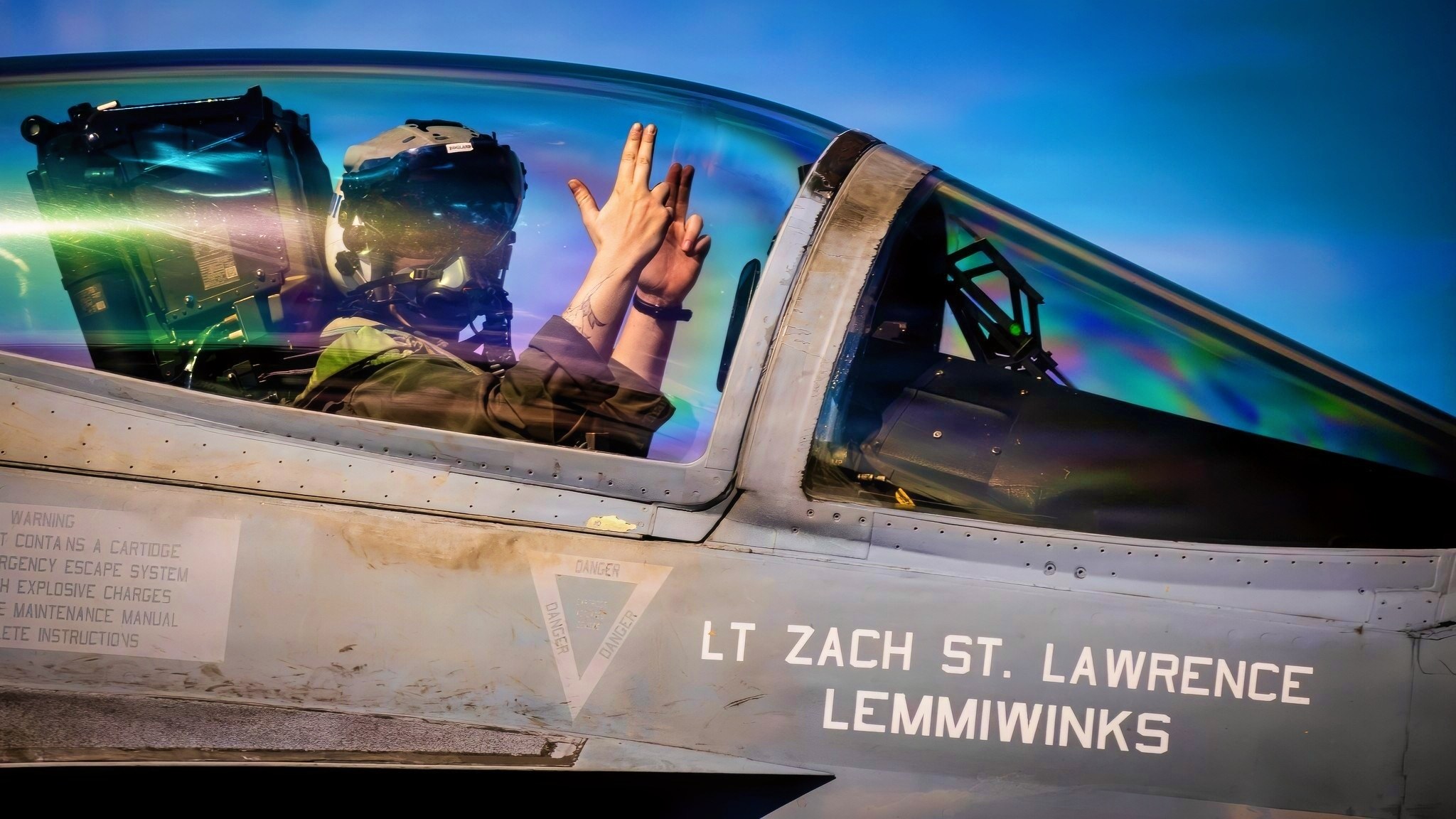
A U.S. Sailor assigned to Strike Fighter Squadron 37 signals to arm ordnance in an F/A-18E Super Hornet aircraft on the flight deck of the world’s largest aircraft carrier, Ford-class aircraft carrier USS Gerald R. Ford (CVN 78), while underway in the Caribbean Sea, Nov. 30, 2025. U.S. military forces are deployed to the U.S. Southern Command area of responsibility in support of Operation SOUTHERN SPEAR, Department of War-directed operations, and the president’s priorities to disrupt illicit drug trafficking and protect the homeland. (U.S. Navy photo)
Renewed Fighting in the Middle East
While a shaky ceasefire had been in place in Iran following the tentative agreement between Tehran and Washington to bring the war to a conclusion, encapsulated in the memorandum of understanding signed by both countries, that pretense of peace has been decisively shattered.
On Wednesday, Iran launched several attacks against American bases in the region, striking military targets in Jordan. Iranian proxies in neighboring Iraq attacked Saudi oil facilities as well, and two ships, one of which was an American tanker, caught fire thanks to explosions onboard, believed to have been caused by drone or missile attacks.
United States Central Command seemingly pushed back on that framing of the war in Iran, however. “CENTCOM assets struck dozens of Islamic Revolutionary Guard Corps (IRGC) targets in Iran, including military command centers, missile and drone facilities, coastal surveillance and defense sites, and maritime capabilities. The strikes aimed to further diminish threats posed by Iran and its proxies to American forces, commercial shipping, and neighboring Gulf countries,” U.S. Central Command explained in one of its daily updates.
“On July 28, IRGC forces launched multiple ballistic missiles from Iran in an attempted surprise attack on U.S. forces based in the Middle East,” Central Command added, saying that “all Iranian missiles were successfully intercepted.”
Global Oil Flows
Farther south, the Houthis, another Iranian-backed group vying for control of Yemen, fired on a Saudi oil tanker in the Red Sea, near the Bab el-Mandeb Strait, a narrow maritime bottleneck that separates the Red Sea from the Gulf of Aden. Although the other strait has long played second fiddle to the Strait of Hormuz, through which around a fifth of the world’s oil and gas transits to the wider world, the Bab el-Mandeb Strait’s importance to global oil flows has increased significantly.
Leveraging its Red Sea port at Yanbu, on the Red Sea Coast and reached by the East-West energy pipeline, Riyadh has managed to divert some of the energy it would have shipped out via Hormuz during previously peaceful times. And while Yanbu cannot fully make up for lost traffic from Hormuz, it has softened the impact of the ongoing energy crisis. But the recent Houthi declaration of an embargo on Saudi shipping via the Bab el-Mandeb Strait threatens to upend the new equilibrium.
New Toll Scheme
On Wednesday, sources knowledgeable about the ongoing situation told Reuters that the Houthis are considering establishing a toll system in which ships can transit Bab el-Mandeb for a fee.
Chinese ships would reportedly be exempt from paying the toll, which would provide the rebel group with a regular revenue stream, both filling their pockets and setting a new precedent for international maritime shipping routes, and poke the United States in the eye.
The plan is believed to have Tehran’s approval, the Houthis’ number one backer. The move would almost certainly be deplored in Western capitals as well as in those of the Middle East, in particular countries that rely heavily on the waterway for trade. But with American naval forces stretched thin near the Strait of Hormuz, it is difficult to see a viable path forward for protecting international shipping through both the crucial Bab el-Mandeb waterway and Hormuz simultaneously.
A Diminishing Interceptor Stockpile
Against the backdrop of these events is the United States’ supply of air defense interceptors. A recent report published by the Center for Strategic and International Studies, a think tank, concludes that while the United States air defense campaign has been largely successful in intercepting the vast majority of munitions fired at American forces and their allies in the region, the stockpile of Patriot and THAAD interceptors has dipped to dangerously low levels.
Deliveries of new-build missiles have been overshadowed by missile expenditures, risking future depletion that could leave gaping holes in the American air defense umbrella.
In the future, a limited stockpile could force the United States and partners in the region to make risky choices about which incoming threats to intercept — but could also alter the geopolitical calculations of America’s adversaries. Recent reporting hinted as much, with American officials expressing concern that Russian President Vladimir Putin and China’s Xi Jinping could be factoring the looming interceptor shortage into their planning vis-à-vis Ukraine and Taiwan, respectively. On Thursday, the United States Army inked a $58.6 billion deal with Lockheed Martin, the Patriot interceptor manufacturer, to produce Patriot interceptor missiles.
About the Author: Caleb Larson
Caleb Larson is an American multiformat journalist based in Berlin, Germany. His work covers the intersection of conflict and society, focusing on American foreign policy and European security. He has reported from Germany, Russia, and the United States. Most recently, he covered the war in Ukraine, reporting extensively on the war’s shifting battle lines from Donbas and writing on the war’s civilian and humanitarian toll. Previously, he worked as a Defense Reporter for POLITICO Europe. You can follow his latest work on X.


