


Key Points and Summary – EU leaders head into a Brussels summit deeply split over how to fund Ukraine’s budget and reconstruction needs through 2028.
-Kyiv may require €90 billion or more, but Hungary’s veto blocks new joint EU borrowing, pushing focus onto a “reparations loan” backed by frozen Russian central bank assets.
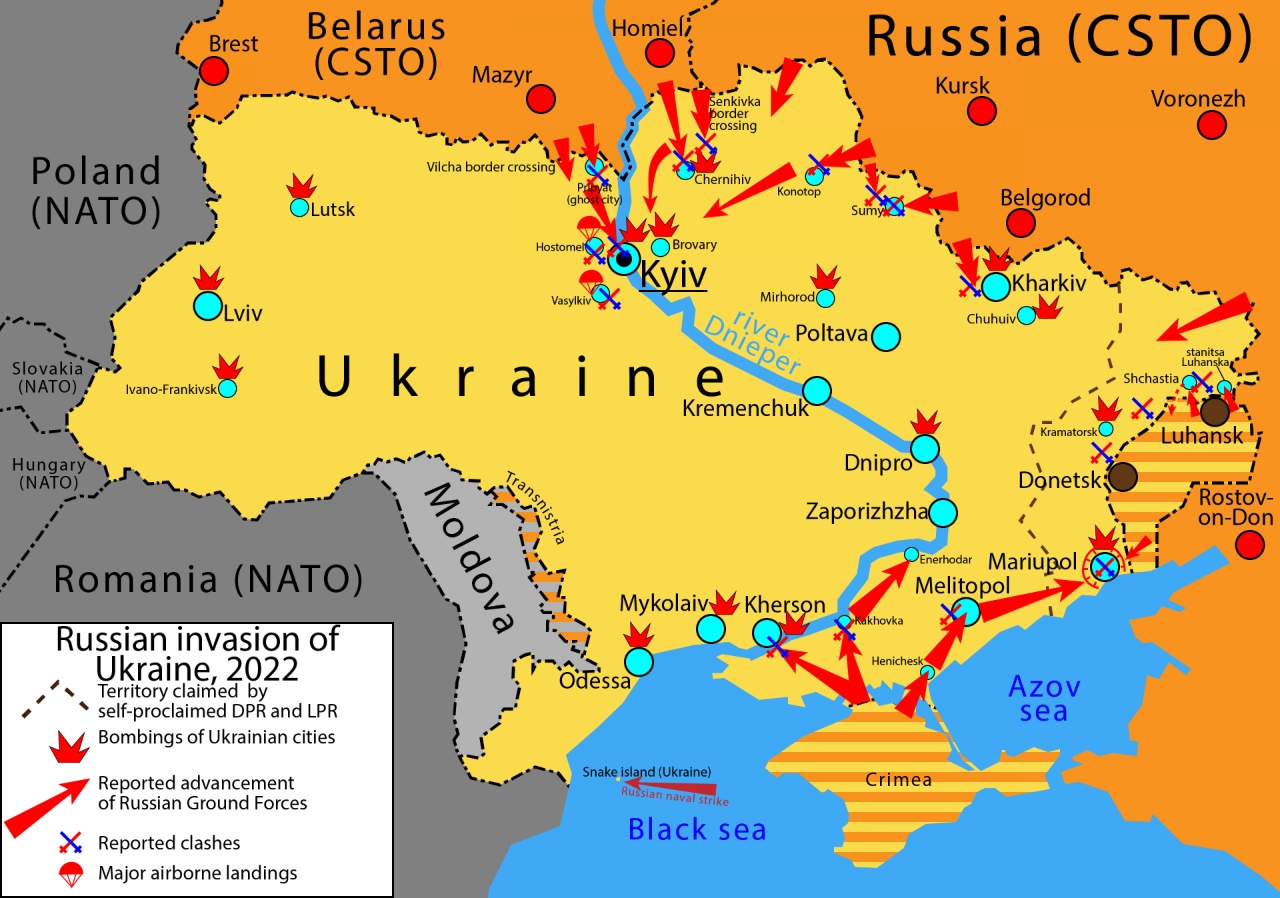
Ukraine War Map. Image Credit: Creative Commons.
-Supporters see it as a fair “you break it, you buy it” mechanism tied to a new claims commission, while Belgium and others fear legal and financial blowback for Euroclear and investors.
-With Ukraine facing a funding cliff as early as spring, failure to agree could force a messy stopgap fix.
EU Remains Divided Over Ukraine War Reparations Plan
European leaders are heading into Thursday’s Brussels summit still wrestling with a problem they have attempted to dodge for months: Ukraine needs a lot of money in 2026 and 2027, and the EU can’t keep assuming the United States will pick up the tab.
Privately, EU officials estimate Kyiv might require €90 billion or more in budget support by 2028. Most governments are keen to fulfill this ambition, but are less certain about how to raise the sum without endangering EU unity or startling investors.
The debate has sharpened following this week’s launch in The Hague of an International Claims Commission for Ukraine, a Council of Europe-backed body designed to assess compensation claims for damage caused by Russia’s invasion.
More than 86,000 claims have already been lodged with the existing Register of Damage, and the World Bank estimates Ukraine’s reconstruction costs could reach $524 billion over the next decade — a figure that continues to climb as Russian strikes intensify.
The commission itself does not guarantee payment. But EU diplomats say its creation has injected new political momentum into long-running discussions over whether frozen Russian sovereign assets could eventually be used to finance Ukraine’s recovery.
Two funding paths are now under consideration. One, increasingly referred to as Plan B, would involve fresh joint EU borrowing, echoing the pandemic-era recovery fund. That option, however, requires unanimity, with Hungary having made clear it will not approve additional Ukraine financing.
This deadlock has pushed attention toward Plan A: a zero-interest “reparations loan” backed by immobilised Russian central bank assets frozen in Europe since 2022. Under the proposal, institutions holding those assets would transfer cash balances to the European Commission, which would then lend the funds to Ukraine. Repayment would only occur once Russia ends the war and compensates for the damage caused — a structure supporters frame as a “you break it, you buy it” mechanism aligned with the new claims process.
Ursula von der Leyen is aiming to pitch the plans as a levy on Russia for continuing its invasion. German Chancellor Friedrich Merz, meanwhile, had stressed that the EU’s “ability to act” could be damaged for decades to come if it fails to nail down these plans.
Nor is Merz the only one with strong words for the EU on this matter; the Nordic and Baltic states, Poland, Ireland, and the Netherlands are all backing his stance, while Spain and Portugal have also expressed support.
Belgium, however, remains deeply uneasy. Brussels-based clearing house Euroclear holds roughly €185 billion in frozen Russian assets, and Prime Minister Bart De Wever argues the proposal exposes Belgium to disproportionate legal and financial risk. Euroclear has already been sued by Russia and has described the approach as legally untested.
Italy, Bulgaria, and Malta have urged the Commission to explore lower-risk alternatives, while Czech Prime Minister Andrej Babiš has resisted contributing financially. Hungary’s Viktor Orbán and Slovakia’s Robert Fico — whose countries heavily rely on Russian energy imports — oppose using frozen assets altogether.
Although the loan could technically pass by a qualified majority, diplomats fear forcing it through could inflame political tensions.
With Ukraine facing a potential funding cliff by spring, officials acknowledge that failure to agree may leave the Commission scrambling for a stopgap solution.
About the Author: Georgia Gilholy
Georgia Gilholy is a journalist based in the United Kingdom who has been published in Newsweek, The Times of Israel, and the Spectator. Gilholy writes about international politics, culture, and education. You can follow her on X: @llggeorgia.


