

Over the weekend, American President Donald Trump backed away from threats against Iran, explaining to reporters that the strikes he had previously announced against the country’s Islamist regime would, in fact, not be happening and that further talks with Iranian negotiators and interlocutors would take place instead.
It is the latest flip-flop from the president, an abrupt about-face that has been oft-repeated in the conflict’s five-month history.

Members of the US Navy F/A-18F Super Hornet Demo Team performs a maneuver at the Wings Over South Texas Air Show. This year’s air show marks the first return of Wings Over South Texas to Naval Air Station Corpus Christi since 2019.
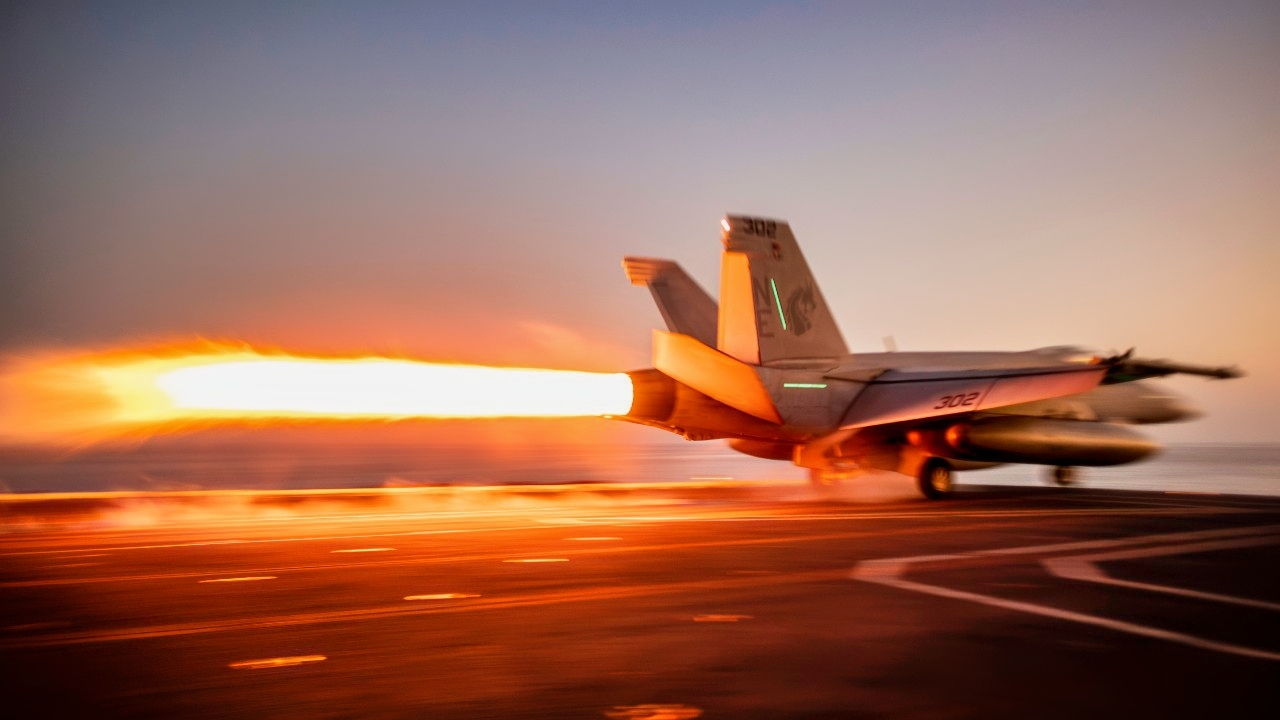
250429-N-FS097-1154 U.S. CENTRAL COMMAND AREA OF RESPONSIBILITY (April 28, 2025) An F/A-18E Super Hornet, attached to Strike Fighter Squadron (VFA) 192, launches from the flight deck of the Nimitz-class aircraft carrier USS Carl Vinson (CVN 70) in the U.S. Central Command area of responsibility. (Official U.S. Navy photo)
Though American forces have made good on some of the president’s threats and repeatedly bombed Iranian military and logistical targets across the country, some saber-rattling from the White House has been called off at the last minute.
Similarly, the president’s claims about continued negotiations have at times helped cool a hot oil market, bringing the price per barrel down during periods of heightened prices.
Though currently not as high as prices during early 2022 following Russia’s full-scale invasion of Ukraine, or during the Great Recession in 2008, prices rose to around $125 and $145, respectively.
But there has been a great deal of ambiguity in the statements emanating from the White House as well as the president’s social media accounts. In some instances, Washington’s negotiating counterparts have outright denied the president’s claims.
Talking or Not Talking?
Posting to Truth Social on Sunday, President Trump wrote that “we have just been asked by Iran, and other Middle Eastern Countries, to hold off any attack in that the perimeters of a deal has been agreed to. This would include the Immediate, Complete, and Total OPENING OF THE HORMUZ STRAIT, and an end to Iran’s nuclear threat.”
“Based on this request,” the president added, “I have agreed, for the future benefit of the WORLD and, likewise, the survival of a successful and prosperous Iran, to cancel the attack, subject to being able to rapidly make a DEAL. The Country of Israel joins me in this commitment. Get to work, everybody, and get it DONE.” It is the latest seeming contradiction between Tehran and Washington, with both sides apparently interpreting talks differently.
On Monday, the spokesperson for the Iranian Foreign Ministry, Esmaeil Baqaei, said that Iran’s talks with Oman concern the Strait of Hormuz exclusively and went on to elaborate that “the issues related to Iran and the United States should be examined in the next stages to see in which direction the situation will go.” When asked if the negotiations with Iran over the strait could eventually lead to talks with Washington, Baqaei explained that Iran will “have to wait a while to see whether this stage and this process can be connected to another process that leads to a reduction in tension in the region.”
In a now oft-repeated pattern, oil prices fell somewhat following the president’s announcement that further strikes would be paused, at least for now, though they remained elevated at around $84 a barrel.
A Widening Conflagration?
Baqaei also addressed Ukraine’s strike against Iranian shipping in the Caspian Sea, an attack that Kyiv explained was part of its ongoing long-range strike campaign against Russia. “We will definitely take whatever action is necessary,” Baqaei said, “both to hold Ukraine accountable and to ensure that such a mistake and crime is not repeated by the Ukrainian side again.”
The Caspian Sea is the world’s largest lake and forms a maritime border shared by multiple countries, including Russia and Iran. Posting to Telegram, Ukrainian President Volodymyr Zelensky said that Ukrainian forces “achieved very good results from long-range strikes in the waters of the Caspian Sea,” and landed strikes on several ships, including one “transporting military cargo in cooperation with Iran.”
The SBU, an acronym for the Ukrainian Security Service, the country’s primary counterintelligence and domestic intelligence agency, confirmed the cargo of the Iranian ship in a separate post on Telegram.
Tehran, Yemen, and the Houthis
The scope of the war in Iran has expanded southward as well, bringing in the Houthis, the Iranian-backed rebel group fighting for control of Yemen, to the south of Saudi Arabia.
Locked in a fight with the internationally recognized and Saudi-backed Yemen government, the Houthis have until last week declined to join the fray in support of Iran.
But perhaps sensing an opportunity, the Houthis declared an embargo on Saudi traffic through the Bab el-Mandeb Strait, a narrow maritime bottleneck that facilitates maritime traffic in and out of the southern part of the Red Sea.
While traffic from the strait has dropped since the Houthis’ embargo declaration, a pair of tankers carrying Saudi oil reportedly transited the strait without incident over the weekend.
About the Author: Caleb Larson
Caleb Larson is an American multiformat journalist based in Berlin, Germany. His work covers the intersection of conflict and society, focusing on American foreign policy and European security. He has reported from Germany, Russia, and the United States. Most recently, he covered the war in Ukraine, reporting extensively on the war’s shifting battle lines in the Donbas and writing on its civilian and humanitarian toll. Previously, he worked as a Defense Reporter for POLITICO Europe. You can follow his latest work on X.


