

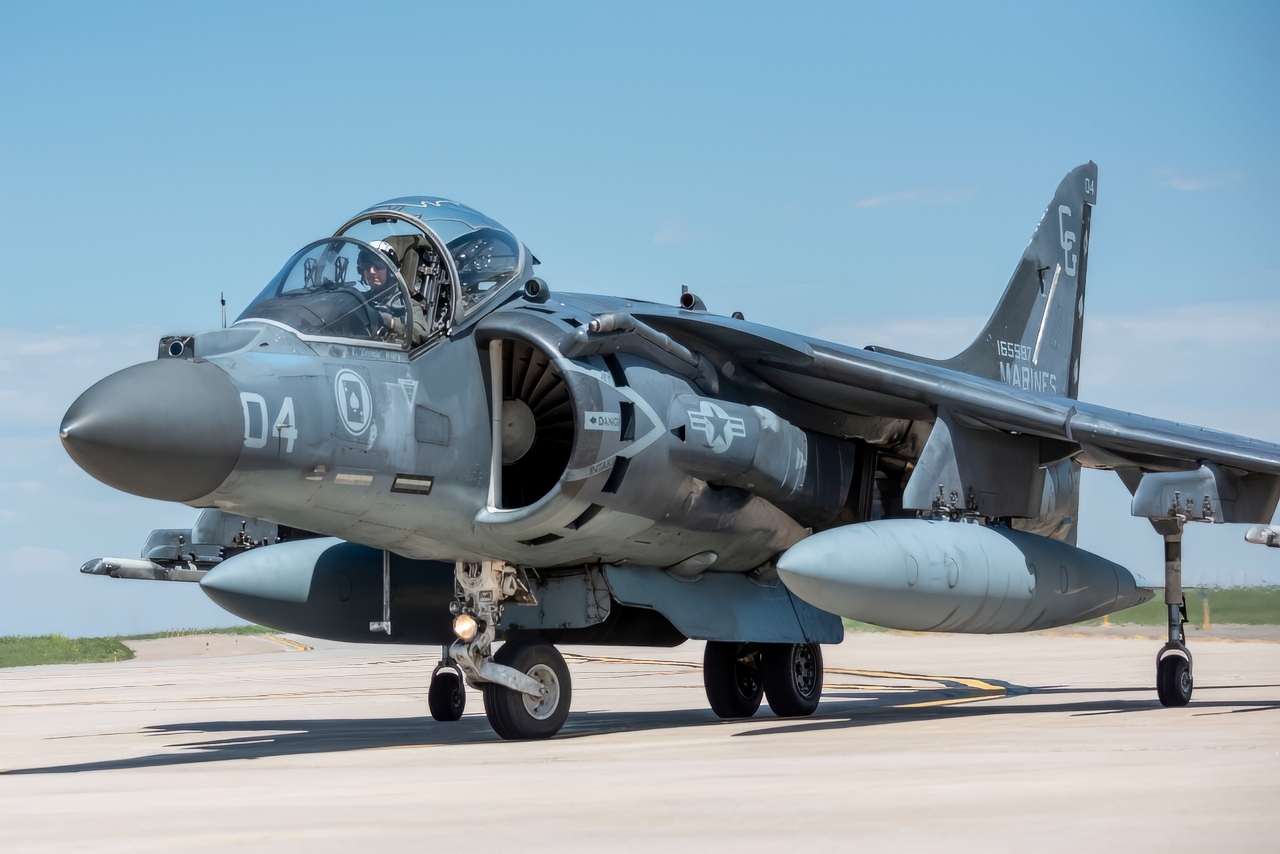
Key Points and Summary – The iconic Harrier “Jump Jet,” famous for its unique vertical take-off and landing (V/STOL) capability, is nearing the end of its celebrated 40-year service with the U.S. Marine Corps.
-A veteran of conflicts from the Gulf War to the present day, the Harrier is still proving its worth, having been recently modified to successfully shoot down Houthi drones over the Red Sea.
-Despite this continued usefulness, the Harrier’s non-stealth, Cold War-era design is being phased out, with the far more advanced and capable F-35B stealth fighter set to take its place.
The Harrier Is Getting Old
The Harrier Jump Jet, a Cold War-era fighter, has achieved significant milestones. Still, in a world increasingly reliant on evading enemy radar, the United States Marine Corps is keen to trade its Harriers for F-35s.
How Fast is the AV-8B Harrier Jump Jet?
The AV-8B Harrier II was never a particularly fast jet. With a top speed of just Mach 0.9, in other words, just under the speed of sound, that ground-attack aircraft’s speed pales in comparison to most other aircraft that are currently in service with the United States—and indeed with other militaries around the world.
It would be easy to jump to the conclusion that, because of the Harrier’s low top speed, it was not a successful aircraft.
That would, however, be a mistaken analysis.
Powered by just a single engine, the Harrier possesses a capability that made it an object of desire for the United States Marine Corps: its ability to take off and land vertically, a vertical and/or short take-off and landing, or V/STOL.
Able to take off and land both from American aircraft carriers, as well as remote and austere forward positions—independently of long runways, necessary for traditional aircraft, the Harrier complied with the Marine Corps’ do-anything-at-any-place ethos.
Origin Story
The Harrier’s origin emerged from the ashes of the Korean War. During that conflict, the utility of aircraft, launched from United States Navy aircraft carriers to support troops on coastlines undertaking amphibious landings, was proven invaluable.
Flying from American flattops toward disembarked troops on the shore, and landing at ersatz airbases on shore for fuel and weapons greatly enhanced sortie rates, an enormous boon to troops on the ground. Although initially developed from the Hawker Siddeley Harrier, an early British foray into jump-jet design, the platform underwent steady improvements, with the AV-8B in Marine Corps service being the most mature of the designs.
Fast forward to today, and the Harrier is a close air support jet that often flies in support of Marines on the ground or friendly forces in the vicinity, though it is not limited to that kind of mission. Other expeditionary operations have seen Harriers conducting air interdiction against valuable targets behind the enemy’s rear, as well as finding opportune targets on the fly, and armed reconnaissance for disembarked Marines and Carrier Strike Groups.
The Harrier reached initial operating capability early in 1985 with the United States Marine Corps. Since then, the jump-jet has participated in nearly every conflict since the Gulf War in 1990-91, including NATO’s campaign in former Yugoslavia, Operation Enduring Freedom, and other conflicts. Most recently, the Marine Corps modified some of its Harrier jets for air defense to aid in fending off attacks from Yemeni Houthis in the Red Sea. One pilot even reportedly shot down seven Houthi drones, apparently launched at American warships.
Houthi attacks against international shipping as well as American and European warships necessitated the modification against what the Harrier pilot termed “suicide attack drones.” Consequently, the Marine Corps outfitted some of its Harriers with air-to-air munitions. “We took a Harrier jet and modified it for air defence,” one Harrier pilot explained to the British Broadcasting Corporation. “We loaded it up with missiles and that way were able to respond to their drone attacks.” But despite the Harrier’s continued usefulness, despite entering service four decades ago, the Marine Corps has already had its eye on the Harrier’s replacement for quite some time: the F-35B.
Like the Harrier, the F-35B is capable of vertical take-off and landing, making it unique from the other two F-35 variants. But that is where the similarities between the two aircraft end. All F-35 variants are fifth-generation aircraft that possess robust stealth features, which the Harrier distantly lacks. But stealth capabilities aside, the F-35B can fly farther combat radii with a greater payload than the Harrier, a significant boon afforded by the jet’s much more modern, higher-thrust engine.
And in addition to range, payload, and stealth advantages, the F-35B can also break the sound barrier: its top speed is Mach 1.6, or 1.6 times the speed of sound. However, the F-35 also boasts a sophisticated sensor suite that enables the near real-time distribution of battle space information with other assets, both in the air and on the ground, a situational awareness capability that the Harrier cannot match. For these reasons, the Harrier’s days, in the United States Marine Corps at least, are numbered.
Sunset on a Cold War-era Innovator
Last summer, the U.S. Marine Corps graduated the last two Harrier pilots who will receive certification on that jet.
“As the Harrier transitions out of the Fleet Marine Force, its role is being filled by the F-35B Lightning II. Marine Attack Squadron (VMA) 223 will be the last Harrier squadron in the Marine Corps and is set to continue operating the platform through September 2026,” Naval Aviation News wrote, underlining that the time had come to retire the platform. But until that day comes, Marine Corps Harriers “will continue to call MCAS Cherry Point home and execute deployed operations as part of Marine Expeditionary Units.”
Though the Harrier is still in service—and clearly demonstrating its usefulness against non-state actors in an air defense role in the Red Sea, the Harrier’s future ability to survive in highly contested air environments against opponents with sophisticated air defenses is certainly less than its F-35 counterpart.
About the Author: Caleb Larson
Caleb Larson is an American multiformat journalist based in Berlin, Germany. His work covers the intersection of conflict and society, focusing on American foreign policy and European security. He has reported from Germany, Russia, and the United States. Most recently, he covered the war in Ukraine, reporting extensively on the war’s shifting battle lines from Donbas and writing on the war’s civilian and humanitarian toll. Previously, he worked as a Defense Reporter for POLITICO Europe. You can follow his latest work on X.
Military Affairs
China’s Stealth Air Force Has 1 Mission


